

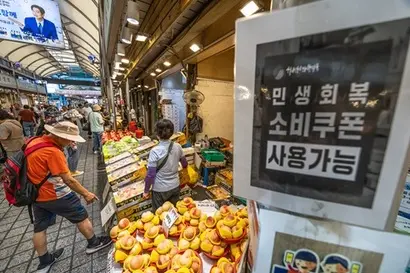
[비즈한국] The Ministry of Economy and Finance has released the 'September Recent Economic Trends (Green Book).' The government assessed that the domestic economy is showing signs of recovery, led by consumption and exports, noting in particular that consumption indicators have improved due to initiatives like the 'Livelihood Recovery Consumption Coupons.' While expectations for an economic recovery are growing, risk factors such as sluggish construction investment, declining youth employment, and an expanding fiscal deficit persist.
According to the 'September Recent Economic Trends' released by the government on the 12th, total industrial production in July increased by 1.9% compared to the same month last year. Production in the mining and manufacturing (5%) and service (2.1%) sectors improved, boosting overall industrial output. Conversely, construction industry production saw a significant decline of –14.2%.
Consumption and investment improved in tandem. Retail sales rose 2.4% year-on-year, and facility investment increased by 5.4%. Driven by a strong semiconductor sector, August exports grew 1.3% compared to the same month last year, marking a three-month consecutive upward trend. As of August, the average daily export value reached $2.6 billion (approximately 3.6134 trillion won), up 5.8% from last year. However, exports to the U.S. fell by 12% due to tariff impacts, marking the lowest level in two and a half years.
Both the Consumer Sentiment Index (CSI) and the Business Survey Index (BSI) showed an upward trend. The August Consumer Sentiment Index stood at 111.4, up 0.6 points from the previous month, while the Business Survey Index (91) also rose by 1 point.
In the labor market, the number of employed persons in August was tallied at 28.967 million, an increase of 166,000 compared to the same month last year. By industry, growth was notable in healthcare and social welfare services, education services, and real estate. In contrast, the manufacturing and construction sectors remained sluggish. By employment type, the number of regular workers increased, while temporary and daily workers showed a declining trend.
The disparity between generations was evident, with youth employment decreasing and employment among older adults increasing. The number of employed people aged 60 and older rose by 401,000, while the number of employed youth aged 15 to 29 dropped by 219,000.

Inflation showed signs of stability. The consumer price inflation rate for August was 1.7%, a slowdown from July (2.1%). The Ministry of Economy and Finance attributed this mainly to the continued decline in petroleum prices and the shift toward lower public service prices following rate cuts by some telecommunication companies. However, the living necessities price index rose 1.5% and the fresh food index climbed 2.1% year-on-year, increasing the burden on household budgets.
Fiscal health is being pointed out as a cause for concern. The managed fiscal balance in July recorded a deficit of 86.8 trillion won, an increase of 3.6 trillion won in the deficit compared to the previous year. The consolidated fiscal balance also widened to 57.5 trillion won, further deepening the deficit.
Despite sluggish investment and external uncertainties, the government expressed optimism regarding economic recovery. It emphasized that recent consumption indicators have improved thanks to the Livelihood Recovery Consumption Coupons. The Ministry of Economy and Finance assessed, "While concerns remain regarding delayed recovery in construction investment, employment difficulties in vulnerable sectors, and export slowdowns due to U.S. tariffs, positive signals for economic recovery are strengthening, such as increased consumption due to policy effects."
Private research institutions offered a similar interpretation. In its recent economic report, the KDI diagnosed that "despite the slump in construction investment, the economic downturn appears to be easing somewhat, centered on consumption."
Regarding burden factors such as external trade risks and domestic demand imbalances, the government stated, "We will concentrate all pan-governmental efforts to ensure that swift execution of supplementary budgets, Livelihood Recovery Consumption Coupons, and large-scale discount events serve as momentum to revitalize domestic demand, including consumption and the regional economy. Simultaneously, we will do our utmost to respond to trade risks, such as providing support for domestic companies affected by U.S. tariffs."