

[비즈한국] The common belief that 'real estate prices rise when a progressive government takes office' appears to be re-confirmed in the early days of the Lee Jae-myung administration. The 'Schwabe Index,' which measures the proportion of housing costs within total consumer spending, has surpassed last year's record high. Apartment sale prices in the Seoul area have also recorded their highest growth rate in seven years so far this year.
The rise in housing prices is not only making life difficult for ordinary citizens but is also making it increasingly challenging to purchase a home. The government's announcement of its second real estate package on the 7th, which includes tightening real estate regulations such as strengthening the Loan-to-Value (LTV) ratio for the three districts of Gangnam and Yongsan-gu, is interpreted as a clear intention not to ignore the overheating trend any longer.
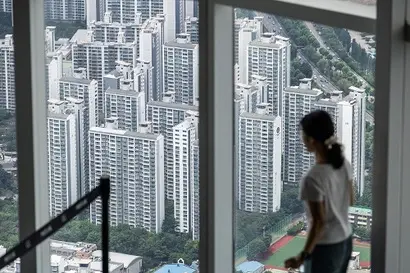
The government released its latest real estate measures on Sunday the 7th, just about two months after the June 27th measures. At a meeting of housing-related ministers held that afternoon, the government announced additional demand-suppression policies aimed at managing household debt and a 'housing supply expansion plan' targeting the construction of 1.349 million homes in the metropolitan area.
Specifically, the plan involves lowering the LTV from 50% to 40% in regulated areas such as the three districts of Gangnam and Yongsan-gu, and starting construction on 270,000 new homes annually for the next five years (2026-2030). The fact that the government released these measures on a Sunday afternoon—a surprise move—is analyzed as an intention to prevent people from rushing to take out loans ahead of time. This reflects a sense of urgency. The government’s decision to issue two sets of real estate measures within just three months of taking office is due to the alarming upward trend in home prices. Although the administration promised to stabilize real estate prices from the time of the presidential campaign, house prices have continued to rise.
According to Statistics Korea, the Schwabe Index for all households nationwide in the second quarter of this year was recorded at 12.22. This is a 0.12p (percentage point) increase compared to 12.10 in the second quarter of last year. Last year's Schwabe Index hit its highest level since the survey began in 2019. There is a high possibility that this year's figure will exceed last year's. A high Schwabe Index means that housing costs account for a large portion of household expenditures. Along with the Engel Index (the proportion of spending on food), the Schwabe Index is considered a representative measure of poverty.
The Schwabe Index rose from 11.26 in 2019 to 11.95 in 2021, then fell to 11.45 in 2022. It subsequently returned to an upward trend, hitting a record high of 12.16 last year. The Schwabe Index was particularly high for households headed by those aged 39 or younger. In the second quarter of this year, the index for households with heads aged 39 or younger was 13.26, up 0.44p from a year ago (12.82). This is higher than the levels for heads of households in their 40s (10.44), 50s (12.19), and even those 60 or older (13.02). While monthly salaries have not increased significantly, housing prices are on the rise, placing a heavier burden of housing costs on household heads aged 39 and under.
Since the inauguration of the Lee Jae-myung administration, the rise in housing prices, especially apartments centered in Seoul, has been concerning. According to the Korea Real Estate Board, the apartment sale price index in Seoul rose 4.54% through July this year, the highest growth rate since the 4.73% recorded during the early days of the Moon Jae-in administration in 2018 (cumulative growth through July).
Seoul's apartment price index seemed to be on a downward trend in 2019, recording -1.72%, but it rebounded to 1.63% in 2020 and jumped to 4.33% in 2021. It fell to -0.47% in 2022 when the Yoon Suk-yeol administration took office and saw its decline widen to -3.48% in 2023, but it rose by 1.75% last year and has continued a steep upward trend this year.
This is also evident in the trend of record-high transaction prices for Seoul apartments. On the 8th, after Zigbang analyzed real estate transaction data from the Ministry of Land, Infrastructure and Transport, it was found that 932 (23.6%) of the 3,946 apartment transactions in Seoul in July were at record-high prices. This is the highest level since July 2022 (27.9%). As the rapid rise in Seoul apartment prices has caused instability in the real estate market, the government has moved to announce its second set of real estate measures.