

[비즈한국] A growing number of self-employed business owners are adopting "table ordering" devices to reduce labor costs. However, many are complaining that the devices they chose to save money have instead worsened their profitability. They signed contracts after hearing the companies describe them as "free," but the hidden "PG (Payment Gateway) fee" clause buried in a corner of the contract has become a major point of contention.
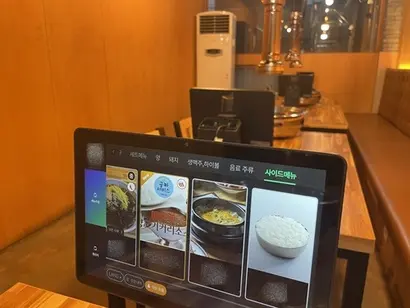
"Tricked by 'Sampling Stores' and 'Government Subsidies'": Why Self-Employed Owners are Protesting
Mr. Kim, who runs a cafe, installed about 10 table ordering devices in his store last November. "I was incredibly busy running the shop alone without any staff," Kim said. "Then one day, a salesperson from Company A visited and told me my store had been selected as a 'table ordering sampling store.' They claimed that in exchange for letting other business owners use my shop as a reference for installation, I could use the devices almost for free. Since I thought I needed them anyway, I figured it was a good deal and proceeded with the contract."
The salesperson explained that while the monthly rental fee was approximately 179,000 won, the company would refund about 160,000 won if monthly sales exceeded a certain threshold (which varies by store). Kim's store was set with a target of 12 million won in sales; if he hit that target, he would receive a 160,000 won refund, effectively costing him less than 20,000 won per month to use the devices.
During installation, the salesperson said the existing POS (payment terminal) was not compatible with the table ordering system and that it needed to be replaced. Kim accepted this without any suspicion.
Two weeks after installation, when Kim was calculating his sales, he noticed that 3.15% of his revenue was being deducted as a "PG (Payment Gateway) fee." "I looked at the contract again and saw the phrase '3.15% PG fee' written there," he lamented. "But I never heard any explanation about this at the time of signing, and I didn't even know what that number meant. The salesperson explained the contract but didn't mention a single word about fees."
After replacing the POS, Kim's fee structure changed significantly. His previous POS was connected to a VAN (Value Added Network) provider, where he only had to pay card company fees of around 0.4%. However, the new POS was linked to a PG system. As a result, the payment gateway fee was added on top of the card company fees, leading to a total deduction of around 3%.
Some table ordering companies take advantage of the fact that there is no clear upper limit on PG fee rates to apply relatively high rates and take a portion of it as profit. This is why they encourage owners to replace their POS machines and adopt PG-exclusive payment systems under the guise of "device compatibility."

Many Owners Keep Devices Switched Off While Still Paying Rental Fees Due to the Burden of PG Fees
A particular problem is that table ordering companies do not clearly disclose the application of PG fee rates during the contract process. In many cases, they mention nothing during negotiations, only to write the fee rate by hand on the contract just before signing, or they avoid giving concrete answers when the contractor asks. Consequently, cases are mounting where business owners, only realizing the fee burden later, demand contract termination.
Mr. Lee, who runs a restaurant, suffered the same fate. His store's sales target was set at 40 million won, with a PG fee of 3.3%. The rental fee is about 480,000 won, and he can only get a partial refund if he hits the 40 million won target. However, the PG fee incurred at 40 million won in sales alone is about 1.3 million won.
He expressed his frustration, saying, "The company came to me, said the device was free, and that I could receive government support, so I installed it. I never heard a word about PG fees. The salesperson took the original copy after I signed it. When I raised the issue later, they sent me a photo of the contract, and the parts that were controversial had been filled in by hand by the staff. Does that make any sense?"
"Among the victims, there is a business owner whose target sales were set at 80 million won," he added. "That person says they pay 2.5 to 3 million won in fees alone every month. The company intentionally sets high sales targets to siphon off more money in fees. You have to hit the sales goal to get the rental refund, but that also increases the fee burden."
Similar cases are piling up in online communities for self-employed individuals. Some are even preparing legal action. "It’s not easy to get legal recourse," one victim lamented. "Since there is a signed contract, it's hard to challenge the deal itself. It was my mistake not to check the contract carefully, but the company’s business practice of intentionally hiding fee-related information to induce a contract is truly malicious."
An investigation of the victims revealed that at least three table ordering companies are operating by securing contracts without clearly disclosing PG fees. Bizhankook reached out to these companies to inquire about these business practices but received no response.
Cha Nam-soo, head of the Policy Development Division at the Korea Federation of Micro Enterprise, pointed out, "If sufficient prior notice regarding table ordering fees was not provided during the contract process, it could constitute unfair trade." He added, "However, for small business owners, the very act of going back and forth to courts or police stations to solve the problem becomes an additional cost, so many realistically give up because they can't afford it. Some even just pay the rental fees while keeping the devices switched off due to the burden of early termination penalties."
"Small business owners must be aware that such damages are spreading recently," he advised. "They should avoid signing contracts without carefully checking the terms just because they hear the word 'free,' and they need to carefully compare multiple companies before making a choice."