

[비즈한국] A scene unimaginable in the Korean music landscape has unfolded on the Apple TV+ variety show 'KPOPPED'. Featuring a meeting between K-pop idol stars and international pop stars, the lineup is astounding, including three-time Grammy winner Megan Thee Stallion, Emma Bunton of the British girl group Spice Girls, American rapper Vanilla Ice, American singers Taylor Dayne, TLC, Kesha, and Kylie Minogue. The format of 'KPOPPED' is a music competition where K-pop artists and international pop stars team up to reinterpret each other's hit songs. K-pop sits at the very center of this reinterpretation. For fans of these veteran pop stars, it is truly mind-blowing.
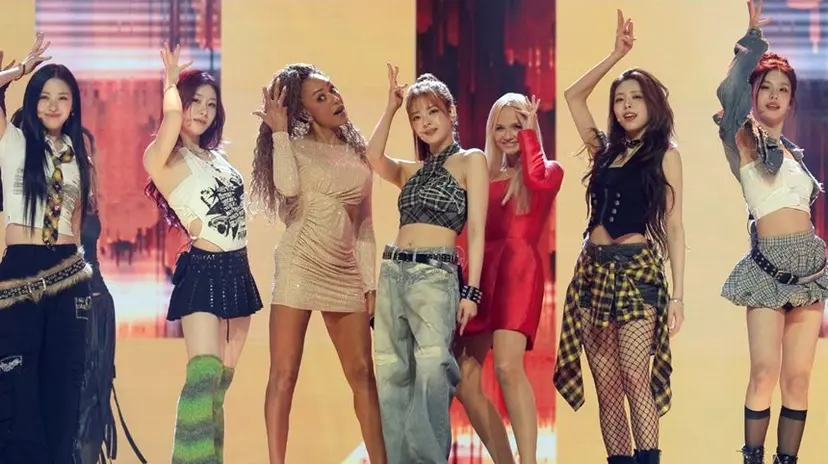
To summarize the significance of this program, which feels like an expansion of 'K-Pop Demon Hunters' (K-De-Heon), one must pay attention to a few points regarding 'KPOPPED'. First, we cannot overlook the songs featured, and it is necessary to consider the meaning of the final stages realized through those tracks. Patti LaBelle's "Lady Marmalade," Vanilla Ice's "Ice Ice Baby," Kylie Minogue's "Can't Get You Out of My Head," Boyz II Men's "Motown Philly," Megan Thee Stallion's "Savage," and Ava Max's "Kings & Queens" are all songs that have enjoyed global popularity.
"Singing these songs with K-pop idols, or competing against them? And in a K-pop version?" While such anticipation is natural, the very fact that these songs are permitted to be rearranged into K-pop versions could be considered a cultural shock. This is because one can easily predict the reaction if songs by musically acclaimed artists in Korea were rearranged into idol music.
The casting process for gathering global pop stars was reportedly not as difficult as one might expect. The production team stated, "Everyone readily accepted the offer, and many reacted with interest, saying, 'We also wanted to collaborate with K-pop artists.'" This is a testament to the elevated status of K-pop. Some point out that K-pop is gaining attention because of these veteran pop stars, which seems partially true. However, they personally visited Korea to utilize K-pop.
For one, this program puts K-pop at the forefront in its title, just like 'K-Pop Demon Hunters', and throughout the entire content. And who leads it is important. A group is split into units of two pop stars, and each spends 48 hours in sync with a pop artist to compete. Of course, they also perform their signature songs or new tracks. Above all, the idol members rearrange old songs into K-pop versions, competing or performing joint stages based on these.
As with pop culture in general, new and fresh styles are always crucial in popular music. This implies K-pop as a value of something "brand new." The fact that a global OTT platform chose K-pop itself speaks to this. Therefore, the pop stars who are reborn through K-pop—a hip music genre for the younger generation—are arguably the ones "putting a spoon" into K-pop. Even so, it is refreshing to see these pop stars embrace novelty. They demonstrate an attitude of fully acknowledging and respecting the K-pop genre.
The lineup of K-pop idols competing against the pop stars is also noteworthy. Billlie, ITZY, Kep1er, JO1, ATEEZ, STAYC, KISS OF LIFE, and Blackswan are mostly from small and medium-sized agencies. These are so-called "small-to-medium agency idols." These days, K-pop members have fully honed their musical capabilities, ranging from songwriting, composing, and arranging to producing and choreography. However, it is easy for them to struggle due to a lack of capital. For them, this program not only provides a global stage but also serves as an opportunity to continuously promote themselves through content. It is timely, as there is a need to reignite the miracle of BTS's rise from a small agency.
Meanwhile, the question of whether 'KPOPPED' can truly be considered K-content has emerged, due to the sources of capital, investment, and production. This was a point previously raised regarding 'K-Pop Demon Hunters'. Of course, like 'K-De-Heon', 'KPOPPED' is "American-made" K-content invested in and produced in the United States. However, with CJ Group Vice Chairwoman Miky Lee, Shin Hyung-kwan (Head of Music Content at CJ ENM035760), Hong Jun-ki (Strategy Promotion Lead), and PD Kim Ki-woong participating as executive producers, the production entity has strong Korean characteristics. The format of featuring many famous singers or competing by rearranging old songs is also very Korean. Most importantly, the experience and introduction of Korean culture are naturally woven in, allowing the influence of the Korean K-style to expand. The attention paid to Korean culture and lifestyle is proof of Korea's hip status.
However, controversy arose when the group JO1 appeared as a K-pop artist. JO1 is an 11-member Japanese boy group that debuted on March 4, 2020, and was selected through the audition program 'PRODUCE 101 JAPAN' aired in 2019. They are mainly active in Japan and have no Korean members. However, it was emphasized that they were trained according to the K-pop system and primarily perform in the K-pop genre.
Going beyond this, something more is needed besides K-pop identity and worldview. It is that they must be autonomous idols, not passive, agency-planned idols. It seems that evaluation criteria should be focused on this point. One cannot help but think that K-pop embodies the zeitgeist of the 21st century in that it allows members to cooperate while showing their individual personalities through a single song.
Of course, 'KPOPPED' lacks the gripping tension of typical competition variety shows. It feels more like a heartwarming, harmonious stage for artists. In any case, it clearly shows a change in the status of K-pop. Through such content, the reach can be expanded. It contributes to deepening the brand value of Korea, as well as K-content beyond K-pop. At the same time, it is during such times that internal systematization and establishment are important. Perhaps it is time for an audition show that deals with what exactly K-pop is and what makes it "K-pop-like."
The author, Kim Heon-sik, has walked or navigated through the forest of pop culture phenomena since his 20s, with the expectation that there is a way to make the world a better place through culture. In the 21st century, where AI and quantum computers are active, he continues on the same path with the same belief.