

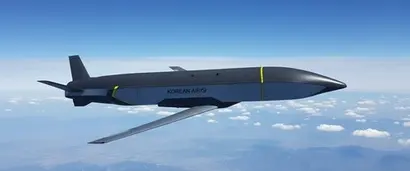
[비즈한국] Korean Air003490 unveiled its independently developed small collaborative unmanned aerial vehicle (UAV), KUS-FX, for the first time at the '2025 UAV Technology Exchange' held on September 4. This unmanned wingman, which possesses the characteristics of both a cruise missile and a drone, can strike targets up to 600km away or perform reconnaissance and deception missions. Notably, unlike competing models, it is capable of both air and ground launches depending on the situation. This facilitates 'economies of scale' through mass production, leading to expectations that it will garner attention as a core weapon system for future battlefield environments.
Since the Ukraine war, quadcopter-type drones, commonly known as 'FPV drones,' have frequently appeared in the news, but defense companies around the world are focusing on developing 'Collaborative Combat Aircraft' (CCA), which are UAVs that operate alongside manned aircraft and helicopters.
CCA are divided into Small CCA (SUCA), which resemble missiles, and Medium CCA (MUCCA) based on their size. Korean Air previously unveiled 'LOWUS,' classified as a medium CCA, this past February, and KUS-FX is the second model following KUS-RP in the small collaborative UAV category.
The size and weight of the KUS-FX are similar to typical expendable drones. It is 4m long, 2.8m wide, weighs 220kg, and has a payload capacity of 20kg. Equipped with a small turbofan engine with 1,300N of thrust, it has a maximum operating altitude of 20,000 feet, a top speed of Mach 0.8, and can fly for 90 minutes.
The core advantage of the KUS-FX lies in the 'Flexible, Expendable' nature embodied in its name. While it can fold its main wings for storage or ground launch, it also adopts a unique 'Asymmetric Overlapping Folding Wing Structure' to maximize flight performance. Thanks to this structure, the KUS-FX secures superior flight capabilities by maximizing the wing's span and length even while the wings are folded.
Furthermore, when the wings are folded, the KUS-FX’s width is reduced to under 500mm, allowing for mass launching from multiple rocket launchers. According to the manufacturer, Korean Air, the KUS-FX can be stored in a 20-foot container (9 units at a time) and launched continuously like a multiple rocket system. This makes it easier and faster to operate than relying on runways or fixed launch pads, providing the advantage of being able to conduct missions even if enemy attacks on airbases render runways unusable.
Moreover, the KUS-FX is being developed to be capable of air launch as well. While domestic competitors like KAI and LIG Nex1079550 are also developing similar UAVs, the KUS-FX is the first to support both ground and air launches. This is expected to drive up demand, leading to mass production and reduced unit costs.
The mission capabilities of the KUS-FX will be developed in stages. The Block-1 version will first be produced to perform simple reconnaissance and enemy air defense deception missions, utilizing a flight time of over 1 hour and 30 minutes and a range of over 600km. Subsequently, the Block-2 version, a loitering munition equipped with a seeker, communication datalink, and warhead, is planned for future development.
Overseas competitors to the KUS-FX include Anduril’s 'Barracuda-500' and CoAspire’s 'RAACM,' while domestic competitors include KAI’s 'AAP-150' and LIG Nex1’s modular missiles.
All these models share the commonality of being deployable for diverse missions through small turbofan engines and modular designs. However, being designed to possess both ground-based multiple launcher and air-launch capabilities is a unique feature exclusive to the KUS-FX.
Another feature of the KUS-FX is its integration of AI mission technology through international joint development with the United States. Korean Air stated that it plans to apply AI-based mission and autonomous flight technology, co-developed with Anduril, by 2026. Following this, the system development for Block-1, capable of deception and reconnaissance missions, is planned to begin in 2029, with Block-2, capable of offensive missions, scheduled for development in the early 2030s.