

[비즈한국] Apple has unveiled the iPhone 17 series. This year, the rumors were more abundant than ever, and in reality, a significant number of them proved to be true. While some might talk about "innovation" yet again, a closer look at the presentation reveals that Apple’s ideas and technical prowess in leading the market remain intact. As CEO Tim Cook put it, the claim that this is the "greatest leap in iPhone history" is not exactly an exaggeration.
iPhone 17
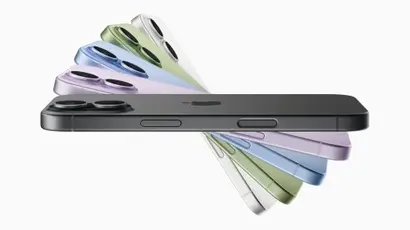
The iPhone 17 undergoes a major change this year: the display. A 120Hz ProMotion display, which refreshes 120 times per second, has been added. Depending on the need, this refresh rate creates smooth motion at 120Hz, but when the screen is static, it drops to 1Hz to reduce power consumption. In fact, because this screen is hard to live without once you get used to it, it was a symbolic element of the iPhone Pro lineup. However, as various types of 120Hz displays have become popularized across many smartphones, Apple has dismantled the barriers for this series as well. Yet, it demonstrates a technical edge by incorporating an LTPO 3 display with a variable refresh rate rather than a simple 120Hz panel.
The front camera has changed significantly, even being renamed the "Center Stage camera." Center Stage is a technology Apple previously applied to Mac and iPad cameras, which uses AI to recognize people and create an appropriate frame. While it is software-based technology, the iPhone 17 adds a different approach: a square sensor.
The iPhone 17's front Center Stage camera allows for free switching between landscape and portrait orientations for selfies. It may seem like a small thing, but you can now take landscape-oriented selfies without tilting the iPhone. Previously, to take a landscape photo, you had to hold the bottom of the iPhone, which strained your hand due to the weight and made pressing the shutter button feel unstable. Also, when taking photos, everyone looks at the center of the screen, but because of the camera positioned in the corner, the resulting output shows everyone looking elsewhere. However, being able to set the photo orientation while holding the phone vertically solves these problems entirely. It may look simple, but it is not a trivial task.
Overall, the iPhone 17 is highly refined in its own right. For general smartphone needs, it is enough that one doesn't necessarily have to look at the Air or Pro lines. However, the iPhone that will receive the most attention this year is surely the rumored iPhone 17 Air.
iPhone 17 Air
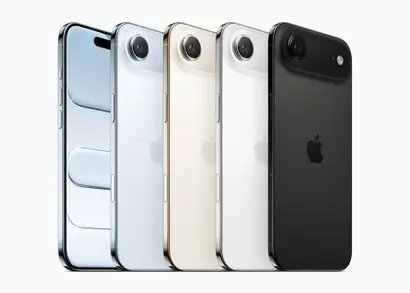
The iPhone 17 Air is a thin smartphone. "Air" is a moniker Apple has used to denote reduced thickness since the MacBook Air, and there are times when it feels like no other word could fit better. The "Air" attached to the 5.6mm-thick iPhone also feels appropriate.
The iPhone 17 Air also includes the 120Hz ProMotion display and has boosted performance through the "A19 Pro" chip. It uses a titanium alloy, positioning the product in the premium lineup.
However, there is one talking point: the camera section, which has been mentioned since the rumors first surfaced. Over the past decade, smartphones have evolved with the camera as the most important element. While smartphones have become thinner, cameras have become larger to increase optical performance. This discrepancy has led to the "camera bump," where the camera protrudes from the case. And the camera section of the iPhone 17 Air looks exceptionally prominent.
It is not the first time a smartphone has been thin, so it isn't hard to understand why the camera looks so distinct. However, Apple's approach is slightly different. They moved the main logic board—which forms the core of the product, including the processor and modem—to this section. Apple calls this part the "Plateau." It is an integrated area that houses the front and rear cameras, speakers, and Apple Silicon.
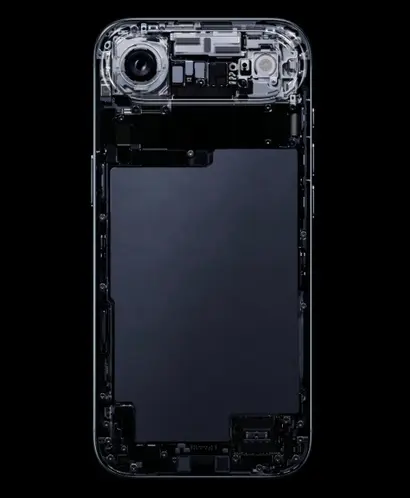
So, are there no device-related parts in the rest of the phone? Yes, almost everything outside of this Plateau is filled with the battery. Previously, the mainboard and sensors were configured vertically on the side opposite the camera (usually the right), and the remaining space was filled with a long, slender battery. But in the iPhone 17 Air, all key components were moved to the top, securing the entire lower section for the battery. This is the biggest secret of the iPhone 17 Air's design.
iPhone 17 Pro
This change also carries over to the iPhone 17 Pro. The iPhone 17 Pro also includes all key components, from the three rear cameras to the A19 Pro chip, in the Plateau. And everything below it is filled with a large battery. Thanks to this, the iPhone 17 Pro has the longest battery life of any iPhone to date, capable of up to 37 hours of video playback.
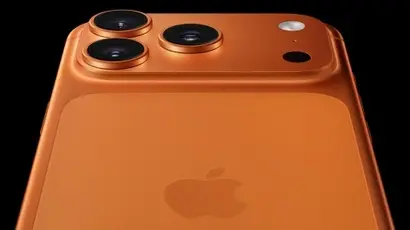
Having a generous battery capacity also means that the processor's performance can be pushed further. Specifically, the iPhone 17 Pro uses a vapor chamber to extract heat and dissipate it throughout the case. For this purpose, the case material was changed to aluminum.
Traditionally, the Pro line of iPhones used cases made of materials commonly considered "premium," such as stainless steel or titanium, while aluminum was used for standard iPhones, so this might seem somewhat unexpected. However, the iPhone 17 Pro shows a turnaround with its unibody design. Unibody design is a case construction technique primarily used for Macs, where the case is carved out of a single block of material. When processed this way, there are no seams, resulting in a smoother design and higher overall structural integrity.
Above all, an aluminum case has a much higher thermal conductivity than titanium, increasing overall thermal performance. Apple stated that it conducts 20 times more heat than titanium, suggesting that heat management was a top priority in the design. In particular, with the processor located in the Plateau, cooling seems critical, as the area touching the ear during phone calls could otherwise become uncomfortably hot.
Ultimately, it seems the iPhone 17 Pro aims to deliver higher performance based on more robust cooling and a larger battery. Already, the iPhone 17 Pro has seen a significant boost in processor performance, and the GPU is designed with separate AI accelerators for each core to run graphics and AI instances more effectively. As the demand for AI, including Apple Intelligence, continues to rise, higher-performance chips will be needed, and a design reconfiguration was likely necessary to accommodate that.
The key to this is the Plateau and the aluminum case. While Apple's designs, such as the AirPods or the notch, are sometimes dismissed as subjects of ridicule, there is ultimately a clear reason behind those changes, and in the end, the market and the industry often follow suit. The Plateau design seems to be one such example. The iPhone 17 series will be available for pre-order starting September 12, and will go on sale in Korea beginning September 19.