

[비즈한국] "Naver035420's current board of directors is violating the duties of directors as prescribed by relevant laws and operational regulations." (Oh Se-yoon, Naver Labor Union Leader) "Management focuses only on short-term financial gains rather than the company's long-term growth, and when a situation arises requiring accountability, the management disappears—a phenomenon that keeps repeating." (Seo Seung-wook, Kakao035720 Labor Union Leader)
Lee Hae-jin, the "hidden executive" who returned to Naver as chairman after seven years. Kim Beom-su, the head of Kakao’s Future Initiative Center, who, while not a registered executive, controls decision-making for the entire group. Criticism has emerged in the National Assembly that the boards of the two leading domestic IT companies have lost independent monitoring functions under a governance system built around the two founders, devolving into entities that merely support the founders' authority. Critics point out that Naver's personnel risks and Kakao's recurring management patterns of frequent spin-offs, mergers, and rumors of divestment stem from these structural limitations.
Authority Concentrated in Founders Lee Hae-jin and Kim Beom-su
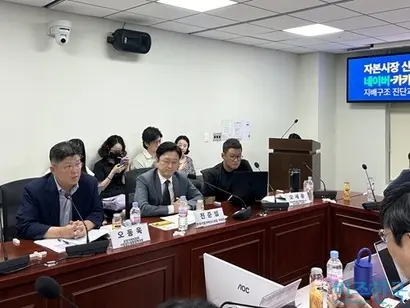
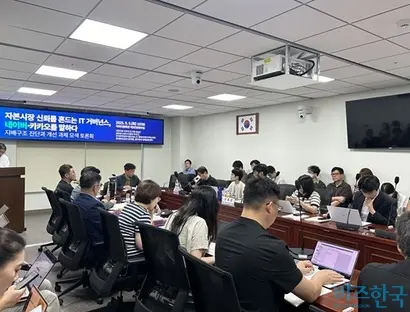
On the morning of the 9th, at a National Assembly forum co-hosted by the offices of lawmakers Park Ju-min, Oh Ki-hyung, Kim Nam-keun, Kim Hyun-jung, Shin Jang-sik, Lee Yong-woo, and Cha Gyu-keun, along with the People’s Solidarity for Participatory Democracy (PSPD) Economic and Finance Center and the Citizens’ Coalition for Economic Justice (CCEJ), the Naver Union (under the Korean Confederation of Trade Unions) and the Kakao Union (Crew Union) urged for the improvement of governance and responsible management at Naver and Kakao.
The forum argued that the opaque governance and responsibility-evading management decisions at Naver and Kakao are threatening capital market trust. The perspective is that the concentration of power around founders, vague accountability structures, and the formalistic operation of boards that enable these are threatening the sustainability of the IT industry.
Strategies considered hallmarks of Kakao's growth, such as M&As, spin-offs, and external fundraising, were criticized for producing side effects. Kakao Enterprise, which started as a division within the headquarters, is a prime example. Spun off from Kakao's internal CIC (Company-in-Company) AI Lab in 2019, Kakao Enterprise underwent large-scale restructuring within just three years. That same year, it was divided into Cloud and Search CICs; the following January, the business service division (KEP) was spun off and absorbed into the systems integration (SI) subsidiary DK Techin. The Search CIC was recently decided to move to a new entity, AXZ, this past June, which the labor union views as a de facto dissolution.
Since July, the Kakao Union has been protesting to demand a resolution to the employment instability of the Kakao Enterprise Search CIC. Beyond Kakao Enterprise, several Kakao affiliates—including Kakao Commerce, Kakao Entertainment, Tapas, and Radish—have experienced unstable situations in recent years due to repeated M&As and spin-offs. Kakao Commerce, for instance, has seen constant changes to its management structure: the spin-off of Kakao Makers (2017), re-merger (2019), merger into Kakao (2021), operation of a Commerce CIC, and the dissolution of the Commerce CIC (2022).

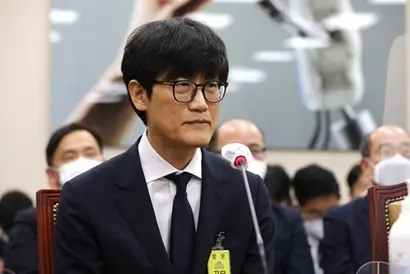
Seo Seung-wook, leader of the Kakao union, said, "A characteristic feature is that spin-offs and mergers at these entities do not end once but occur continuously. The problem is that in many cases, there is little evidence of sufficient review or preparation in terms of governance or management strategy," adding, "Kakao employees have experienced multiple times how governance issues translate into labor issues."
The Naver union brought up the issue of the return of former COO Choi In-hyuk. This incident served as a trigger for the release of internal dissatisfaction and distrust regarding the "old guard" system established by Chairman Lee Hae-jin upon his return as head of the board. Former COO Choi is pointed to as a person responsible for the workplace bullying incident at Naver in May 2021. Choi returned as head of Tech Business this May, and critics argue that no appropriate check-and-balance measures were implemented during the decision-making process for his return.
Naver Union Leader Oh Se-yoon claimed, "The board, without any basis in company regulations or procedures, ordered the company’s internal audit and legal organizations to host an explanatory session for CEO Choi. In particular, it instructed the audit organization to act in defense of CEO Choi," adding, "The explanatory session was conducted entirely from CEO Choi's perspective."
He continued, "During this process, the board’s internal dedicated committee for managing personnel risks, the Risk Management Committee, could have requested supervision, clarification, or suspension, or deliberated and voted, but it took no action," emphasizing, "It is inappropriate for a company like Naver to have governance where one can maintain management control simply because they were an early colleague of the founder."
How to Change
The Naver union proposed guaranteeing the right of minority shareholders to request shareholder rights through amendments to the Commercial Act, and increasing transparency by having the National Pension Service (NPS)—as a major shareholder—monitor and check the board. The Kakao union emphasized strengthening investment review processes for IT companies, introducing a "Say on Pay" system (voting on executive compensation policies and actual payments), and establishing compensation structures based on long-term performance.
Kim Eun-jung, deputy secretary-general of the PSPD, observed, "The failure to stop CEO Choi’s return appears to be a result of Chairman Lee Hae-jin’s influence at work." She added, "Kakao is quite unique. Chairman Kim Beom-su is neither a CEO nor a registered director, yet as the largest shareholder, he controls decision-making for the entire group. It is a structure that exercises substantial control without taking legal responsibility."
The opaque decision-making structure by controlling shareholders and a small number of founders is a problem also found in existing large conglomerates. In these two companies, where the founders are in their 50s, there are no overt moves to "hand over" control to their children. Nevertheless, critics argue that the issue of decision-making monopolized by founders, which has become entrenched in large IT firms, must be addressed.
Lawyer Cheon Jun-beom, vice chairman of the Korea Corporate Governance Forum, pointed out, "It is difficult for general shareholders with less expertise to have the ability or will to exert prior control over management judgments made by founders. This is a problem seen not only in Korean IT companies but also in US big tech firms like Tesla and Meta."
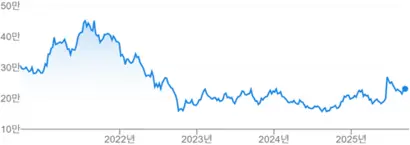
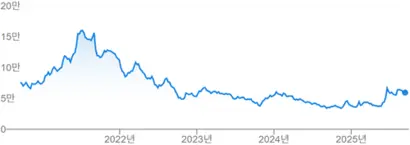
Stock prices for leading domestic IT firms like Naver and Kakao have shown high volatility over the past few years. During the pandemic boom of 2020–2021, their stock prices reached all-time highs, but they have since regressed to 2019 levels, showing a persistent downward trend. Beyond global economic stagnation and intensifying AI competition, investor trust in the IT industry has declined due to factors like slowing search ad growth, sluggish new business performance, management risks, and controversies over spin-offs and divestments.
Lawyer Cheon stated, "We need proactive policies that strengthen market competition by mandating cumulative voting to instill a corporate culture of appointing at least one highly professional director, and by providing more opportunities and support to startups."
Won Jong-hyun, chairman of the NPS’s Stewardship Code Committee, remarked, "It is difficult for the National Pension Service to approach issues involving specific individuals within Naver or Kakao," but added, "Regarding executive compensation, we are enhancing dialogue with companies, such as by requesting the disclosure of executive compensation caps."