

[비즈한국] Nothing is certain until it actually appears before your eyes. Even with plausible renderings or blueprints, things often don't turn out as planned. However, there is a building that has become a topic of conversation—not just for falling short, but for deteriorating into something completely different. This is the story of ‘Dyad Cheongdam,’ a members-only club standing at the prime location of No. 1 Cheongdam-dong.
The exterior of Dyad Cheongdam has changed several times over a period that can hardly be called long. Its initial appearance was a generic high-rise building with an emphasis on vertical flow. While not particularly striking, it seemed like a solid plan with few variables. However, midway through, it was changed 180 degrees to the design by famous French architect Dominique Perrault, who designed the Ewha Womans University ECC.
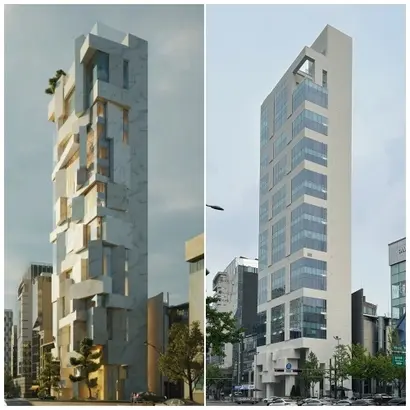
The original design by Dominique Perrault had a dynamic feel, with natural marble protruding here and there, as if intending to create a sculpture that stands out like a trophy. The way the planes divide and merge makes it look new and flamboyant from any angle. While opinions may vary, one could say it fit the character of the building. However, the developer that received the design failed to implement it properly. Perrault presented a compromise with toned-down radicalism, but even that was not achieved to a satisfactory level. He eventually distanced himself from the building and requested that his name be removed. It was the final measure a creator could take.
Standing tall at No. 1 Cheongdam-dong, Dyad Cheongdam looks like a giant wooden block or a barricade. Some have even mocked it by calling it ‘Daiso Cheongdam’ instead of Dyad Cheongdam. The building itself is quite tall for the size of the plot, and it feels even more overwhelming because the surrounding buildings are relatively low. The unnatural part is particularly the low-rise facade. While the other sides have become excessively flat, this area retains awkward, bumpy traces of the original plan. It looks as if plastic blocks were stacked up rather than marble. It reminds me of the days when I used to play with Lego blocks to build something similar as a child.
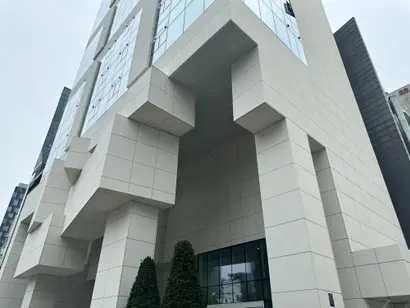
The biggest reason the finished product turned out this way is money. In addition to the burden of Project Financing (PF) loans, the land purchase alone cost over 100 billion won due to its location at the intersection of two major Gangnam boulevards. No matter how much financial backing there is, that is a daunting amount from the start. This made cutting construction costs crucial. Furthermore, the reality that it is not easy for an architect to closely oversee the entire process from design to completion to forcefully push through the original concept likely played a role. Dyad plans to return the building, which has become a hybrid of various interests and completion deadlines, to the level of Perrault’s compromise, but it remains to be seen how much of a change in atmosphere is possible through a project that changes only the skin while the foundation remains weak.
Modifications are inevitable in the process of actually implementing a project. However, this case feels a bit extreme. A building that has lost its philosophy due to realistic conditions does not suit the top 0.1% of wealthy individuals, who align with the philosophy of the operating entity—the very target of the membership recruitment. There are buildings that are demolished despite excellent design and symbolism because they get caught up in circumstances, and there are buildings that survive and reach completion because the process, rolling like a giant wheel, cannot be stopped even when everything is lacking. Circumstances kill and save buildings. That fact leaves those who pursue beauty feeling bitter.
Who is the author, Han Dong-hoon?
A typeface designer. He is interested in all areas related to letters, including writing, calligraphy, and designing and teaching typography. He currently designs various corporate fonts and retail fonts at the font studio AlignType. He has contributed to 'Monthly Design' and the quarterly 'Design Review', and conducts typeface design lectures on both online and offline platforms. In 2021, he published the essay collection 'The Universe in Letters'.