

[비즈한국] The feasibility study report for the Yeongwol-Samcheok Expressway construction project has been released seven months after passing the preliminary feasibility study (pre-FS) last January, but the report raises several questions. Not only has the total project cost increased by 400 billion won from the initial plan, but the report itself explicitly states that the locations of the interchanges (IC) require further review. This project was approved despite having a B/C (benefit-cost) ratio of 0.27, the lowest in history. Normally, highway projects with a B/C ratio below 0.5 are considered unlikely to pass a pre-FS.
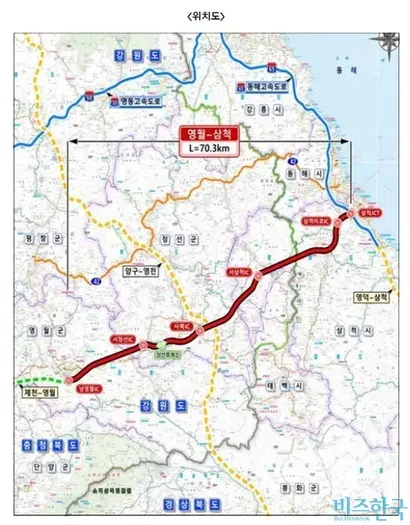
400 Billion Won Increase in Construction Costs, IC Locations Also 'Need Review'
According to the Yeongwol-Samcheok Expressway pre-FS report, the total project cost is 5.6167 trillion won, an increase of over 400 billion won from the 5.2031 trillion won planned in 2022. The main factors for the cost increase are higher unit prices for tunnels and bridges, and the addition of side shafts and vertical shafts.
The locations of the interchanges (IC), which drew much attention, were also disclosed. A total of four are planned: Seo-Jeongseon IC, Sabuk IC, Seo-Samcheok IC, and Samcheok Miro IC. Taebaek, which had been considered a likely candidate, was excluded. It is known that the original highway construction plan included ICs in Nam-Yeongwol, Sabuk, Taebaek, and Miro.
While the pre-FS report proposed the four IC locations, it also specified issues such as concerns over traffic accidents, the need for location reviews, and potential public complaints. For the Seo-Jeongseon IC, the report explained that it was added to improve accessibility, although it was not in the original construction plan. It then noted that the review of the location and design of the Seo-Jeongseon IC is necessary, citing concerns over high risks of traffic accidents due to the short distance between exits and high longitudinal gradients.
Regarding the Sabuk IC, it stated that a review of the location and design is deemed necessary, considering the short distance between the IC and tunnels. For the Seo-Samcheok IC, it specified that a review is needed to determine if it meets the requirements for IC installation.
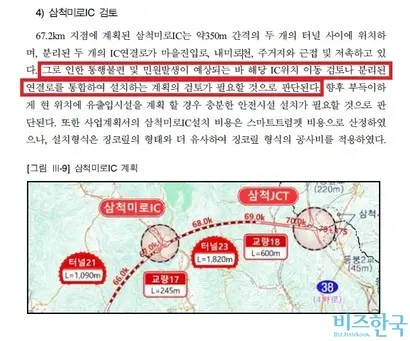
As for the Samcheok Miro IC, the report explained that 'an IC location shift review' is necessary, as the two connection ramps are close to village access roads, the Naemiro Stream, and residential areas, which is expected to cause traffic inconvenience and public complaints.
Question Marks Over All Three Indicators: Economic Feasibility, Policy, and Balanced Regional Development
The Yeongwol-Samcheok Expressway has the lowest economic feasibility among all highway projects in history. Representatively, the B/C ratio, an indicator of economic feasibility, was evaluated at 0.27, and the Internal Rate of Return (IRR), which shows investment profitability, was –5.28%. The Net Present Value (NPV), which converts future profits into present value, was –2.8683 trillion won.
The conditions for pushing forward with the project appear to reflect the positive opinions of the Ministry of Land, Infrastructure and Transport (MOLIT), the Korea Expressway Corporation, local governments, and residents. The report states that MOLIT and its affiliated agency, the Korea Expressway Corporation, hope for the prompt implementation of this project for balanced national development, and that local governments are showing a strong willingness to proceed. Petitions from local residents are also included.
Beyond the fact that its economic feasibility is the lowest ever, questions are also being raised about the policy and balanced regional development evaluation indicators. The report includes both the contents presented by the competent ministries and the review opinions of the pre-FS research team, and there are many instances where the two conflict.
The competent ministries presented policy effects such as completing network connectivity, revitalizing the economy of former mining regions, utilizing abundant tourism resources, and strengthening the competitiveness of local industries; however, whether these will actually have an effect remains to be seen. The pre-FS research team pointed out that there is a limit to grasping the effects because the ministries did not present the scale of the effects resulting from network completion, and regarding the revitalization of former mining regions, it noted that some content overlaps with indicators for improving regional backwardness and employment.
Furthermore, the research team pointed out that from the perspective of the national economy as a whole, an increase in regional visitors could lead to a decrease in visitors to other regions, and that the prediction that tourist visits would significantly increase solely through highway construction could be seen as excessively optimistic. It also noted that the data presented by the ministries regarding the effects were redundant or exaggerated.
The job creation effects also differed between the ministries' claims and the research team's review. The ministries presented a direct employment effect of over 60,000 people during the construction period and employment effects for vulnerable groups. However, the research team pointed out that the direct employment effect is at the 39,000-person level, significantly lower than the figure presented by the ministries.
Regarding accessibility, the research team noted that while it could be a positive factor for local residents' access to hospitals, education, and culture, the time-saving benefits for access to Incheon Airport presented by the ministries partially overlap with the saving benefits in the economic feasibility analysis. It also stated that it is difficult to grasp the effect of the psychological accessibility improvement item with the data submitted by the ministries.
In the balanced development section, the team pointed out that highway IC accessibility and the highway density rate overlap, and that the ministries did not present what kind of impact improving highway equity would have. Regarding the equal opportunity infrastructure construction item, it stated that it partially overlaps with the industrial job improvement indicators of regional backwardness. For user convenience improvements such as long-distance driving comfort and pleasantness, while it was suggested that the Yeongwol-Samcheok Expressway would improve the convenience of autonomous driving compared to other roads, the team pointed out that the basis for autonomous driving being possible on highways before national roads is unclear.
Regarding the environmental assessment, the research team judged that the ministries failed to provide clear figures. The ministries suggested that the terrain disconnection reduction index is 161% compared to highways nationwide and that they would plan a route to minimize the sections passing through the Baekdudaegan Mountain Range protected area. However, the research team pointed out that the use and effects of the terrain disconnection reduction index were not verified, and it was not presented what effects would be gained by minimizing environmental damage to the Baekdudaegan. It evaluated that the content presented is not about positive environmental impacts when the project is implemented, but about minimizing environmental damage.
Regarding the safety assessment, the ministries suggested that travel time could be reduced when disasters or accidents occur in the southern Gangwon region. However, the research team stated that while it could act as a partial alternative route when National Road No. 38 is inaccessible, there is a limit to judging the magnitude of the effect based solely on the submitted materials.
In the balanced regional development section, the content presented by the ministries and the research team's review opinions also differed. The ministries suggested that emergency medical facilities could be accessed within one hour, but the research team judged that it is difficult to access Wonju Severance Christian Hospital within one hour. Regarding the effect of improving industrial and job indicators, the ministries suggested that the number of businesses and employees would increase due to highway construction, but the research team explained that it is difficult to judge that this would increase solely due to the highway opening.
Despite 'Lowest Ever' Economic Feasibility, Comprehensive Evaluation is 'Decent'
The Yeongwol-Samcheok Expressway construction project did not receive noteworthy evaluations in terms of policy or balanced regional development, let alone economic feasibility, in the pre-FS, but the comprehensive evaluation exceeded 0.5, and the project was confirmed. Among the 12 sub-committee members of the Preliminary Feasibility Study under the Fiscal Project Evaluation Committee, the comprehensive score excluding the results of the 4 highest and lowest scorers was 0.578, and all 8 evaluators voted in favor of the project.
Some point out that the reliability of the pre-FS system has declined due to the Yeongwol-Samcheok Expressway project passing the pre-FS. An industry expert pointed out, "The reason for conducting a preliminary feasibility study is to evaluate economic feasibility, so it is puzzling that a project without economic feasibility was passed." Another expert criticized, "The pre-FS has practically lost its meaning. Projects are pushed based on public sentiment, such as the intentions of local governments and jurisdictional authorities. Moreover, since pre-FS reports lack concreteness and specific construction costs and compensation fees are determined at the detailed design stage, it is difficult to discuss the feasibility of the project at the current stage."
The Yeongwol-Samcheok Expressway construction project, which passed the preliminary feasibility study, is expected to proceed until 2034. A 70.3km-long four-lane highway will be built, and of the total project cost of 5.6167 trillion won, 2.1225 trillion won will be covered by state funds, and 3.806 trillion won will be borne by the Korea Expressway Corporation.