

[비즈한국] Dark matter is the ghost of the universe. It leaves no trace whatsoever. The "dark" in dark matter does not simply mean it is black or obscure in color. It means that it neither emits nor absorbs light, and is completely indifferent to the electromagnetic forces that mediate light. Strictly speaking, it might be closer to a "transparent" substance than a dark one.
In modern astronomy, dark matter is one of the most important components of the universe. Without it, the appearance of our universe cannot be explained. On the surface, the universe appears to be an empty void. It is difficult to explain why the universe maintains such a solid form using only brightly shining stars and gaseous matter. To understand a universe that is "sturdier than it looks," one must conclude that something invisible exerts gravity to support the universe and prevent it from dispersing.
The responsibility for uncovering the identity of dark matter has now shifted from astronomers to particle physicists. Given that dark matter does not interact with light in any way, it is likely not composed of standard protons, neutrons, or electrons. It is highly probable that it consists of entirely different fundamental particles that we have yet to discover. Thus, a massive ritual of chasing ghosts is being conducted at the frontiers of particle physics, such as the Large Hadron Collider. Scientists constantly smash particles accelerated to near-light speed, hoping a ghost will pop out. Unfortunately, no signals have been detected by these ghost-hunting machines just yet.
Perhaps a greater séance is needed? Is the mere collision of two particles insufficient? With the particle physicists facing ongoing failures, astronomers have stepped back into the fray. True to their nature, they are thinking bigger. They aren't settling for clashing two particles; they are colliding two massive galaxy clusters. Of course, astronomers don't initiate these collisions themselves; they carefully observe the scenes of two galaxy clusters crashing into each other at high speeds in deep space.
The most representative example is the "Bullet Cluster," also known as 1E 0657-56, located 3.7 billion light-years away. This site is considered the strongest evidence that the ghost known as dark matter truly haunts the entire universe. It is also the site that dealt the greatest blow to alternative hypotheses that emerged to deny the existence of dark matter. Recently, the James Webb Space Telescope (JWST) took another look at this "holy site of darkness," and important new clues regarding the identity of the dark matter ghost have been revealed.
Even when galaxy clusters collide, the galaxies within them rarely crash into each other directly. Galaxies within a cluster are sparsely distributed with very low density. Therefore, the galaxies within the clusters that are rushing toward each other at high speeds simply pass right through one another. At the moment of impact, their speeds might decrease slightly as they brush past each other, but there is no major change.
However, galaxy clusters are not just filled with starlight-producing galaxies. There is hot gaseous matter spread throughout the vast space between galaxies. In fact, it is no exaggeration to say that the true protagonist of a galaxy cluster is not the galaxies, but the gas. This is because the total mass of the gas exceeds the total mass of all the galaxies combined.
Gaseous matter is sensitive to collisions. As two galaxy clusters collide, the gas within each cluster also collides. At that moment, unlike the galaxies, the gas experiences high-density packing and stagnation at the collision interface. This causes the temperature to spike into the millions of degrees, an intense energy that can be confirmed through X-ray observations. When the Bullet Cluster is observed with the Chandra X-ray Observatory, one can see the distribution of the superheated gas along the collision interface. Unlike the distribution of galaxies that have passed through the collision front, the X-ray-observed gas is clearly concentrated at the collision boundary at a uniquely high density.
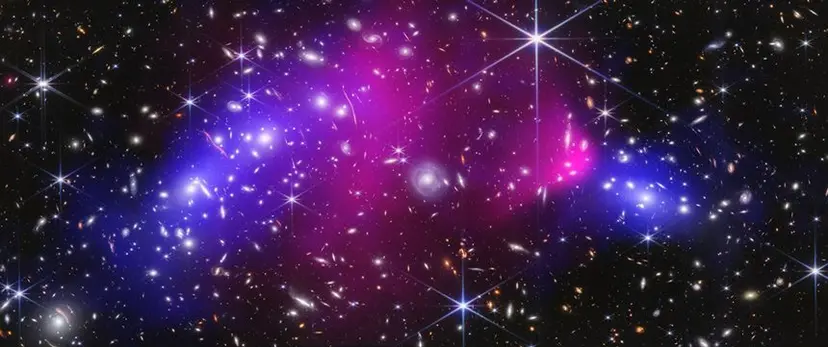
There is an interesting phenomenon that always follows the observation of such massive galaxy clusters: the false images created by gravitational lensing. Galaxy clusters are filled with a massive, albeit invisible, amount of dark matter. It distorts the surrounding spacetime by an amount proportional to its total mass. As light from the background universe beyond the cluster travels to us, it traverses this distorted spacetime, causing the path of the light to bend. Consequently, the light from distant background galaxies is observed as distorted, circular arcs.
Through the gravitational lensing observed in the vicinity of galaxy clusters, we can determine how much dark matter there is and how it is distributed. Back in 2004, astronomers used the Hubble Space Telescope to observe gravitational lensing images around the Bullet Cluster, determining how the total mass of the cluster—including dark matter—must be distributed. They discovered something astonishing.
In the image, the blue-colored areas represent the distribution of dark matter identified via gravitational lensing. This distribution differs significantly from the distribution of hot gas identified via X-ray observations. Unlike the gas that stagnates and collects at high density at the collision front, the total mass distribution shows two distinct clumps of mass that have pierced through the collision front and moved to either side. This is accepted as the strongest evidence that a ghost-like dark matter, which passes through the collision site without interacting with baryonic gas, truly exists as matter.
In other words, it demonstrates that dark matter is composed of "collisionless" particles. The distribution of gas, which stagnates briefly at the collision front before being dragged through in the wake of the dark matter, looks like the shockwave of a bullet flying through the air. That is why this site is called the Bullet Cluster. True to its name, it has been accepted as the most compelling "smoking gun" for dark matter.
Instead of assuming the ghost of dark matter, there is an alternative hypothesis known as Modified Newtonian Dynamics (MOND), which assumes that the efficiency of gravity varies depending on the scale at which it acts. Specifically, it attempts to explain how stars on the outer edges of galaxies can rotate faster than expected—as if held by stronger gravity—by modifying gravity so that it acts slightly stronger than standard Newtonian physics at small scales of gravitational acceleration. However, even MOND cannot easily explain the Bullet Cluster. The discrepancy between the gas distribution and the total mass distribution shown by the Bullet Cluster is simply too large. It is difficult to create such a clear disparity merely by adding minor modification factors to Newton's law of gravity.
Recently, the James Webb Space Telescope took a detailed look at the Bullet Cluster, a veritable holy site for dark matter proponents. Thanks to its significantly superior performance compared to Hubble, it identified smaller, fainter gravitational lenses that had not been seen in previous observations. In this study, astronomers identified over 140 large-scale gravitational lensing images in the Bullet Cluster. They also utilized relatively small-scale lensing images hidden in between for their analysis. By synthesizing these lensing images across various scales, they employed an algorithm to more accurately determine the cluster's total mass distribution. Through this, they reconstructed a map of the total mass distribution that can account for all observed gravitational lensing images.
Looking closely at the reconstructed total mass distribution map from this analysis, the left side is much more elongated and elliptically distorted. This suggests the possibility that before the current collision, the galaxy cluster on the left may have undergone another collision.
More importantly, the total mass distribution of each galaxy cluster currently undergoing collision still matches the distribution of starlight within each cluster almost perfectly. Comparing the bright galaxies within the cluster and the distribution of "Intracluster light (ICL)"—light spread in the space between galaxies—there is no major difference from the total mass distribution determined by the gravitational lensing analysis. This confirms that dark matter particles truly do not interact with other stars or gaseous matter. Not even with other dark matter.
Currently, astronomers are contemplating the hypothesis of "Self-interacting dark matter (SIDM)," which suggests that dark matter particles might interact and collide with one another, albeit weakly. In the traditional Cold Dark Matter (CDM) model, dark matter was assumed to be a "gravitational dummy" ghost particle that doesn't interact with anything, even itself, and only responds to gravity. However, since there are cosmological problems that the CDM model cannot explain, they are considering the hypothesis that dark matter might have some self-interaction.
However, if dark matter particles do indeed interact, we can propose a limit on how close they need to be to feel each other—the minimum cross-section for interaction. A large cross-section means dark matter particles are more sensitive than expected and can interact even when relatively far apart, whereas a small cross-section means the particles are truly dull and timid, needing to pass extremely close to each other to interact. The cross-section of dark matter particles required to explain the virtually negligible discrepancy between the total mass distribution and the total light distribution identified by the James Webb observations is quite surprising.
The calculations show that the cross-section of dark matter particles remains at a maximum of 0.5 cm²/g. This is barely at the lower limit of the effective cross-section range proposed by SIDM models. Comparing this to a common hydrogen atom reveals how small this cross-section is: for hydrogen, the cross-section per unit mass is 1.7×10⁷ cm²/g. This means hydrogen atoms can sense and interact with each other even when separated by much greater distances.
According to this latest observation, if dark matter particles are indeed SIDM, they likely won't feel each other's presence or interact unless they pass right in front of one another. If this is true, dark matter particles are, for all intents and purposes, "indifferent ghosts" that might as well not exist, both to other particles and to each other. It becomes understandable why we have failed to capture their traces until now. I wonder if this provides some consolation to the empty-handed particle physicists.
The results of this study, revealed by taking a closer look at the collision site of two galaxy clusters, offer a useful guideline for particle physicists attempting to summon dark matter by colliding two particles in an experimental setting. It provides a clear limit on just how shy and non-interacting a particle one must look for, and to what extent the limits of the Large Hadron Collider must be pushed.
As indicated in the results of this study, the unit for the dark matter particle cross-section uses the term "per unit mass," as it is divided by mass (g). This is because we still do not know the exact mass of a dark matter particle. The actual cross-section of a dark matter particle may ultimately depend on how heavy it is. Also, while the James Webb Space Telescope has excellent resolution, its field of view is very narrow. Therefore, in this analysis, astronomers were forced to focus only on the central part of the Bullet Cluster. The Nancy Grace Roman Space Telescope, which is set to launch soon, has a much wider field of view. Once we can add data from the Nancy Grace Roman Telescope, we will be able to find more gravitational lensing images over a much wider area and draw a more extensive map of dark matter.
Regrettably, we still need dark matter to explain our universe. A ghost still wanders the cosmos. The ghost called dark matter.
Reference
https://iopscience.iop.org/article/10.3847/2041-8213/add2f0
Who is the author, Woong-bae Ji? He loves cats and the cosmos. After watching 'Galaxy Express 999' as a child, he dreamt of sharing the beauty of the universe. He currently researches the evolution of galaxies through their interactions at the Yonsei University Galaxy Evolution Center and the Near-Universe Cosmology Laboratory, and engages in various science communication activities such as lectures and writing. He has authored books such as 'Thumb-tasting Observatory,' 'Thinking About the Universe All Day Long,' and 'Stars, the Science of Light.'