

[비즈한국] A manager at a major conglomerate in his 40s, who is scheduled to be dispatched to the U.S. next year as an expatriate, is on high alert. He had planned to visit the U.S. and stay for about a month before the dispatch to handle the handover and prepare for his residency—a routine practice at his company. However, the U.S. has recently begun a massive crackdown on illegal residents. The manager had initially intended to enter the U.S. around next month and work while traveling back and forth between South Korea and the U.S. until his visa interview for his expatriate status was scheduled, but he is now worried that the Electronic System for Travel Authorization (ESTA) will no longer suffice.
Secretary B, who assists executives and frequently manages overseas schedules for a financial firm, has also begun to fear U.S. business trips. While there is an option to apply for a B-1 or B-2 visa, the company has always used ESTA for simple schedules because it is overwhelmingly more efficient, considering the time and costs involved in visa issuance. The B-1 visa is a non-immigrant visa issued for short-term commercial purposes such as business, meetings, and conferences, while the B-2 visa is for temporary visits like tourism, family visits, or medical treatment. However, the U.S. Department of State clarifies that neither ESTA nor B-1 visas permit “labor or profit-making activities in the United States.”
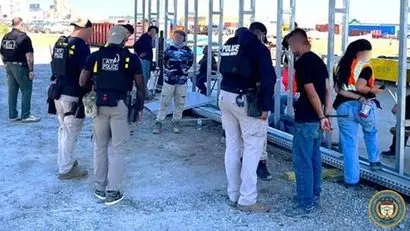
Caught by the practice of relying on ESTA
The business world is in shock after U.S. Immigration and Customs Enforcement (ICE) and Homeland Security Investigations (HSI) conducted a crackdown on illegal residents at the construction site of the Hyundai Motor Group-LG Energy Solution373220 joint battery plant (HL-GA Battery Company) in Savannah, Georgia, on the 4th (local time). Most of those arrested were South Korean employees who had entered the U.S. on ESTA to work on setting up the factory, which led to the issue.
ESTA is a document that allows temporary visa-free entry into the U.S. For 40 countries, including South Korea, that are part of the Visa Waiver Program (VWP), the U.S. waives visa requirements for short-term tourism and business trips of up to 90 days, issuing ESTA instead. Because ESTA is not a formal visa, it only permits short-term non-profit business trips, tourism, or transit. It can be obtained by submitting personal information online without going through a U.S. Embassy interview.
If the purpose of the visit involves profit-making activities within the U.S., a formal visa must be obtained. While the B-1 visa is also a visitor visa that allows for stays of up to six months for business meetings, contracts, or seminars, U.S. authorities do not authorize "profit-making activities." Long-term stays and profit-making activities are only possible with formal work visas, such as the H-1B professional visa or expatriate visas (L-1 or E-2).
However, these come with the drawback of being time-consuming and expensive. The L visa, a U.S. expatriate visa, takes up to five months just for the procedure, and the H-1B, a specific professional work visa, is issued via a lottery system with a success rate of less than 20%. In particular, for employees of partner companies who are high-level professional personnel, if their employer does not have a U.S. headquarters, there is a high possibility that immigration authorities will classify them as skilled labor rather than professionals, leading to a flat-out visa denial.
Most of the approximately 300 Koreans apprehended by U.S. authorities this time were holders of such ESTA or B-1 visas. An official from a large conglomerate hinted, "Since even a formal B-1 visa takes quite a bit of time compared to ESTA, employees often used ESTA for trips if the schedule was around a month," adding, "Since there is no way to get a work visa if there is no local entity in the U.S., you can assume that employees of partner firms have always obtained ESTA when accompanying teams to the U.S."
Emergency for companies with factories in the U.S.
Companies that have factories in the U.S. and cannot avoid sending Korean technical staff for long-term stays are now in an emergency. The aforementioned "Manager A" expressed concern, saying, "Our company alone has about 100 Korean employees at our U.S. plant. If those who received expatriate assignments don't get their visas by the assignment date, they first enter on an ESTA to start working, then return to Korea to get their visas once the U.S. embassy interview is scheduled." He added, "Including such employees, it seems there are quite a few cases in our factory that could become problematic."
The problem is that if caught for visa issues in the U.S., one could face a permanent entry ban in the future. It is reported that companies with factories already under construction or planned in the U.S., such as Samsung Electronics005930, SK Hynix000660, Samsung SDI006400, and SK On, are closely monitoring the situation and reviewing measures such as 'postponing business trips' or 'recalling staff.' This is because they cannot afford to be held back by visa issues while they need to continuously dispatch skilled personnel for the construction of new plants.
A business industry source confided, "Once caught, you could face a permanent ban from entering the U.S., which is a serious issue not only at the individual level but also at the corporate level. Everyone is trying to understand the background and find alternatives as to why this customary practice is suddenly being treated as a problem. However, given that obtaining U.S. visas is not easy, there are virtually no viable alternatives at the moment."