

[비즈한국] Although T'way Air091810 became the first domestic low-cost carrier (LCC) to launch European routes last year, its profitability has actually worsened. This appears to be due to the nature of LCCs, which offer lower fares than full-service carriers (FSC), combined with persistent variables such as the Russia-Ukraine war. Under these circumstances, the aviation industry is closely watching whether T'way Air can succeed in improving its performance following its recent acquisition by the Sono International Group.
European routes fail to generate expected profits
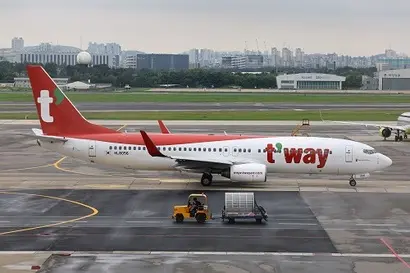
T'way Air began operating European routes—including Incheon-Paris, Incheon-Frankfurt, Incheon-Rome, and Incheon-Barcelona—in June of last year. These routes were transferred as part of Korean Air003490's acquisition of Asiana Airlines020560. In approving the merger, European Union (EU) competition authorities mandated the transfer of European routes that posed competition concerns.
It is said that expectations were high within T'way Air at the time of the European launch. The company rolled out various deep-discount promotions and introduced a new membership system. A T'way Air official stated at the time, "We have opened flight schedules to Rome and Barcelona, destinations many have been waiting for, and have prepared record-breaking fare events and rich benefits. T'way Air will do its best to meet the growing demand for travel to Europe and provide a more comfortable and safe journey."
Contrary to these expectations, however, T'way Air’s performance plummeted after launching the European routes. Unlike the first quarter of last year, when it recorded an operating profit of 76.1 billion KRW, it posted losses for five consecutive quarters from the second quarter of last year to the second quarter of this year. While quarterly operating losses last year were in the multi-billion KRW range, the operating loss for the second quarter of this year reached 78.3 billion KRW. As a result, T'way Air's total equity stood at negative (-) 42.3 billion KRW as of the end of June, placing the company in a state of complete capital impairment.
Most importantly, the assessment is that T'way Air's European routes are not generating as much profit as expected. T'way Air's European tickets are cheaper than those of FSCs like Korean Air or Asiana Airlines. Furthermore, its aircraft have fewer seats than those used by Korean Air. Because of this, it is difficult to generate large-scale profits even when tickets are sold at a high volume.
The aircraft used by T'way Air for its European routes consist of six 'A330-200s' and two 'B777-300ERs.' The A330-200 has 246 seats, a significant difference from Korean Air's aircraft, most of which have over 300 seats. T'way also owns four 'A330-300' aircraft with 347 seats, but they are currently unusable. Since the A330-300 has a relatively shorter flight range, it can only reach Europe via routes through Russian airspace, which are currently unavailable due to the ongoing Russia-Ukraine war.
Choi Go-woon, an analyst at Korea Investment & Securities, assessed, "The A330-200 model has a long range but struggles to secure sufficient revenue. On top of that, due to behavioral remedies imposed by the Korea Fair Trade Commission following the Korean Air and Asiana merger, T'way Air is in a position where it must lower long-haul fares, which has actually created setbacks for T'way Air's European operations, which should have been competing against the duopoly."
It is reported that not only European routes but also existing LCC routes to China, Japan, and Southeast Asia are underperforming compared to the past. Ahn Do-hyun, an analyst at Hana Securities, analyzed, "A slowdown in demand for Japan routes has been detected since June due to weather and earthquakes. Since Japan and Southeast Asia routes account for over 60% of LCC revenue, there is a need to lower the performance expectations for LCCs." Ahn added, "If a visa-free travel system for Chinese visitors to Korea is implemented in the future, it could have a positive impact on air demand, but LCCs only account for 10% of revenue from Chinese routes. Because their route portfolios are limited, the related benefits will inevitably be concentrated on FSCs."

Sono International Group: "Resolving T'way's capital impairment first"
However, financial improvement can be expected now that the Sono International Group has acquired T'way Air. On August 28, the Sono International Group injected 110 billion KRW into T'way Air in the form of a capital increase. T'way Air has also decided to issue 90 billion KRW in perpetual bonds. In effect, the urgent financial crisis has been mitigated.
The aviation industry is watching whether T'way Air will make additional investments. The Ministry of Land, Infrastructure and Transport (MOLIT) is planning to redistribute routes held by Korean Air and Asiana Airlines in the near future. These are also routes where there are concerns about restricted competition, and they are being redistributed to resolve duopoly issues. The routes subject to redistribution include those in Asia, such as Japan, China, and Southeast Asia—routes primarily operated by LCCs.
There is no cost to receiving these redistributed routes. However, operating additional routes requires investment in aircraft introduction, setting up local offices, and hiring personnel. Given that T'way Air is currently running at a deficit, additional support from the Sono International Group may be necessary.
However, there are concerns that T'way Air's parent company, Sono International, also has an unstable financial structure. According to audit reports, Sono International's debt-to-equity ratio was 612.14% as of the end of last year. While its total liabilities reach 4.7624 trillion KRW, it holds only about 247 billion KRW in cash and cash equivalents. Sono International had originally planned to pursue an initial public offering (IPO) but has postponed it to support T'way Air.
In August, Sono International stated, "Proactively resolving T'way Air's capital impairment is desirable for the protection of T'way Air's minority shareholders and, by extension, the shareholders who will become investors in Sono International. (The postponement of the IPO) is not a simple delay, but a proactive choice to solidify the company's long-term value enhancement."
The routes being redistributed this time are generally considered "plum" routes. Even if they do not generate significant profits immediately, they could be profitable in the long term. If T'way Air receives more route redistributions this time, it could rise to a level where it can compete with Jeju Air089590 for the top spot among LCCs. This is why the aviation industry is paying close attention to T'way Air's future moves.
T'way Air has already surpassed Jeju Air in revenue. T'way Air's revenue in the first half of this year was 824.5 billion KRW, while Jeju Air's was 717.1 billion KRW. However, Jeju Air's revenue decline is largely due to the Muan International Airport airliner incident that occurred last year. T'way Air has not stated an official position regarding the route redistribution.