

[비즈한국] The Seoul real estate market is entering a period of reorganization. Even amidst the skyrocketing prices in the "Gangnam 3" districts and the high-flying trend of the Ma-Yong-Seong (Mapo, Yongsan, Seongdong) belt, there is one area that still harbors immense potential: Gwangjin-gu. Entering 2025, the Gwangjin-gu real estate market is reaching a clear turning point. It is no longer an "undervalued" area, but is emerging as a new growth axis for Seoul.
Recently, an 84㎡ unit at Gwangjang Hyundai Apartment Complex 5 along the Han River sold for 2.025 billion won, setting a new record high. This is a jump of 275 million won in just six months, up from 1.75 billion won in January. This is not merely a price increase, but a signal that a full-scale revaluation of the Gwangjin-gu real estate market has begun.
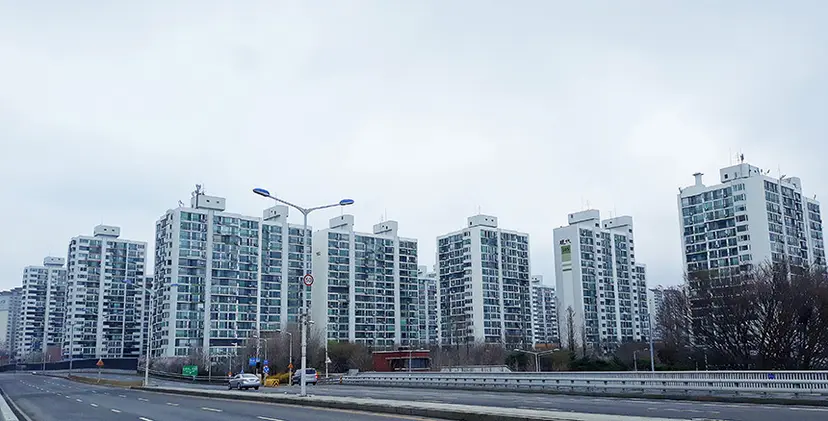
The core value of Gwangjin-gu lies in the full-scale implementation of large-scale redevelopment and reconstruction projects. The scale and ripple effects of the currently ongoing projects are nothing short of revolutionary.
The Housing Improvement Redevelopment Project in Area A of Jayang 4-dong is the highlight of Gwangjin-gu's development plans. A mega-complex spanning 139,130㎡, reaching up to 49 stories and containing 2,999 households, will be built. Often nicknamed "Seongsu District 5," it is expected to create synergy with developments in Seongsu-dong. As a region densely packed with aging buildings transforms into a large-scale complex with Han River views, the ripple effect on surrounding property values will be beyond imagination.
Gwangjin-gu is actively utilizing the Seoul Metropolitan Government's "Rapid Integrated Planning" system to pursue simultaneous development across five districts. The Sinhyang Villa reconstruction project in Junggok 4-dong will increase from the existing 7-story limit to 20 stories, expanding the complex to 339 households. This is the first case where the "Type 2, 7-story regulatory relief policy" has been applied, and it will serve as a model for similar future projects.
Geukdong Apartment Complex 1, considered a landmark-level reconstruction project in Gwangjin-gu, is a prime beneficiary of its Han River frontage. The 1980s-era buildings will be reconstructed into a complex of up to 49 stories and 2,043 households, with a floor area ratio of 333% applied. It holds significant symbolic meaning as the first apartment complex along the Han River in Seoul to pass safety inspections following the Ministry of Land, Infrastructure and Transport's changes to diagnostic standards.
The second point to note is that Gwangjin-gu is the last opportunity for the "Han River Belt." With Han River waterfronts in Seongdong-gu and Mapo-gu already entering high-price territory, Gwangjin-gu stands as the final bastion where one can secure a view of the Han River at a relatively reasonable price.
The emergence of Posec Han River, which opened the era of 100 million won per pyeong in 2024, has set a new benchmark for the Gwangjin-gu real estate market. Despite shocking prices—with an 84㎡ unit priced at 4.4 billion won and a 244㎡ unit reaching as high as 16 billion won—the actual premium is being proven as residents begin moving in. This is a clear example of the potential value of Han River-front real estate in Gwangjin-gu.
It is also worth noting that the Gwangnaru Hyundai complex near Posec Han River is being remodeled by Samsung C&T028260 into "Raemian Lucir Hangang." The complex will expand from the existing 380 households to 437, reborn as a development spanning 6 underground levels to 29 above-ground floors. With a construction cost of 270.8 billion won, this project is situated in a prime location just a 5-minute walk from Gwangnaru Station and within the core Gwangjang-dong school district, so it is expected to have a significant impact on local prices.
The Han River waterfront in Gwangjin-gu is one of the few areas where permanent views are guaranteed. As complexes along the river, such as Gwangjang Hyundai Complex 5 and Geukdong Complex 2, consecutively break the 2-billion-won mark, the "Han River view premium" is becoming a tangible reality. In particular, if future reconstructions result in even taller buildings, the value of these views will rise exponentially.
The third key element is the modernization project of the Dong Seoul Terminal. This project, which transforms a 38-year-old aging terminal into a wide-area transportation hub with 7 underground levels and 39 above-ground floors, is a "mega-event" that will change the future of Gwangjin-gu.
The Dong Seoul Terminal modernization project, pushed by Shinsegae Property, has a total project cost of 1.879 trillion won. It will feature a passenger terminal underground and commercial, office, and cultural facilities above ground, with a target completion date of 2031. This is not just a terminal improvement, but a landmark project that will elevate the status of the entire Gwangjin-gu area.
With public contributions alone totaling 138.1 billion won, the project will include the creation of Guui Park, a direct ramp to the Riverside North Road, and community sports facilities. By resolving existing problems regarding noise, exhaust fumes, and traffic volume, the modernization of the terminal will dramatically improve the value of surrounding real estate.
The fourth strength of Gwangjin-gu is its excellent school district and living infrastructure. These are core factors that underpin long-term residential value.
Gwangjang-dong is evaluated as one of the four major school districts in Seoul. It is adjacent to prestigious schools like Gwangnam Elementary, Middle, and High Schools, as well as Yangjin Elementary and Middle Schools and Daewon International Middle School. In particular, the Gwangjang-dong academy district is concentrated within a 5-minute walking distance, offering outstanding educational conditions.
The school district premium is also reflected in actual transaction prices. Gwangjang Hillstate, which benefits from both Han River views and an elite school district, saw an 84㎡ unit trade at 2.2 billion won, setting a new record. Geukdong Complex 1 is also seeing 84㎡ units trade at 2.13 billion won as demand for the school district flocks in alongside the confirmed reconstruction.
Gwangjin-gu features complete living infrastructure, including the Konkuk University Station commercial district, Lotte Department Store, and Konkuk University Medical Center. In particular, the extension of bus route 2227 has greatly improved accessibility to the district office, Gwangjin Culture & Arts Center, and the Gwangjin Youth Center. This is a key factor that increases the value of actual residence.
The fifth point to note is the spread of small-scale maintenance projects such as "Moa Town." This system, which efficiently develops areas where large-scale redevelopment is difficult, is lifting the residential environment of all of Gwangjin-gu to the next level.
The Jayang 2-dong Moa Town District B will be built as a large complex of 2,448 households on a 95,352㎡ site. Developed to reach up to 40 stories, it is expected that some households will be able to secure Han River views. As 395 dilapidated houses transform into a modern apartment complex, the residential environment of the surrounding area will improve drastically.
Along with the rezoning from Type 2 to Type 3 general residential areas, surrounding roads will also be expanded to a maximum of 14 meters. This is a comprehensive approach that goes beyond simple housing supply to upgrade the urban infrastructure of the entire region.
Gwangjin-gu apartment prices rose by 4.4% in the first half of 2025, recording the highest growth rate in Seoul. According to statistics from the Korea Real Estate Board, Gwangjin-gu saw a 0.14% increase in the first week of September, the second-highest rate following Seongdong-gu (0.20%). This is not a temporary phenomenon, but the beginning of a structural change.
The Gwangjin-gu real estate market is no longer an "undervalued investment destination." It is firmly establishing itself as a new growth axis for Seoul and a premium residential belt. Four key driving forces—innovation in transportation infrastructure, mega-redevelopment projects, the Han River belt premium, and the development of the Dong Seoul Terminal—are working simultaneously to create synergy.
It is important to note that these changes represent a structural transition, not a temporary phenomenon. After 2030, when the large-scale redevelopments and the modernization of the Dong Seoul Terminal are completed, Gwangjin-gu will have an entirely different appearance.
As of 2025, we are at the beginning of these changes. With not all positive news yet fully reflected in prices, preemptive investment opportunities remain. However, these opportunities will diminish as time goes on. Just as the "crazy" presale price of Posec Han River is now considered a "fair price," the current Gwangjin-gu real estate prices may be a point in time that we will look back on in a few years and say, "That was the opportunity."
A new paradigm for Seoul real estate is beginning. And Gwangjin-gu is at the center of it. Now, the choice is yours.
Kim Hak-ryul, the director of the Smart Tube Real Estate Research Institute, famous by the pen name "Pashong," previously served as the team leader of the Real Estate Research Division at Gallup Korea. He manages and hosts the Naver blog "Pashong's World Tour" and the YouTube channel "Stue TV." He is the author of books including "The Power of Gyeonggi-do Real Estate (2024)," "The Absolute Principles of Seoul Real Estate (2023)," "The Future of Incheon Real Estate (2022)," "Kim Hak-ryul's Absolute Principles of Real Estate Investment (2022)," "The Future Map of South Korea Real Estate (2021)," "From Now On, Only Places That Will Rise Will Rise (2020)," and "South Korea Real Estate User Manual (2020)."