

[비즈한국] The government's 2025 tax reform bill has been submitted to the National Assembly. This revision is the first tax overhaul announced by the Lee Jae-myung administration, structured around three main goals: supporting the leap toward an economic powerhouse, inclusive tax policies to stabilize public livelihoods, and expanding the revenue base while rationalizing the tax system. The government anticipates that these reforms will generate over 8 trillion won in additional tax revenue compared to the previous year. The bill includes a provision to double the education tax rate for financial and insurance companies with revenue exceeding 1 trillion won, drawing strong pushback from the industry. There are also growing concerns that financial firms will pass the tax burden on to consumers.
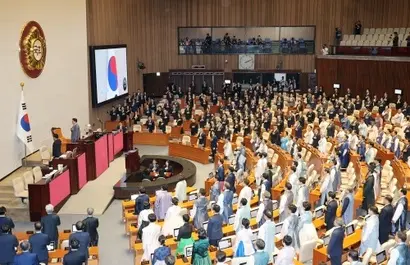
On the 3rd, the Lee Jae-myung administration’s first tax reform plan was submitted to the regular session of the National Assembly. The government announced the ‘2025 Tax Reform Plan’ on July 31 and finalized it at a cabinet meeting on August 26. This reform package includes 13 related laws (Framework Act on National Taxes, National Tax Collection Act, Restriction of Special Taxation Act, Income Tax Act, Corporate Tax Act, Education Tax Act, Customs Act, etc.). Once the bill passes deliberation and voting in the National Assembly and is passed by the plenary session, it will be promulgated following a cabinet meeting.
The Lee Jae-myung administration expects to collect an additional 8.1672 trillion won in tax revenue through these revisions. The areas with the largest tax revenue effects are corporate tax (4.5815 trillion won) and securities transaction tax (2.3345 trillion won). The corporate tax rate has been changed to pre-2022 levels, and the securities transaction tax rate to 2023 levels.
A notable aspect of this revision is the increase in the education tax rate paid by financial and insurance companies. Until now, a 0.5% rate was applied regardless of the amount of revenue, but the revision imposes a 1% rate on revenue exceeding 1 trillion won. Revenue in this context is a concept that includes not only sales but also non-operating income such as dividends. The increased rate will apply to taxable periods starting on or after January 1, 2026.
The education tax was originally introduced in 1981 as a temporary measure to secure funding for education with the goal of normalizing education and resolving issues related to excessive private tutoring; it was converted into a permanent tax in 1991. The financial and insurance industries are exempt from value-added tax, and the previous 1% business tax on financial institutions was replaced by an education tax levied at 0.5% of revenue. Since January 2024, online investment-linked finance companies (P2P firms) have also been included as taxpayers under the Education Tax Act.
According to the National Tax Service, the education tax collected from financial and insurance companies over the past five years has exceeded 1 trillion won. In 2023, it recorded 1.7504 trillion won. Following the tax reform, this figure is expected to easily exceed 2 trillion won. While the education tax does not account for a large portion of total national tax revenue, financial and insurance companies contribute over 20% of the education tax collected.
However, the first rate hike in 45 years has triggered debate. Financial firms that will have to pay double the tax on revenue exceeding 1 trillion won are pushing back, calling it a "tax bomb." During the public comment period prior to the bill's finalization, financial firms reportedly objected citing increased burdens on consumers and worsening profitability. An industry official stated, "I understand that rather than asking for the rate itself to be lowered, the industry suggested adjustments to the tax base or deduction items."
As opposition grew, the Ministry of Economy and Finance explained the purpose of the education tax revision: "There has been no change to the tax system since the introduction of the education tax in 1981. We raised the rate in consideration of the growth rate of the financial and insurance industry. We limited the application to ultra-large financial and insurance companies with revenue exceeding 1 trillion won, taking into account their capacity to bear the burden." According to the ministry, the domestic gross value added of the financial and insurance industry grew significantly from 1.8 trillion won in 1981 to 138.5 trillion won in 2023. Approximately 60 ultra-large financial and insurance companies will be subject to the increased rate after the revision of the Education Tax Act.

Above all, there is persistent concern that the tax burden will be passed on to consumers. Financial companies may raise loan interest rates to shift the burden of the tax hike onto customers. When calculating loan interest rates, banks add a reference rate and a spread; they currently include the education tax as a legal cost component in the spread. In fact, the Board of Audit and Inspection pointed out after a regular audit of the Financial Supervisory Service in 2023 that "it is an unreasonable structure for consumers that banks include legal costs such as education tax in the spread."
The insurance industry points to the possibility of deteriorating financial soundness and higher insurance premiums. Unlike banks, insurance companies use risk premiums as the tax base; as insurance revenue accumulates, the tax burden increases, which could lead to premium hikes. An insurance industry official said, "If the increase in education tax leads to an increase in insurance liabilities, soundness could deteriorate," adding, "A decline in soundness indicators could indirectly affect insurance premiums."
Because of this, the Ministry of Economy and Finance is considering ways to lower the loan interest burden through the Enforcement Decree of the Education Tax Act. The current Education Tax Act specifies exclusions from the tax base such as: △ items subject to VAT, △ internal/temporary income, and △ income from overseas business sites. The ministry has submitted a draft amendment to the enforcement decree to add 'interest income generated from loans for common people' to this list.
However, the exclusions are limited to "loans for common people," focusing on easing the interest burden on vulnerable groups. There were predictions that the tax base might be relaxed by excluding items like securities trading profits or dividends received from subsidiaries, but these were not included in the announced plan.
A ministry official stated, "We are in the stage of reviewing specifically which items should be reflected in the tax base exclusions. Since there have been suggestions from the industry regarding securities gains, dividends, etc., we will evaluate their appropriateness," adding, "Normally, enforcement decree revisions are carried out at the end or beginning of the year following the revision of the law."
Meanwhile, as an increased burden on consumers is foreseen, there are calls for the legislation to clearly specify the taxable entity. Kim Deuk-ui, representative of Financial Justice Solidarity, emphasized, "Since the education tax is included in loan interest rates, an increased tax burden is essentially the same as rising loan interest rates. It is a principle that taxes should be borne by the beneficiary. The bill should clearly state who pays how much more."