

[비즈한국] On the afternoon of the 3rd, as the heatwave began to subside, international tourists and citizens visiting Gwanghwamun Square were captivated by a massive new screen installed on the exterior wall of the adjacent KT030200 building. On the two digital advertising billboards wrapping around the building in an 'L' shape, promotional videos for a luxury global brand featuring Rosé of the group BLACKPINK and brand signature advertisements were playing simultaneously. As the screen switched to an ad for the new Disney+ series 'Polar Star,' with the main poster and teaser video playing on each screen respectively, the entire building was transformed into a singular media space.
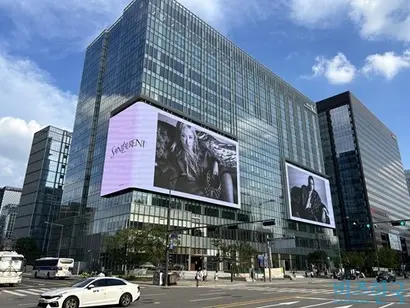
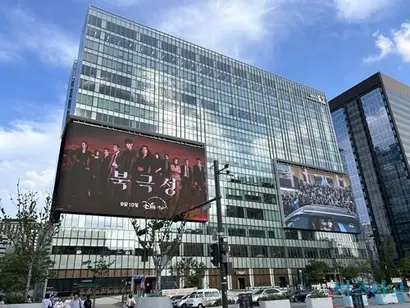
These advertising billboards are a key pillar of the 'Gwanghwamun Square' project, which aims to create a national representative media space. Following this project, which seeks to establish a media landmark akin to New York's Times Square, large screens and pillar-type advertising facilities will be installed sequentially throughout the area.
Large Billboards Become the Center of Gwanghwamun’s ‘Media Hub’
Two large billboards have been installed on the KT Gwanghwamun West building, which resumed operations last month following remodeling. Each screen measures 47 meters in width and 21 meters in height, totaling 1,977 square meters in area. Currently, advertising videos are being broadcast on both screens, and according to the Ministry of the Interior and Safety, they are undergoing trial operations ahead of the 'K-Festa Gwanghwamun Square' opening ceremony on the 5th.
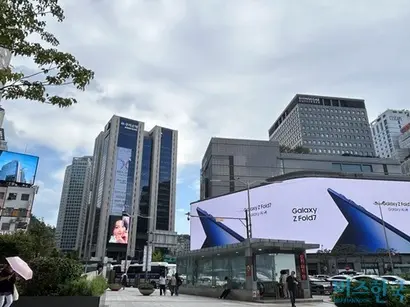
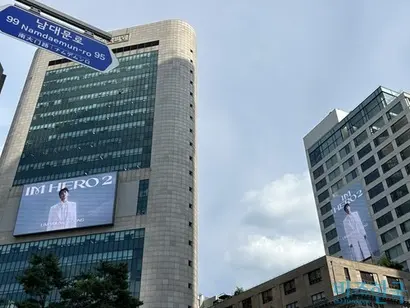
The Myeong-dong Special Tourist Zone in Jung-gu, Seoul, which stretches from Euljiro 1-ga Station on Subway Line 2 to Lotte Department Store and Shinsegae Department Store, is also transforming into 'Myeong-dong Square,' packed with advertisements of various sizes. In the case of Myeong-dong Square, there are plans to prioritize the installation of advertisements by the end of this year at four major hubs, including Hana Bank, Young Plaza, Myeongdong Nanta Theater, and Shinsegae Department Store, as well as the surrounding inner roads of Myeongdong-gil. The large billboard operating on the exterior wall of the Shinsegae Department Store main branch since last November is already considered a major photo spot in Myeong-dong. It is also drawing attention for its '3D anamorphic' technique, which provides three-dimensional imagery through optical illusions.
This project is being promoted as part of the second phase of the 'Free Indication Zone' project designated by the Ministry of the Interior and Safety. In addition to Gwanghwamun and Myeong-dong in Seoul, the Haeundae-gu Jung-dong area of Busan has also been included as a second-phase zone. In a Free Indication Zone—a top-tier area for outdoor advertising deregulation—standards different from general outdoor advertising regulations are applied. Restrictions on size, shape, and installation location are eased, and various advanced advertising techniques such as LED and holograms can be utilized. Deliberation procedures are also simplified.
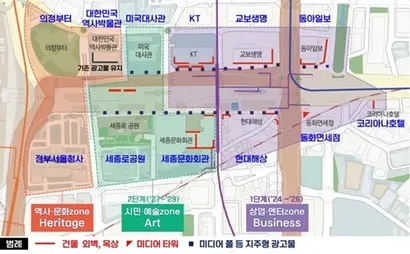
Jongno-gu, Seoul, has a vision of establishing Gwanghwamun Square as a media hub representing downtown Seoul. The Gwanghwamun Square project involves installing advanced advertising media and media poles (pillar-type advertising facilities) on a total of nine buildings across 221,815 square meters of the Gwanghwamun Square and Sejong-daero area, running from January of last year through 2033. In addition to the KT building, other target buildings include the Kyobo Life Insurance building, the Dong-A Ilbo headquarters, the Ilmin Museum of Art, and the Koreana Hotel.
An official from the Ministry of the Interior and Safety stated, "The primary purpose of designating Free Indication Zones is to revitalize the local economy and create landmarks," adding, "Through digital outdoor advertising, we expect to expand the domestic advertising market, attract foreign advertisers, and enhance promotion effects for foreign tourists."
Focusing on ‘Coexistence’ with SMEs and ‘Public Ad Quotas’
A common thread among the second-phase zones is that they are located in symbolic spaces with high foot traffic and tourism demand, making advertising highly effective. In the case of the Samseong-dong Trade Center area in Gangnam-gu, Seoul, which was a first-phase Free Indication Zone, while there were quantitative gains in advertising revenue, critics pointed out that the diversity of the composition and the true purpose of the Free Indication Zone were not fully realized due to the nature of the commercial district. A representative from the small and medium-sized advertising industry noted, "Given the nature of COEX and the roadside area, the commercial district itself is not an environment conducive to incorporating diverse signage culture. While large billboards on major blocks remained, the role of injecting vitality into the city and the commercial area was disappointing."
It is true that large-scale outdoor advertising projects within Free Indication Zones are often too daunting for small and medium-sized advertising companies to handle in terms of scale. According to the industry, these ultra-large projects can cost anywhere from billions to tens of billions of won, making it difficult to find SMEs in the domestic outdoor advertising industry capable of covering the installation costs. For smaller companies, both experience and capital are lacking, making entry realistically impossible unless they form a consortium.
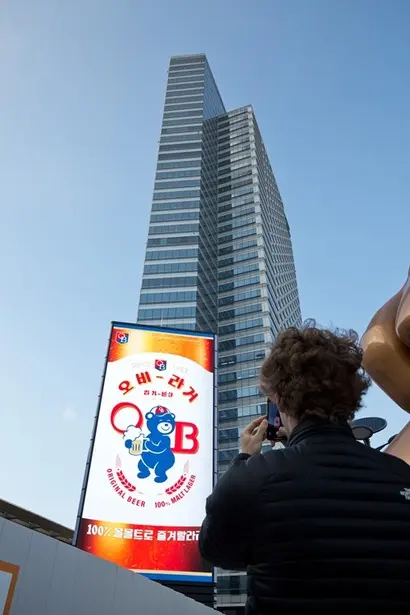
As this aspect did not align with the original intent of the Free Indication Zone system to promote the advertising industry, the second phase has set conditions to promote small-scale advertising media projects like media walls and to factor the participation of SMEs into the evaluation process. A Ministry of the Interior and Safety official stated, "We judged that 'coexistence,' such as SME participation, is important for growing the digital advertising market. In the second phase, we have included this as a review requirement and are evaluating whether it is being properly implemented."
Attention is also focused on how this plan, which will extensively transform the landscapes of major attractions in Seoul and Busan by 2033, will drive economic effects. Depending on the location, outdoor advertisements generate road occupancy fees and installation permit fees when advertisers sign contracts with local governments or building owners. For instance, installing media poles on roads allows local governments to collect road occupancy fees as revenue. According to the Korea Outdoor Advertising Center at the Korea Local Finance Association, 13 special cases, such as the relaxation of advertising display regulations, have been applied in the five years since the first-phase Free Indication Zone designation (2018), resulting in 157.7 billion won in advertising revenue.
However, the Free Indication Zone system focuses more on indirect economic effects rather than direct fiscal revenue generated from the permitting, installation, and operation of advertisements. Global advertising hubs like New York's Times Square, Osaka's Dotonbori, and London's Piccadilly Circus function as complex spaces where tourism and culture blend, going beyond mere billboards.
Cheon Yong-seok, a senior researcher at the Korea Outdoor Advertising Center, explained, "Free Indication Zones are effectively promoted as private-led projects. Along with the promotion of the advertising industry, the creation of landscapes and landmarks emerges as an effect," adding, "Free Indication Zones can contribute to increasing local government tax revenue and expanding the local economic base by leading to the attraction of foreign advertising, the revitalization of commercial districts centered on landmarks, and the hosting of festivals and cultural events."
Public service advertisements are frequently broadcast on outdoor billboards in the Euljiro area. Public interest is also a key factor reflected in deliberations. According to the Ministry of the Interior and Safety, large billboards of 30 square meters or more must broadcast public service advertisements at a rate of 20% according to relevant laws. While details such as the unit price and operation method of public service ads are decided by a public-private joint steering committee, the quantitative ratio of public service ads is a crucial element confirmed during the review and evaluation process.
A Ministry of the Interior and Safety official mentioned, "We are also conceptualizing participatory advertising cases where tourists and citizens can communicate and enjoy directly. Experiential advertising linked to the site will be a differentiating factor," and added, "If a Free Indication Zone is operated in a way that does not meet its original intent, designation can be revoked through annual evaluations."