

[비즈한국] It has been revealed for the first time that 'HyCore,' a hypersonic vehicle developed in secret, has already successfully completed its flight test and verification. HyCore exceeded its development goal of "maintaining combustion for more than 5 seconds at Mach 5" by achieving a top speed of Mach 6. Based on this achievement, HyCore has been nominated for the "Top 10 Technologies of the Year in South Korea," hosted by the Korean Society of Mechanical Engineers (KSME).
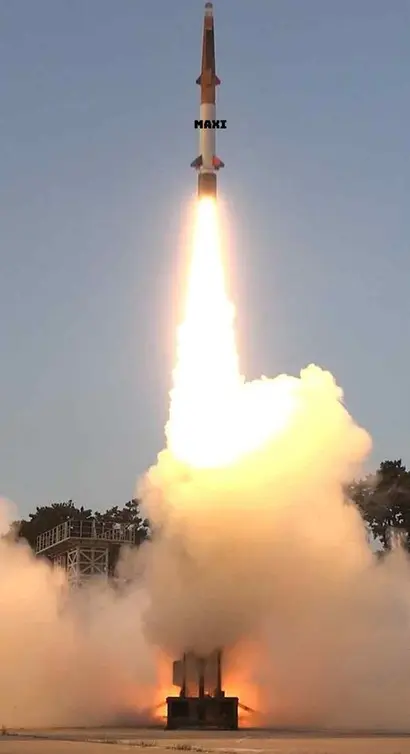
The HyCore vehicle, researched from October 2018 to June 2024, was a research project aimed at developing core technologies for a "multi-mode flight vehicle." In terms of aircraft or missile speeds based on the speed of sound ("Mach 1"), passenger planes and cruise missiles are considered subsonic (less than Mach 1), while fighter jets are generally capable of supersonic flight between Mach 1.6 and 2.5.
HyCore is called a "multi-mode flight vehicle" because it can perform both supersonic flight (Mach 3 or higher) and hypersonic flight (Mach 5 or higher), moving beyond subsonic speeds. A ramjet engine is required for the vehicle's jet engine to fly at Mach 3 or faster, and a scramjet engine is necessary for Mach 5 or faster; HyCore is equipped with a dual-mode ramjet function that allows the engine to transition from a ramjet to a scramjet as speed increases.
According to reports submitted to the KSME, to implement this technology, HyCore successfully realized integrated design technology for high-speed vehicles, structural technology for high-speed vehicles, fuel supply technology for high-speed flight tests, integrated performance diagnostic technology, and supersonic combustor technology for flight testing.
Through this, HyCore achieved a peak altitude of 23km and a top speed of Mach 6 during test launches, exceeding its initial goals of a 20km peak altitude and Mach 5. Mach 6 is a speed that covers 2.04km per second or 7,344km per hour; if HyCore were capable of flying for one hour, it could travel from Seoul to Kyiv, Ukraine, in just one hour.
Following the successful launch tests, the Agency for Defense Development (ADD) and partner companies like Hyundai Rotem064350 have registered 3 domestic patents, 1 software registration, and 5 academic papers, along with 43 research and development reports and 47 technical data filings.
Another significant feature of HyCore is that it is a test vehicle nearing weaponization, utilizing a proven weapons system. While countries like Japan, Australia, and India completed hypersonic test vehicles like HyCore before South Korea, South Korea’s HyCore utilizes the KTSSM tactical ballistic missile and space launch vehicle boosters, and is launched using a canister for guided weapons rather than a launch pad for space vehicles.
HyCore has effectively secured the necessary design and engine base technologies. Remaining tasks include completing the dual-mode ramjet technology by next spring, and securing key technologies required for hypersonic missile development, such as variable air intakes, by November 2028.
Weapons that could potentially be created using HyCore technology include hypersonic air-to-surface missiles launched from the KF-21 and hypersonic unmanned aerial vehicles, but a hypersonic anti-ship missile is considered the most likely candidate for initial development. Support work is currently underway to have this reflected in the Navy's requirements. Once a hypersonic anti-ship missile based on HyCore is completed, it is expected to become a powerful "Anti-access/Area Denial" (A2/AD) weapon capable of preventing Aegis-class destroyers with missile defense (MD) capabilities or aircraft carriers from approaching the Korean Peninsula.