

[비즈한국] GemVax & Kael082270 (GemVax) has announced a large-scale fundraising plan to accelerate the development of treatments for Progressive Supranuclear Palsy (PSP) and Alzheimer's disease. The goal is to fully commit to the remaining Phase 3 clinical trials without funding issues, as global Phase 2 trials are nearing completion and the fruition of new drug development is on the horizon. However, critics argue that the company is passing the financial burden of drug development onto retail shareholders.
The GemVax board of directors resolved on the 29th of last month to conduct a rights offering through a general public offering of unsubscribed shares following shareholder allocation. The total scale is 248.57 billion won, the largest fundraising amount since its KOSDAQ listing on June 24, 2005.
Since its listing, GemVax has raised funds several times to secure research and development costs and operating capital for its only drug candidate, GV1001. It is estimated that approximately 321.8 billion won has been raised since listing through rights offerings, convertible bonds (CB), and bonds with warrants (BW). While this shareholder-allocated rights offering raises capital directly from shareholders, third-party allocations, CBs, and BWs dilute existing shareholders' equity through stock conversion or the exercise of warrants, meaning the burden of fundraising is essentially shared with the shareholders.
Because of this, the company seems to be losing the trust of its shareholders. Some shareholders are criticizing GemVax for asking for help to secure massive funds, pointing out that there have been no tangible results for their sole drug candidate in the 30 years since development began. GV1001 is a cancer drug candidate originally developed by the Norwegian Radium Hospital (now Oslo University Hospital, Rikshospitalet) starting in 1989, and was developed into various anti-cancer agents by the Norwegian biotech firm GemVax AS, established in October 2001. Later, in 2008, Chairman Kim Sang-jae of Kael acquired GemVax AS for approximately 10 million dollars (11 billion won at the exchange rate at the time), securing the development and patent rights for GV1001.
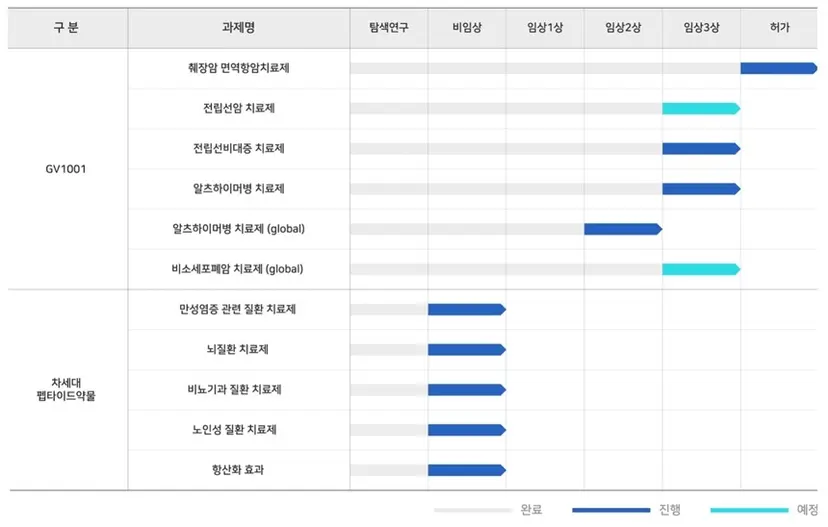
Although GV1001 has been under research and development at GemVax for nearly 20 years, it remains in the clinical development stage, with the exception of one instance where it received conditional approval as a pancreatic cancer treatment. Based on the results of Phase 2 clinical trials in 2014, it received conditional approval from the Ministry of Food and Drug Safety as a pancreatic cancer treatment named "RiaVax," but the approval was revoked in August 2020 after the company failed to submit Phase 3 clinical trial results.
GemVax is currently reviewing the domestic new drug application and commercialization of GV1001 as a pancreatic cancer treatment through its affiliate, Samsung Pharmaceutical001360, and has also explored its potential as a prostate cancer treatment. However, the company is currently focusing more on PSP and Alzheimer's disease indications than on pancreatic cancer. Of the funds raised through this rights offering, 163.6 billion won is planned to be used for global Phase 3 clinical trials for PSP (93.4 billion won) and Alzheimer's disease (70.2 billion won).
Furthermore, shareholder dissatisfaction is growing as it has been reported that the largest shareholder and specially related persons will not participate in their full allocation. In a securities filing, GemVax stated that its largest shareholder, Gem & Company, along with GLK Equity Invest and Samsung Pharmaceutical, plan to subscribe to only 766,868 shares—approximately 46.8% of their allocated 1,637,241 shares. GemVax explains that if they participate only as planned, the stake held by the largest shareholder and specially related parties will decrease from the current 26.67% to 23.02%.
Some shareholders have reacted sharply, saying things like, "If founder and advisor Kim Sang-jae, the board, and the employees say they are buying it all, then I will buy it too," and "Setting aside success or failure, I am now even questioning if that substance is truly valuable enough to justify the large amount of money spent to buy it from Norway." On the other hand, many shareholders support GemVax's commitment to drug development, noting that there are currently no treatments for the rare disease PSP and no effective treatments for Alzheimer's disease.
A GemVax official stated, "The number of shares for rights offering participation stated in the securities filing is merely a plan, and actual subscription quantities may change," adding, "The final subscription quantities for each company will be decided through internal investment deliberation and board resolutions." GemVax plans to hold an investor relations (IR) meeting on the 22nd to explain the business progress and the background of the rights offering.