

[비즈한국] The group Stray Kids has topped the Billboard main album chart, the 'Billboard 200', for the seventh consecutive time with their new album, 'KARMA'. This achievement is even more significant as it marks an unprecedented record in Billboard history, starting from their sixth consecutive number one.
Stray Kids is a group that possesses the quintessential "K-pop" identity while simultaneously transcending its limitations. Their ability to deliver the dynamic, knife-like choreography of K-pop while demonstrating perfect musical fusion stems from the fact that they have moved beyond the mold of traditional, agency-produced idols. Stray Kids are well-known for writing, composing, and producing their own music while navigating various genres, making them both artist-idols and project-idols. Consequently, their song lyrics are incredibly unique, and the more one mulls over the content, the more one can feel the wit, meaning, and even cultural value. This lyrical wordplay can serve as a vital foundation for building a dedicated fanbase.
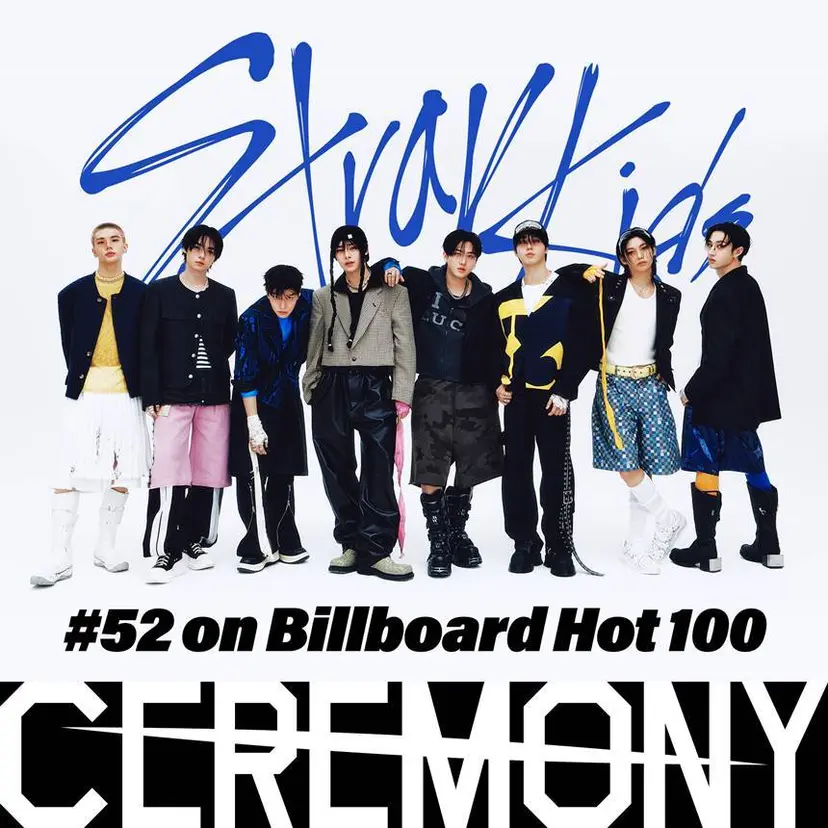
There are several types of wordplay they employ. First, we can consider double meanings. '3RACHA' is the name of a unit composed of Bang Chan, Changbin, and Han, and there is also a song with the same title. In the lyrics "We lead everything we say, 3RACHA," the word "mal" (말) can be interpreted in two ways: as "speech" (spoken words) and as a "horse" (the animal). It conveys the meaning that the words we share can become the "horses" that lead us forward. In 'Charmer', the lyrics "A '99-liner celeb, sticking to me like a leech, even the pigeons on the street follow me, cooing (gu-gu)" appear. This implies that their charm is strong enough to make pigeons, which coo ("gu-gu" in Korean), follow them, while also referencing their birth year, 1999 ("gu-gu").
'Winter Falls' contains the lyric, "The snow falls, we fall apart," which carries a double meaning of falling downward and a relationship drifting apart. In "I wonder if I miss 'then', or if I miss 'you' (geu-dae)," they playfully utilize the similar pronunciation of 'geu-ttae' (then) and 'geu-dae' (you). In 'ROCK', the lyrics "How about returning to the time before one's first birthday (dol), or dreaming of becoming a rock (dol)?" utilize the dual meaning of 'dol' (the Korean first-birthday celebration) and 'dol' (stone/rock). In 'Silent Cry', the lyrics "The anger inside the kettle boils up, drawing me into the anger, I wish that anger was a flower, not a sea of fire" contrast anger with flowers in terms of emotion. By using opposing nouns in parallel, they express a desire to sublimate anger. 'ALL IN (Korean Ver.)' features the line, "I have to remain until the end, most of them fly (flee)," which carries both the meaning of receiving attention and the act of running away.
In 'God's Menu', they use the hanja "神" (God) instead of "新" (New), incorporating three meanings: a new menu, a god-like menu, and a spicy menu (referencing the hanja '辛' for spicy). It even encapsulates their musical identity as "Mala-flavored K-POP." "This is our tang tang tang-tang" includes both the Korean 'tang' (stew) and the 'tang' (sound of gunfire). At the timing of shouting "DU DU DU," the sound of a gunshot is heard. In 'TA', the lyrics "Ride it, burn it, ride it, burn it" repeatedly use "ta," but cleverly employ the homonyms 'ollata' (ride) and 'taolla' (burn). The line "There’s no way it’s a mess, there’s no way it’s a commotion" is similar, as 'nalli' (mess/commotion), 'nal ri' (a way to happen), and 'hal ri' (a way to do) have similar pronunciations but distinct meanings.
Next, there is wordplay that simply uses sound. In 'Hellevator', the lyrics "Moving away from the classroom hallway (bokdo), I've got no luck (bok) on this strange road" connect the situation and the space by consecutively using the words 'bokdo' and 'bok'. 'Give Me Your TMI' features the lyrics "Ding-dong-daeng or ttang, ding-dong-daeng or ttang-ttang-ttang, my head is tting, the surroundings spin, spinning round and round, bang-bang-bang." These use similar sounds like daeng, ttang, bang, tting, and ping without specific meanings or context, but offer an enjoyable play on words. The song 'S-Class' (Teuk) revolves around the word 'Teuk' (Special). Lyrics like "I step big with hip-hop steps, being exceptional is my specialty (teuk-gi), I come and go like it's my own home, I'm not jealous of a special feature (teuk-jip), my studio is crowded with special rooms (teuk-sil), unique characteristics (teuk-jing)" express their thoughts using similar sounds like 'teuk' and 'deuk'. In 'Muddy Water', they use "Stagnant water (go-in-mul), go away, goin' water," utilizing the similar pronunciation of 'go-in' and 'goin' (as in going), showing a unique wordplay combining Korean and English.
'Spider Web' features "Spider web" (geomi-jul) and "Got me, got me, got me," connecting the pronunciation of 'geomi' (spider) and 'Got me' (gat-mi). In 'GO LIVE', the line "I know, you know, we know, Lee Know" involves member Lee Know himself, adding a touch of humor. "Actually, even if our hearts are rushed, if it's not an urgent (da-geup) matter, you know I’m just lazy, so just go slowly" connects 'da geup-haedo' (even if we are rushed) and 'da-geup-han' (urgent).
Cases of expanding into other meanings can also be seen. In 'Grrr', 'Grrr' is the growling sound of a beast, but it can also be a slang term. It is a form of resistance against adults who interfere with their lives with useless talk. In 'Mixtape: Gone Days', 'Gone Days' targets the term 'kkondae' (condescending elder). They even pronounce it as 'kkondae' when performing. The English title of 'Grow Up' is 'Jal hago isseo' (You're doing well), which sounds like 'Jarago isseo' (You are growing), aligning with the K-pop narrative where growth is important. In 'Mirror', the lyrics "I am a maze (miro) reflected in the mirror (mirror)" use the similar sounds of mirror and maze to convey a sense of complex confusion. In 'Get Cool', the song title implies 'gae-kkul' (awesome/jackpot in slang). The pronunciation in the song is also 'gae-kkul'. What’s important is that it expresses finding happiness in trivial, everyday things. "So-so but a lucky day" connects 'So-so' (just okay) with 'so-so-han' (small/trivial).
Wordplay via compound words is also noteworthy. The song title 'Hellevator' is a combination of 'Hell' and 'Elevator'. They compare their debut process to an elevator and hell. It feels relatable to honestly reveal that while they are ascending to debut on stage, the process itself is hell—or a very difficult stage. Many critics evaluated that the song title 'Christmas EveL' combines 'Christmas Eve' and 'Evil', bringing the movie 'The Nightmare Before Christmas' to mind. In 'GO LIVE', the lyrics "I don't want to go fast, I just want to play, play like Nolbu, I don't want to go fast, I just want to play, I want to become a joy-bringer (heung-buja), play" naturally bring 'Heungbu' to mind because of 'Nolbu'. In 'SSICK', the English lyrics "I’m so sick, Me so sick" employ a pun combining 'miso' (smile), 'Me so' (I am so), the slang 'sick' (dope), and the ideophone 'ssik' (describing a smile).
There is also wordplay borrowed from traditional music lyrics. This makes one think about Stray Kids' identity, as they strive to incorporate Korean into English while refusing to let go of traditional aspects. In 'Easy', the lyrics "Carry me and play, eat and play, carry me and play, play secretly from mom, let's flip everything and play" are taken from the 'Sarang-ga' (Love Song) of the pansori 'Chunhyang-ga': "Come here, let me carry you and play." Seeing Felix ride a hand-palanquin in the choreography shows its origins in the pansori 'Chunhyang-ga'.
There is also wordplay directed at anti-fans, using storytelling techniques. For example, in 'Thunderous', the lyrics "Woodcutter, please go back, there is nothing to criticize (namural-dega) here" use a pun: since there is no wood to cut (namural-dega eopdaneun, which also means "nothing to scold"), the woodcutter should leave. It is essentially a warning to those who nitpick their music.
Lyrics that incorporate oral children's songs and childhood games also exist. In 'Ttang', the lyrics "Freeze tag (eol-eum-ttang), freeze tag, eat breakfast and ttang, eat lunch and ttang, eat dinner and ttang" combine the children's game 'Eoreum-ttang' and the lyrics of the oral folk song 'Skull'. The line "Hands above your head (hands up), feel the liberation (da turn up), run away before the tagger comes, freeze tag, freeze tag" creatively digests their own emotions and meanings beyond just oral songs. 'Mixtape #5' applies the 'Barley Rice' game played in childhood with the line, "It's fine if it's cold outside the blanket, it can be chilly (ssal-ssal), would you maintain the optimal temperature for sleeping?"
Beyond just lyrics, they now use wordplay even for album titles. 'GO LIVE' (GO-SAENG in Korean) means 'hardship' (gosaeng), but also 'Live your life' or 'Go live' (being lively). From this point on, there is a view that they started to commit to wordplay even in album titles. '合 (HOP)' is an album name that is a pun, combining the 'hop' of hip-hop and the hanja '合' (hap, meaning to combine). It also means to 'hop' (leap forward). In other words, all three meanings are contained in the album name. 'MAXIDENT' combines 'Maximum' and 'Accident'/'Incident', referring to a major event or incident that occurred unexpectedly. The pronunciation of the album title 'ATE' is similar to the number 8 (Eight), and in English slang, 'ate' also serves as a compliment meaning "did great/slayed." '樂-STAR' can be thought of as 'Rockstar', with the same pronunciation as 'rak' (joy/music). 'ODDINARY' combines 'Odd' and 'Ordinary'. They are contrasting words, which is why some evaluate it as an oxymoron.
Such wordplay may not resonate immediately. However, after listening to the songs repeatedly, one can realize the meaning, get captivated, and become a core fan. This is one reason why Stray Kids achieves their best results on global album charts. In particular, because they make good use of the Korean language to create wordplay, they contribute to the spread of Korean in their own way. Stray Kids is effectively showing what methods are valid for promoting the Korean language to the world.
The author, Kim Heon-sik, has wandered through and navigated the forest of popular culture phenomena since his 20s, with the expectation that there is a way to make the world better through culture. Even in the 21st century, where artificial intelligence and quantum computers are active, he still follows the same path with the same belief.