

[비즈한국] The Korea AeroSpace Administration (KASA) is developing a 'High-Bypass Turbofan Engine for Electrified Aircraft' (hereinafter referred to as an electrified jet engine). Although this engine is a small-scale model with 4,500 pounds of thrust, it boasts more than three times the power generation capacity of a 16,000-pound class advanced engine, positioning it to be highly competitive in the Collaborative Combat Aircraft (CCA) market. KASA plans to develop this engine for use not only in unmanned combat aircraft but also in civilian business jets.
At the gas turbine symposium ‘GTS2025’ held in Gangneung on August 28, KASA unveiled its ongoing gas turbine (jet engine) research under the theme of ‘Planning for Civil-Military Cooperation in Developing Advanced Engines and Application Systems for a Leap in the New Aviation Industry.’
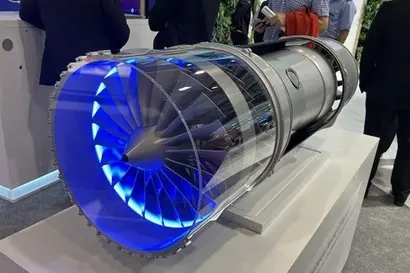
The electrified jet engine unveiled by KASA is a small, long-life turbofan engine with 4,500 pounds of thrust. Until now, South Korea has developed two types of long-life jet engines, the KTF-5500 and KTF-10000, and had planned to develop a 16,000-pound class turbofan engine capable of being mounted on the KF-21 fighter in the future.
At first glance, one might assume the 4,500-pound class jet engine being developed by KASA is a low-output engine with inferior performance compared to the KTF-5500 already under development. However, this engine incorporates technically advanced concepts.
First, it is being developed as a high-bypass ratio engine. A jet engine gains thrust by compressing air with a fan and then combusting it. The flow of air that passes through the fan without being combusted is called 'bypass.' While the KTF-5500 has a bypass ratio of 0.71, KASA’s electrified jet engine has a ratio of over 4. For this reason, while its high-speed performance is slightly lower than that of the KTF-5500, its thrust-to-weight ratio and fuel efficiency are significantly superior.
However, the true value of the electrified jet engine lies, as the name suggests, in its excellent power generation capability. It incorporates a ‘rotor-integrated embedded motor-generator,’ a first for South Korea, which is a technology that connects a generator directly to the jet engine fan. Through this, the electrified jet engine can stably supply 100kW of power. This is a power generation capacity several times greater than even the 16,000-pound class jet engine intended for the KF-21.
Modern military drones carry large-scale electronic equipment and require significant power. In particular, loyal wingman drones known as 'CCA' carry their own independent radars or sensors, but because they are less than half the size of manned fighters, they have been limited by low power output for their electronic equipment and insufficient performance.
However, if the electrified jet engine being developed by KASA is mounted on a CCA, the situation changes. It will be able to supply power on par with a manned fighter, providing the potential to carry not only compact but high-output radar and electronic warfare equipment, but also tactical laser weapons.
KASA plans to invest 47 billion KRW over four years from 2026 to 2029 to complete the basic model of this engine, and from 2029, it plans to pursue certification from the FAA (U.S. Federal Aviation Administration) and the Ministry of Land, Infrastructure and Transport (KAS 33) to allow for its installation on civilian business jets.
Through this, mass production for CCA unmanned fighters is set to begin in 2030, and mass production for civilian business jets in the U.S. and South Korea is scheduled to enter full swing starting in 2033.
Although the mass production manufacturer has not yet been decided, many domestic companies have expressed great interest and indicated their willingness to cooperate. If the expected performance and development schedule are met, the engine is expected to secure strong competitiveness in the CCA unmanned fighter engine market.
The U.S. aerospace publication 'Aviation Week' projected that more than 530 CCAs will be produced worldwide by 2034, with their proportion gradually increasing as they replace manned fighters. Therefore, if this engine development is successful, it is expected that the South Korean aviation engine industry will secure a product that can pioneer new markets beyond engines for the KF-21, paving the way for large-scale exports.