

[비즈한국] The Korea Art Promotion Project, which began as an initiative solely to support artists, has continued for 10 years. Keeping true to our initial intent, we have supported over 230 artists. This was a unique endeavor, never attempted by any media outlet, cultural organization, or state institution in Korea. We take pride in the fact that this decade of persistence has been etched into the 21st-century Korean art scene as a distinct value. For this reason, the 10-year history of the Korea Art Promotion Project is recognized as a vantage point from which to observe the flow of contemporary Korean art. Now, in Season 11, we intend to pave another path for Korean art.
The skill of creating beauty is called "art." To be beautiful generally means that something is pleasant to look at, makes us want to see it again, and consequently, puts us in a good mood.
However, the criteria for defining beauty have shifted according to the era and environment. This is why artists have consistently attempted and strived to find the value of beauty even in things that are not beautiful.
Caravaggio, a painter from the late Renaissance, sought the essence of true beauty through ugly figures. Géricault, regarded as a genius of Romantic Realism, attempted to approach new values of beauty by using corpses or severed animal carcasses as subjects, and the Swiss symbolist painter Böcklin pursued a grotesque beauty in the imagery of death.
German and Nordic Expressionist painters also expanded the concept of beauty through images that are difficult to call beautiful. The Norwegian painter Munch found another face of beauty in things like melancholy, anxiety, and fear, while the German painter Kollwitz found it in the suffering of poverty and hunger.
Meanwhile, Francis Bacon, who led British postmodernism, found it in twisted human figures blended with drugs, homosexuality, and violence, and Damien Hirst, the British contemporary artist who became a star with shocking imagery, presented the face of beauty that this era contemplates through bizarre aesthetics.
What did they want to say through these images that are hard to call beautiful? It must be "truth." They believed that true beauty is the reality surrounding human beings, and that finding and revealing it is the purpose of art.
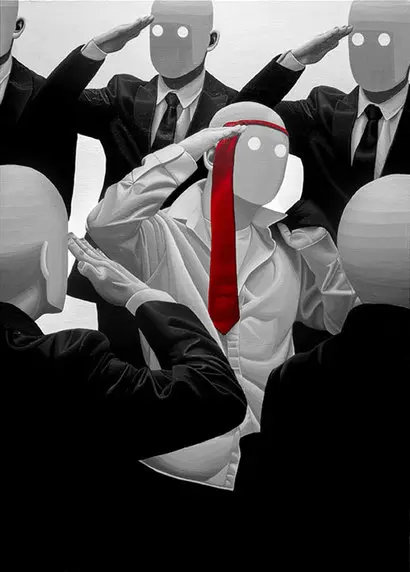
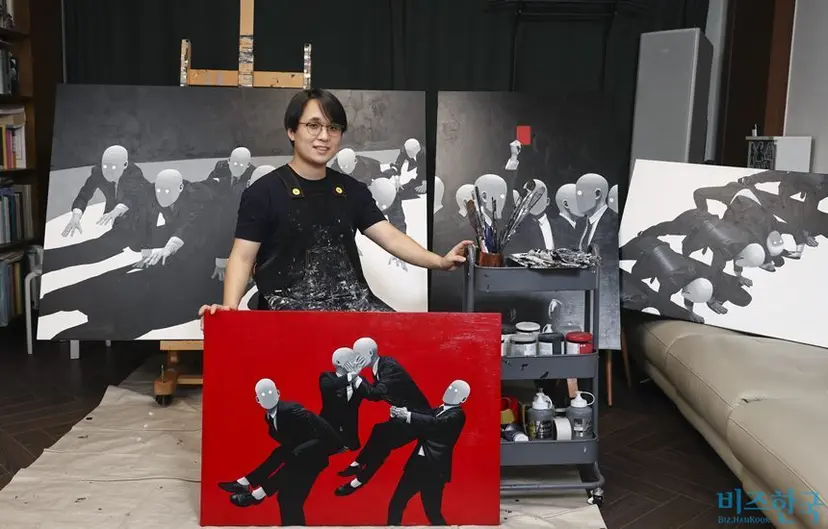
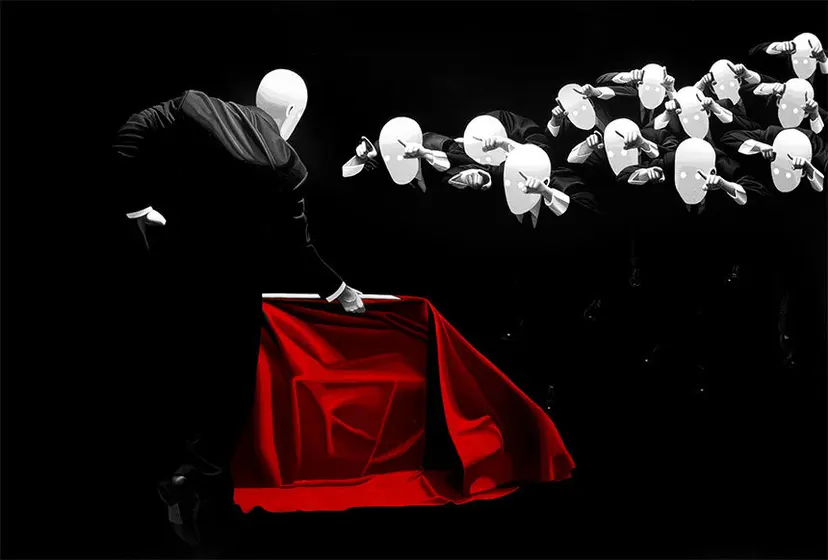
Chae Jung-wan’s paintings should be approached along the same lines as these artists. His work is filled with a dark and gloomy atmosphere. He works primarily in monochromatic tones to reveal his powerful messages. On the other hand, the imagery is highly realistic and clear. Figures in suits, reminiscent of Agent Smith from the movie "The Matrix," show the stories the artist wishes to tell through various actions. Therefore, it is true that one feels uncomfortable when looking at his paintings.
What is the truth that Chae Jung-wan wants to convey through this? He wants to mock the image of power, where groups with immense strength manipulate society according to their own will. The reason his work remains persuasive despite the direct expression of heavy and strong messages is that he directs his scenes using a code of black humor.
In these times where the "unbearable lightness of being" is rampant, why is it that Chae Jung-wan's paintings, which show such seriousness, come across as surprisingly fresh? Especially considering that we now live in a world built by democratic forces advocating for populist values.