

[비즈한국] The anime "Gurren Lagann" features a shocking scene. In it, massive robots the size of galaxies, galaxy clusters, and even the entire universe engage in a duel, going so far as to throw galaxies at each other like ninja stars. In that scene, galaxies are depicted as paper-thin disks, and one galaxy even thinly slices through another. For an astronomer who studies galaxies, that scene is truly shocking.
Are galaxies really that thin, like a vinyl record? Interestingly, recent observations from the James Webb Space Telescope (JWST) suggest that the anime’s depiction might not be entirely wrong. Astronomers identified 111 galaxies with very thin disks among those observed by Webb. Because these galaxies are positioned edge-on from our perspective, we don't see their rounded spiral arms, but rather thin shapes viewed from the side. It is as if we are looking at the Milky Way's disk from within, but viewing the "Milky Way" of distant galaxies located hundreds of millions or billions of light-years away.
However, these thin-disk galaxies show a surprising trend. Structures that were not visible in distant galaxies appear to emerge as we look toward the closer, more recent universe. This discovery holds amazing clues about the birth of galaxies that possess thin disks, including our own Milky Way.
In fact, the Milky Way's disk is not a single entity; a "Thin Disk" and a "Thick Disk" coexist. The thin disk, which forms the center of the Milky Way, is about 1,000 light-years thick. It is composed primarily of younger stars born relatively recently, like the Sun, and has a high concentration of heavy elements such as oxygen and carbon. The thick disk is about 3,000 light-years thick and consists mostly of much older stars born long ago, which is why it has a much lower metal content—there were fewer heavy elements left behind by exploding stars at that time.
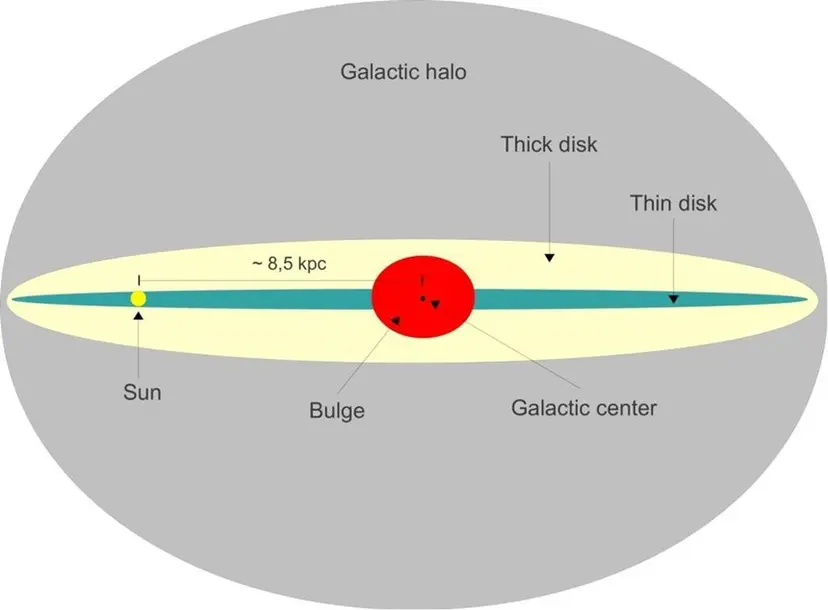
When people think of disk galaxies, they often only think of the thin disk, but more than two-thirds of the galaxy disks in the universe also possess a thick disk. Because the generation of stars and the chemical composition of each disk differ significantly based on the thickness and scale of the galactic disk, understanding how these thick and thin disks can coexist, how each was formed, and why they are so clearly distinct is a very important question in the field of galaxy formation.
There have been two main hypotheses regarding how these thick and thin disks are formed. The first suggests that the thick disk forms first, followed by the thin disk. Long ago, as large and small dwarf galaxies collided and blended, gas was rapidly accelerated and heated, causing the initial galactic disk to spread out thick. As time passed, new stars began to form within this thick disk. As more stars were created, their combined gravity caused the thick disk—which had been spread out vertically—to calm down and settle, resulting in a thinner disk. This hypothesis posits that a thin disk eventually forms within the thick one after a significant amount of time.
The second hypothesis is the opposite: the thin disk forms first, and the thick disk forms later. It assumes that stars are born in a thin disk initially. Over time, the galaxy interacts with neighboring galaxies and undergoes various dynamic changes, such as the growth of spiral arms and bar structures. These processes cause the stars and gas that were thinly settled in the disk plane to spread out vertically, eventually forming a thick disk.
Interestingly, these two hypotheses provide diametrically opposed explanations for the same galaxy that contains both a thick and a thin disk. Until recently, it remained unclear which one was correct. However, recent observations from the James Webb Space Telescope have made it clear which answer is closer to the truth.
Astronomers selected 111 edge-on galaxies from JWST images, allowing them to view the disks thinly. This observation reaches back as far as 10 billion years into the past. The most distant galaxy captured appears as it was only 3.8 billion years after the Big Bang. Astronomers categorized each galaxy based on its edge-on view, separating them into those with only a thick disk and those with both a thick and a thin disk. A striking trend emerged.
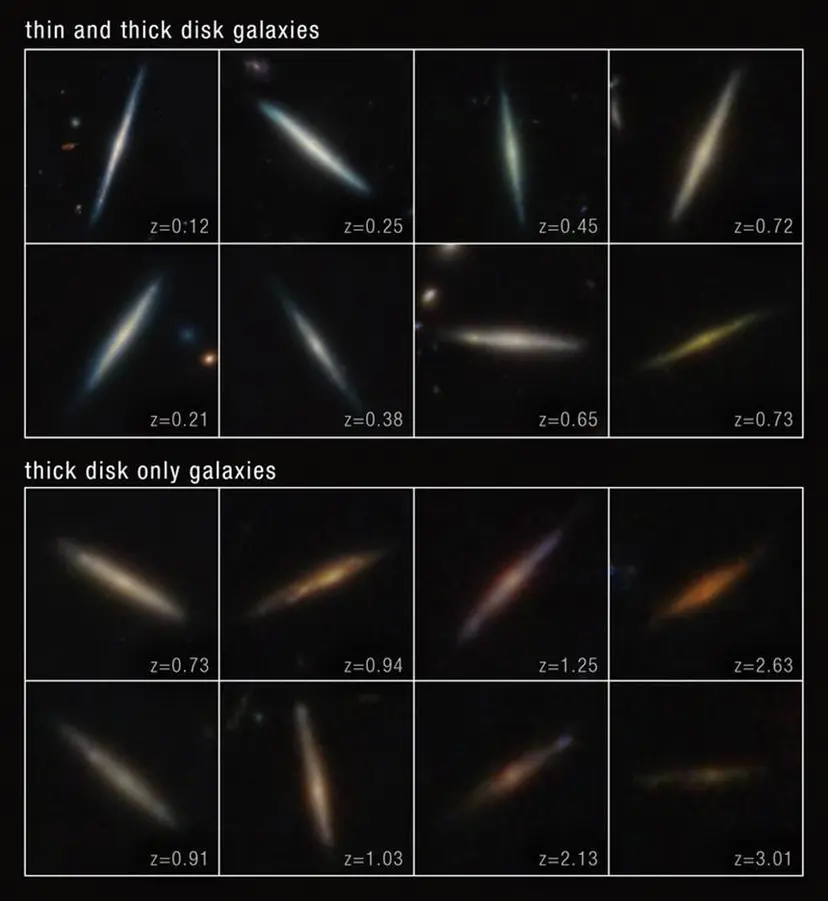
In distant galaxies, thin disks are not visible; most possess only a thick, blurry disk. Conversely, as we look closer at the more recent universe, galaxies begin to display thin disks. This clear correlation supports the hypothesis that galaxies initially form with only a thick disk and gradually form a new thin disk over time, eventually resulting in a double-disk structure. In other words, out of the two hypotheses explaining the formation of thick and thin disks, the one that posits the thick disk forms first and the thin disk later is the correct one.
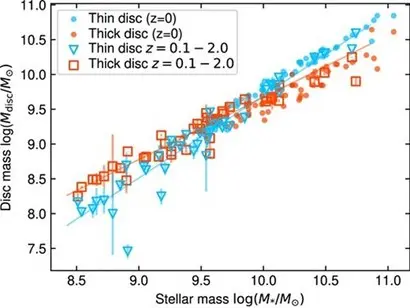
The graph above, which directly compares the total stellar mass of galaxies with the mass of their respective disks, makes this even clearer. In the graph, the orange dots represent the growth of the thick disk, while the light blue dots represent the thin disk. While all disks tend to grow as the galaxy gains mass, the light blue line rises more steeply than the orange line. This shows that the thin disk, which forms later, grows faster than the thick disk that formed first.
Furthermore, an interesting difference emerges based on galaxy mass. Heavier galaxies begin to form thin disks earlier. Comparing the point at which galaxies with only thick disks start to develop a thin disk, massive galaxies began transitioning to a double-disk structure 8 billion years ago, whereas lighter galaxies only began this transition 4 billion years ago. Lighter galaxies began to develop their thin disks 3 to 4 billion years later than the heavier ones.
This demonstrates that the two disks are not separate structures created in isolation, but rather structures that coexist and grow together. It is not a simple case of a thin disk forming only after the thick disk is finished; rather, they co-evolve, with the only difference being the timing of their initial formation. Even after the thin disk begins to form, the thick disk does not stop growing; as the galaxy itself gains mass, both the thick and thin disks continue to grow thicker and heavier.
To analyze this discovery more clearly, astronomers later conducted additional analysis of these galaxies using the ALMA radio telescope. They analyzed how quickly gas within each galaxy disk was turbulent and compared the heavy element content of each disk. Indeed, in galaxies with thick disks that exist in the early universe, the gas material fluctuates more rapidly. This shows that the turbulence of the gas in the thick disks of the early universe had not yet settled.
In the early universe, galactic disks were still full of rapidly swirling gas particles. The disks were filled with turbulence and were hot because they were composed of fast-moving particles. This is why galactic disks were thick in the early stages. As the first generation of stars was born within these turbulence-filled, thick disks and the disks developed, the turbulence began to subside. As the disks became calmer, younger stars were born later, and the heavy metal elements they left behind filled the thin disk. Conversely, the older, metal-poor stars that had survived from long ago continued to make up the thick disk. According to this analysis, our Milky Way’s thin disk appears to have formed about 8 billion years ago. Interestingly, this figure aligns well with the chemical ages of stars estimated from the spectra of stars in our own Milky Way’s thin disk.
In galactic astronomy, which views the evolution of the entire universe using galaxies as units, the question "Is our galaxy a unique world?" is very important. If the Milky Way was formed through the same very ordinary evolutionary process as other galaxies, we can believe that the scenery of the universe we observe well represents the entire universe. If, on the other hand, we experienced a unique history different from other galaxies, it becomes difficult to believe that the surrounding cosmic landscape we see represents the average characteristics of the universe as a whole.
Unfortunately, we are likely to live our entire lives trapped within our galaxy, unable to even confirm its actual appearance. Unless we become beings capable of freely traversing the universe beyond our galaxy, the question of whether the surrounding cosmic landscape we are given truly represents the average appearance of the entire universe is a very important and sensitive question that determines the very foundation of modern cosmology and astronomy. Fortunately, this discovery shows that our galaxy has experienced a history of birth similar to the countless other disk galaxies in the universe. Numerous galaxies in the universe contain a "Milky Way"—a center where a thin, clear stream flows, accompanied by wider, thicker rivers on both sides. And we are just one of them.
References
https://science.nasa.gov/missions/webb/nasas-webb-digs-into-structural-origins-of-disk-galaxies/
https://academic.oup.com/mnras/article/540/4/3493/8169912?login=false
About the author, Ji Woong-bae: He loves cats and the universe. After watching "Galaxy Express 999" as a child, he dreamed of sharing the beauty of the cosmos. He currently researches galaxy evolution through galactic interactions at the Center for Galaxy Evolution and the Near-Field Cosmology Laboratory at Yonsei University. He also engages in various science communication activities, such as lectures and writing. He is the author of books including "The Observatory of Flirting," "Thinking About the Universe All Day," and "Stars, the Science of Light."