

[비즈한국] The Lee Jae-myung administration, which sharply lowered its economic growth forecast for this year to 0.9%, has decided to increase next year's budget to the 720 trillion won range to foster recovery. As a result, next year's budget will see a significant increase of over 8% compared to this year, surpassing the 700 trillion won mark for the first time in history.
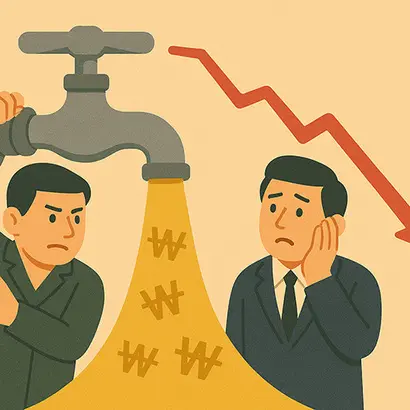
However, looking at the trends of the budget and growth rate over the past decade, the growth rate has been on a downward trajectory even as the government increased its annual expenditure. Critics argue that the government must tailor its budget to recover growth rates to ensure that the injection of a 700 trillion won budget does not become another empty gesture that fails to improve economic outcomes.
President Lee Jae-myung presided over a cabinet meeting on the 29th and finalized the budget bill for next year. In the '2026 Budget Proposal,' the first under the Lee Jae-myung administration, the government set total expenditure at 728 trillion won. This is an increase of 54.7 trillion won (8.1%) from last year's budget of 673.3 trillion won. It marks the end of fiscal austerity and a full-scale pivot toward expansionary fiscal policy.
The government explained that the budget was formulated based on the belief that active fiscal management is necessary to support growth and recovery. Seemingly mindful of concerns regarding national debt due to the massive budget expansion, the government also stated it would pursue performance-oriented fiscal management, focusing investment on high-performance areas while restructuring low-performance ones.
The government's move toward fiscal expansion aligns with President Lee Jae-myung's campaign promise to raise the potential growth rate to the 3% range. It is also interpreted as a reflection of the government's resolve to recover growth next year, as this year's growth rate is expected to reach only 0.9%, half of the initially projected 1.8%.
However, an examination of the budget and economic growth over the past decade shows that even with increased budgets, growth rates have tended to decline. This trend was particularly pronounced under the Moon Jae-in administration, which also pursued expansionary fiscal policies, increasing the budget by 8–9% annually. The government budget, which was 375.4 trillion won in 2015, grew by 2.9% to 386.4 trillion won in 2016.
In the following year, 2017, the government budget increased by 3.6% to 400.5 trillion won, surpassing the 400 trillion won mark for the first time. The economic growth rate rose from 3.2% in 2016 to 3.4% in 2017. Later, in 2018, when the Moon administration began drafting budgets centered on income-led growth, the size of the government budget increased by a massive 7.1% year-on-year to 428.8 trillion won. However, the growth rate fell to 3.2%. In 2019, the budget surged by 9.5% to 469.6 trillion won, but the growth rate fell even further to 2.3%.
In 2020, citing the need to improve economic conditions due to COVID-19, the budget was increased by 9.1% to 512.3 trillion won, surpassing 500 trillion won for the first time, yet the growth rate recorded a negative 0.7%. In 2021, the budget was increased again by 8.9% to 558 trillion won, and the growth rate was 4.6%. While the growth rate increased, it was not an impressive performance when considering the base effect.
Compared to the post-global financial crisis period, where the growth rate rose from 0.8% in 2009 to 7.0% in 2010, the performance was unsatisfactory. Furthermore, the Moon administration set the budget for 2022, its final year, at 607.7 trillion won, an 8.9% increase, crossing the 600 trillion won mark for the first time, but the growth rate was only 2.7%.
This situation, where growth rates fall despite increased budgets, continued under the Yoon Suk-yeol administration. The 2023 budget was set at 638.7 trillion won, a 5.1% increase from the previous year, but the growth rate fell further to just 1.6%. In 2024, the budget was increased by 2.8% to 656.6 trillion won, but the growth rate was 2.0%, barely maintaining the potential growth level.
Even though this year's budget was increased to 673.3 trillion won, with an additional 30 trillion won in supplementary budgets planned, the growth rate is expected to reach only 0.9%. The phenomenon where increased budget input fails to translate into economic growth is becoming increasingly severe.