

[비즈한국] The South Korea-U.S. summit held on the 25th is considered relatively successful, contrary to domestic and international concerns. This is largely thanks to the recent global political climate, where a smooth atmosphere without distinct disagreements between the two countries is viewed as a success in itself.
Another reason this summit is considered successful is the "Korea-U.S. Business Roundtable." The event, held immediately after the summit, was attended by 15 heads of major Korean conglomerates and the ministers of trade and foreign affairs, while the U.S. side included executives from 21 major companies, including Nvidia, and various financial firms.
During this roundtable, 11 memoranda of understanding (MOU) for industrial cooperation were signed, through which the two countries agreed to promote broad industrial cooperation for the revival of U.S. manufacturing. These 11 MOUs, covering shipbuilding, nuclear power, aviation, LNG, and core minerals, are seen as a significant achievement of the summit, symbolizing the expansion of the Korea-U.S. alliance from a military alliance to an industrial and technology alliance.
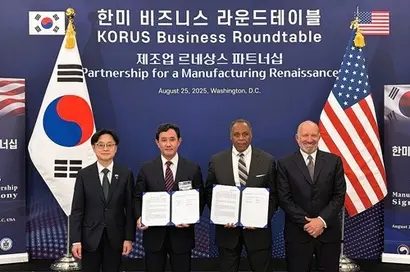
Among these, there were MOUs related to the defense industry. Samsung Heavy Industries010140 signed an MOU for a maintenance, repair, and overhaul (MRO) project partnership for U.S. naval vessels with Vigor Marine Group, and Korea Zinc signed an MOU with Lockheed Martin, the largest defense contractor in the U.S., to establish a germanium supply chain.
The MOU between Lockheed Martin and Korea Zinc is particularly significant. Lockheed Martin is the world's largest and premier defense contractor, known well in Korea for producing the Republic of Korea Air Force's KF-16s, F-35A stealth fighters, and C-130 transport aircraft, as well as the ROK Navy's Aegis combat systems, MH-60R maritime operations helicopters, and Patriot (PAC-3) missiles.
The contents of the MOU signed by the two companies are as follows: Korea Zinc will supply germanium refined in countries excluding China, North Korea, Iran, and Russia to Lockheed Martin, and both parties will pursue an off-take agreement for Lockheed Martin to purchase it on a priority basis. To this end, Korea Zinc plans to invest approximately 140 billion won to build a new germanium production facility at its Onsan Smelter in Ulsan.
The reason a global defense giant has partnered with a Korean company to secure core minerals is clear: germanium is an indispensable material for state-of-the-art weapons, but its supply chain is effectively controlled by China.
The key to night warfare, which often determines the outcome of modern conflicts, lies in infrared (thermal) sensors and cameras. Achieving "Thermal Dominance," where one can detect and attack enemies first using night-vision goggles or infrared tracking equipment, is crucial. Without germanium, it is impossible to manufacture such thermal imaging equipment. Germanium has extremely high transmittance and a high refractive index in the mid-wave infrared (MWIR, 3-5µm) and long-wave infrared (LWIR, 8-14µm) wavelength bands, making it essential for creating lenses and windows for infrared optical equipment.
For this reason, dozens of advanced weapon systems produced by Lockheed Martin, such as the Electro-Optical Targeting System (EOTS) for F-35 fighter jets and the FGM-148 Javelin anti-tank missile, utilize infrared equipment made with germanium. Furthermore, germanium is an essential material for fiber optic cables and high-frequency semiconductors.
However, germanium is not a mineral extracted directly from mines; it is recovered as a byproduct from zinc or coal ash. As a result, global production and supply are heavily dependent on China, a powerhouse in zinc smelting. 54% of the germanium the U.S. imports annually comes from China, and since the 30% sourced from Belgium is also refined from Chinese raw materials, effectively more than 80% of U.S. germanium consumption is under Chinese influence.
Moreover, China has been leveraging this monopolistic position to increase supply chain instability. Since August 2023, it has tightened control by requiring export permits for gallium and germanium-related items.
In this context, the MOU with Korea Zinc is expected to be a major help in securing a stable supply chain for Lockheed Martin. The Onsan Smelter, where investment is underway due to this cooperation, is expected to produce approximately 10 tons of high-purity (99.999%) germanium dioxide annually starting around 2028. This is a significant volume, equivalent to about 30% of the annual U.S. germanium consumption.
Restructuring supply chains for materials or raw components—which previously depended on specific countries like China—toward allied nations is known as "friend-shoring." In many cases, like with germanium, U.S. advanced weapon systems have vulnerable supply chains due to over-reliance on specific countries. It is hoped that this MOU will serve as an opportunity to further expand defense industry cooperation, with Korean-made raw materials, parts, and equipment contributing to U.S. advanced weapons development.