

[비즈한국] Irregular workers at KEPCO KPS051600, colleagues of the late Kim Chung-hyun—who passed away in a crushing accident at the Taean Thermal Power Plant on June 2—have been recognized by the court as having been illegally dispatched after a 3-year and 3-month legal battle. The court ruled that the subcontracted workers were essentially working in a dispatch capacity and that, consequently, KEPCO KPS has an obligation to hire them directly. This ruling is considered a wake-up call against the subcontracting of high-risk tasks at power plants, known as the "outsourcing of risk."
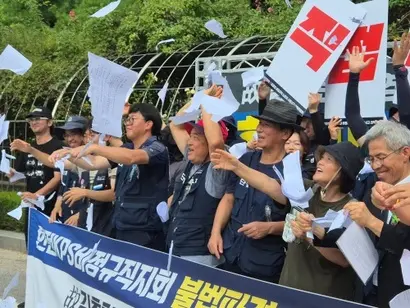
On August 28, the 41st Civil Division of the Seoul Central District Court ruled in favor of the plaintiffs, the irregular workers of KEPCO KPS, in their lawsuit to confirm worker status. The court determined that while KEPCO KPS and its subcontractors had signed formal subcontracting agreements, the actual working relationship constituted an illegal dispatch. As a result, KEPCO KPS is now under obligation to directly hire these subcontracted workers.
Kim Young-hoon, head of the KEPCO KPS irregular workers' branch of the Korean Public Transport Workers' Union (KPTU), stated, "With this ruling, we can finally stand at the starting line of our struggle," adding, "We demand that KEPCO KPS comply with the ruling and will also hold the government accountable for neglecting illegal dispatch practices in public institutions." KEPCO KPS, having lost the case, stated that they would "review the ruling."
Work, Personnel Management, and Equipment Shared with KEPCO KPS Staff
In terms of the employment structure, the prime contractor, Korea Western Power, initially outsourced routine maintenance (daily inspections, rounds, minor repairs, etc.) for the Taean Thermal Power Plant to KEPCO KPS. KEPCO KPS then divided the work into electrical and mechanical sectors and further subcontracted it to secondary subcontractors. The irregular workers who filed the lawsuit were employees of these secondary subcontractors.
However, the court viewed this as an illegal dispatch in substance. The subcontractors existed only in name; even when the companies changed annually, the workers were subject to succession of employment and continued working. Jung Chul-hee, head of the Taean Power Plant division of the KEPCO KPS irregular workers' branch, testified, "The company I worked for changed 15 times. Because the company name kept changing, I couldn't even put a company logo on my work uniform."
The court cited key criteria for determining dispatch, such as the power of command and instruction, the right to manage personnel and labor, and the ownership of work equipment. In reality, the workers performed their duties under the instructions of KEPCO KPS, and detailed work assignments and personnel deployment were announced during morning briefings. Even during tasks, they received real-time instructions via text message or KakaoTalk. They were also deployed to other power plants at the request of KEPCO KPS.
On-site, KEPCO KPS regular employees and irregular workers worked together, and their names were listed identically on work orders and safety training rosters. Most of the tools used were also owned by KEPCO KPS. Kook Hyun-woong, a KEPCO KPS irregular worker, argued, "Even a single hammer belonged to KEPCO KPS," adding, "Illegal dispatching within power plants must stop."
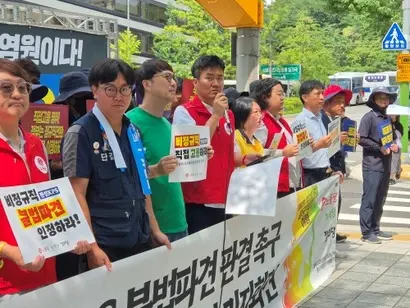
Outsourcing Risk to Cut Labor Costs… A String of Fatal Accidents
This ruling is seen as putting a brake on a structure where the prime contractor offloads safety responsibilities onto subcontractors. Lee Baek-yoon, leader of the Labor Party, emphasized, "This will be a turning point in overcoming the multi-layered subcontracting structure where the prime contractor reaps the power and profits while bearing no responsibility," adding, "If direct employment is achieved, labor conditions and safety management levels will improve."
Following the 2019 death of Kim Yong-gyun, a "Special Investigation Committee on Labor Safety" also recommended that KEPCO KPS directly hire private maintenance workers to prevent the outsourcing of risk. However, the government and the ruling party at the time did not accept this, citing concerns over potential bankruptcies of private firms, litigation conflicts, and the weakening of the competitive power generation system.
Critics point out that as a result, the sub-subcontracting structure remained, leading to the fatal accident of Kim Chung-hyun. Despite the necessity of specialized personnel and safety training due to the nature of power plant facilities, the fragmentation of responsibility led to a persistent structure where irregular workers were forced to act as both safety managers and operators simultaneously.
Kwon Young-guk, leader of the Justice Party, criticized this, saying, "Power plant facilities are organically connected, so it was a problem to forcefully separate them for subcontracting," and added, "Because safety responsibilities were also divided on the grounds of different employment status, the risks were ultimately concentrated on the subcontracted workers."
The labor sector is calling for an end to the structure of continuous outsourcing for the sake of cost-cutting and evasion of responsibility. Attorney Kim Ha-na, representing the plaintiffs, pointed out, "The outsourcing of risk stemmed from cutting labor costs and reducing safety management expenses," adding, "We need to re-examine whether the irregular worker laws are actually increasing safety costs rather than reducing them."