

[비즈한국] While the government has recently introduced a foreigner land transaction permit system to curb real estate speculation by foreigners, it has been confirmed that the buyer who set a record-high transaction price for an apartment at Apgujeong Hyundai Complexes 1 and 2 in Gangnam-gu, Seoul, last April, is an American. The transaction price at the time was 10.5 billion won, marking the first time the sales price for this complex exceeded 10 billion won. Foreigners, who are considered to be freer from real estate regulations compared to locals, have been increasing their influence on the housing market by repeatedly breaking record-high transaction prices.
April Contract, August Ownership Transfer… Avoiding Mortgage Regulations
According to industry sources and the real estate registry, an American individual surnamed A purchased an apartment at Apgujeong Hyundai Complexes 1 and 2 (exclusive area of 198㎡) in Gangnam-gu, Seoul, for 10.5 billion won on the 20th. This unit has the largest exclusive area in the complex and is located along the Han River. A completed the transfer of ownership registration about four months after signing the sales contract last April. Given that a domestic financial institution established a mortgage of 6.27 billion won at the time, it appears that about 5 billion won, which is half of the purchase price, was procured through a mortgage loan.
This transaction is the first instance where the sales price of an Apgujeong Hyundai Complex 1 and 2 apartment exceeded 10 billion won. The previous record-high price for the complex was 9.5 billion won (exclusive area 196㎡) in February, which is 1 billion won lower. The previous record for the same 198㎡ exclusive area was also 9.4 billion won in February, making it 1.1 billion won cheaper. Following A's transaction, the record-high transaction prices for this complex jumped to 12 billion won and 12.7 billion won (197㎡) respectively in June. The 198㎡ exclusive area also hit a record high of 11.78 billion won that same month.
Individual A also managed to sidestep mortgage loan regulations. On June 28, the government limited mortgage loan limits for housing in the metropolitan area and regulated areas to 600 million won regardless of income. It blocked multi-homeowners in the metropolitan area from utilizing mortgage loans and imposed a mandatory move-in period within 6 months for those purchasing homes in the metropolitan area using such loans, making it impossible for non-actual residents to obtain bank loans. Foreigners are subject to the same regulations as locals when borrowing from domestic financial institutions, but it appears A completed the loan application before these regulations were implemented.
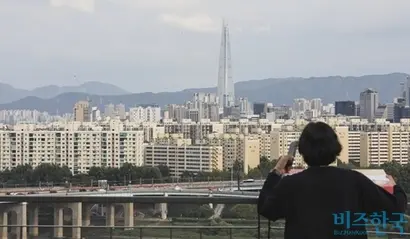
Apgujeong Hyundai Complexes 1 and 2 are representative reconstruction complexes in South Korea. The Seoul Metropolitan Government created the Apgujeong Apartment District along the Han River in Gangnam-gu in the 1970s to revitalize apartment supply. Since then, the area has been densely packed with Apgujeong Hyundai (1~14th), Miseong (1~2nd), and Hanyang (1~8th) apartments. As most have now reached their 40th year since completion, adjacent complexes are divided into six districts to pursue reconstruction. The Apgujeong Hyundai Complexes 1 and 2 purchased by A belong to Apgujeong District 3, which is the largest in scale among them.

Introduction of Foreigner Land Transaction Permit System: “Loan Regulations Should Also Match Equity”
Foreign-owned housing is on an upward trend. According to data from the Korea Real Estate Board on foreign housing ownership, the number of houses owned by foreigners in South Korea increased from 83,512 units in the second half of 2022 to 91,453 units in the second half of 2023, and to 100,216 units in the second half of 2024. As of the second half of last year, housing owned by foreigners accounted for about 0.52% of all housing in Korea. Most foreign-owned housing consisted of multi-unit dwellings such as apartments (91,518 units) and were concentrated in the metropolitan area, including Gyeonggi, Seoul, and Incheon.
Instances of foreigners breaking record-high housing prices are also continuously confirmed. In April last year, an American purchased an apartment at Hannam The Hill in Yongsan-gu, Seoul (exclusive area 240㎡), for 12 billion won, breaking the complex’s record. In November of the same year, an Uzbek national purchased an apartment at Banpo Xi in Seocho-gu, Seoul (exclusive area 245㎡), for 7.4 billion won, setting a record high for that complex. In April this year, a Maltese national bought an apartment at Yonsei River Terrace in Gangnam-gu, Seoul (243㎡), for a record-high price of 6.9 billion won. According to Korea Real Estate Board data, 70% of housing transactions exceeding 3 billion won purchased by foreigners between January and August last year were at record-high prices.
The government recently introduced a foreigner land transaction permit system. The measure aims to prevent foreigners who do not reside in the country from purchasing homes in areas where there are concerns about rising housing prices. From the 26th of this month until August 25 of next year, the entirety of Seoul, 7 districts in Incheon, and 23 cities/counties in Gyeonggi Province have been designated as foreigner land transaction permit zones, requiring foreigners to obtain permission when purchasing apartments, detached houses, multi-family, row, or multi-household houses. Foreigners granted permission for a housing transaction must move in within 4 months of the date of approval and are required to actually reside there for 2 years after acquisition.
Lee Eun-hyung, a research fellow at the Research Institute of Construction & Economy, assessed, “Considering the fairness issue between locals and foreigners, this measure is positive. Until now, foreigners were free from real estate regulations applied to locals, such as mandatory residence, loan regulations, and investigations into the source of funds.” He added, “While this foreigner land transaction permit system focuses on verifying actual residential demand and excluding speculative demand, it is still questionable how it aligns with equity regarding loan regulations compared to locals. It is also regrettable that officetels, which are quasi-residential facilities, were excluded.”
Foreigners are considered to be freer from real estate loan regulations than locals. When foreigners borrow from domestic financial institutions, they are subject to domestic loan regulations such as the Loan-to-Value (LTV) ratio or the Debt-to-Income (DTI) ratio. However, they can bypass these domestic regulations if they borrow from banks in their home countries. Furthermore, since it is difficult for the government to track the actual housing ownership status of individual foreign household members, they are generally freer from multi-homeowner regulations.