

[비즈한국] Recently, KB Kookmin Bank revamped its Non-Fungible Token (NFT) wallet service within its electronic wallet. Although the market has shrunk as the NFT fever has cooled, banks are still operating NFT wallets and seeking ways to utilize them. With a series of bills related to digital assets being introduced in the National Assembly and ongoing discussions on legalization at the government level, attention is focused on whether these banking efforts will move beyond one-off events and lead to the expansion of digital asset businesses.
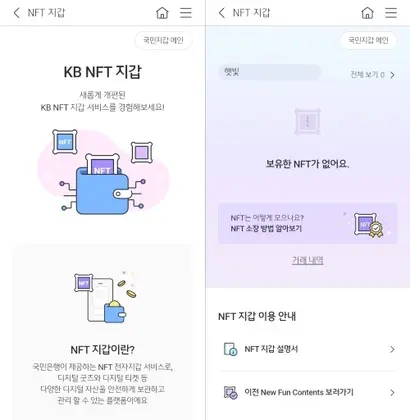
On August 26, KB Kookmin Bank renamed its ‘KB NFC’ service within its electronic wallet to ‘KB NFT Wallet.’ An NFT wallet refers to a tool that allows users to store, issue, or connect with NFT marketplaces to buy and sell NFTs. Kookmin Bank’s NFC service had been functioning like an NFT platform, allowing users to create digital content such as images and videos.
Kookmin Bank explained, “We had been operating content using NFT technology under the name ‘NFC,’ but we reorganized and integrated existing features while rebranding it as an ‘NFT Wallet.’ We intend to clarify the naming and provide diverse services for customer convenience.”
As the NFT craze has subsided, domestic and international NFT marketplaces are increasingly closing their doors or discontinuing services. As investment value has plummeted, the volume of NFT transactions has also dropped significantly. Nevertheless, banks continue to operate NFT wallets, likely with an eye toward the potential for expanding their digital asset business in the future.
Major commercial banks provide NFT wallet services within the electronic wallets integrated into their apps. They use self-issued NFTs for marketing or as a means to attract new customers. NFTs provided by banks cannot be converted into cash equivalents or sold on external markets. The functionality of these in-app NFT wallets is limited to storing NFTs received from events or sharing them among users.
Kookmin Bank uses NFTs for customer invitation events or prize draws. A company official stated, “We did not include features for financial valuation or trading when we launched NFC,” adding, “We are reviewing ways to use them for sports events or concert tickets held by the bank.” Kookmin Bank even ran a promotion through August 20, gifting professional golf tournament gallery passes to premium customers in the form of NFTs.
Woori Bank unveiled a renewed NFT wallet based on its own blockchain network this past February. The wallet is equipped with various features including NFT issuance, synthesis, art creation, ticketing, and community functions. The community feature is particularly notable; users who hold NFTs in the Woori Bank wallet can share their NFTs on a bulletin board and see reactions from other users. In effect, it allows users to interact with others within the banking app, similar to a social media platform. Recently, to boost engagement, Woori Bank held an event offering prizes to top users who received the most reactions on their NFT posts.
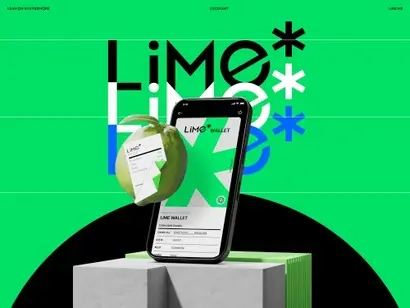
iM Bank launched its NFT wallet, ‘Lime Wallet,’ in the fourth quarter of 2024. It was one of the services introduced as a differentiator after transitioning to a commercial bank. In March, the wallet won an award at the German ‘iF Design Award 2025.’ iM Bank has set out to expand its use cases, such as linking Lime Wallet with university academic management services.
However, critics point out that with interest in NFTs waning, the banks’ NFT businesses are effectively in a state of suspended animation. Shinhan Bank provides an NFT service in partnership with ‘Ohai Wallet’ from blockchain firm Hexlant, but no announcements have been made since January 2023. Methods to obtain NFTs are also limited to one-time events (such as initial wallet signup or signing up for a Shinhan certificate), with the exception of university donations.
Since the launch event tied to ‘MyData,’ iM Bank has not engaged in significant customer acquisition activities for Lime Wallet. Because Lime Wallet itself does not allow users to issue NFTs or send held NFTs to other users, and it remains disconnected from other banking services, there are few practical ways for bank customers to utilize the wallet.
An official from a commercial bank remarked, “Since NFT is a technology that digitally proves content ownership via blockchain, there are many potential areas for application, such as in the trading of tangible and intangible assets. The problem is that utilization requires NFTs to be popularized, which is difficult at the moment. We are currently exploring various ways to utilize the functions we have built.”
Meanwhile, despite the sluggishness of the NFT business, the financial sector remains interested in digital assets. With the launch of the new government this year, stablecoins have emerged as a new growth engine, prompting financial group heads to take direct action. It is known that Shinhan Financial Group Chairman Jin Ok-dong and Hana Financial Group Chairman Ham Young-joo recently met with U.S. stablecoin issuers. As movements toward legalization emerge—with bills related to digital assets being introduced in the National Assembly—banks appear to be accelerating their adoption efforts.
The industry expects that once digital asset legalization is fully implemented, opportunities for business expansion will arise. Heo Myeong, Team Leader of the Strategic Business Office at Lambda256 (a Dunamu blockchain subsidiary that collaborated with iM Bank and Woori Bank), stated, “The examples of NFT wallet operations in the banking sector show how traditional finance is preparing for digital assets and Web 3.0 (intelligent, personalized web). It is true that expansion is difficult because NFT services are currently limited to private networks. However, if regulations are eased through domestic legalization and government policy preparation, I believe it will be possible to pursue various business initiatives utilizing digital assets.”