

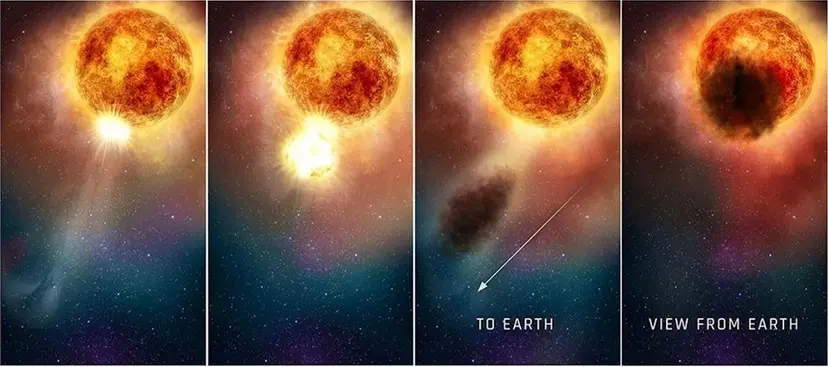
[비즈한국] In 2019, Betelgeuse suddenly dimmed. It was noticeable even to the naked eye. Betelgeuse is a supernova candidate star nearing the end of its life. People hoped that perhaps it was finally entering its final, unstable phase before an explosion. However, nothing happened in 2019, 2020, or since. The full story behind the dramatic drop in brightness observed in 2019 was revealed later.
Betelgeuse is inherently unstable and volatile. At that time, it had ejected a massive amount of coronal material from its surface, which cooled rapidly in space and formed a giant dust cloud that obscured the star's light. Betelgeuse eventually returned to its original state, leaving those who had been waiting for the spectacular fireworks of a nearby supernova explosion disappointed.
The unstable fluctuations of Betelgeuse have long been well-known. Its brightness variations are a mix of two distinct cycles. Fundamentally, there is a pulsation pattern that fluctuates with a period of about 420 days, which appears to be its primary mode. Beyond that, there is a much longer, slower vibration with a period of about 2,100 days. Why this second pulsation mode occurs has remained a mystery until now. Some astronomers speculated that another companion star might be hidden near Betelgeuse, suggesting that it is actually a binary system. However, the identity of that companion remained unconfirmed for a long time.
But recently, a surprising photograph that appears to directly capture this companion star of Betelgeuse has been released! If this discovery is confirmed, it would mean that Betelgeuse is not a lonely supergiant oscillating and dying by itself, but rather has a partner by its side, watching over its final moments.
How can we explain the 2,100-day cycle seen in Betelgeuse’s brightness changes? Because the star itself is so inherently unstable, massive convection currents occur that churn the entire star. Just as granulation patterns of various sizes are visible on the Sun’s surface, Betelgeuse likely has enormous convection cells. However, these convection cells alone are insufficient to explain the fixed periodic pattern, as convection happens randomly across the surface.
One might consider a large sunspot on the star’s surface, but that does not explain the case of Betelgeuse. Sunspots are relatively dark and cooler areas, whereas the 2,100-day brightness mode is more prominent in hotter, bluer wavelengths than in redder, darker ones. Furthermore, even when modeling changes in the magnetic field—a primary cause of sunspots—Betelgeuse’s magnetic field varies over a period much longer than 2,100 days, so sunspots alone cannot explain it.
Ultimately, astronomers began to speculate that the long-period variation is caused by a hidden companion star near Betelgeuse. The theory is that the companion and Betelgeuse periodically eclipse each other, altering the total brightness. Betelgeuse has a very extended atmosphere, and material blown out from the star reaches the companion's orbit. The companion orbits while weaving through this dust cloud. Consequently, when the companion passes in front of Betelgeuse, it might not just dim the star but actually brighten it by clearing away the dust cloud obscuring Betelgeuse.
As Betelgeuse is such a bright and famous star, it has been observed since the 17th century. Astronomers analyzed vast amounts of data accumulated over nearly 100 years and discovered that the 2,100-day pulsation pattern had remained remarkably stable. This provided key evidence, suggesting the pattern is not due to random stellar surface convection or explosions, but to a companion star orbiting with a stable period.
At the time, astronomers estimated the radial velocity based on Betelgeuse’s long-period pattern. Based on this, they estimated that a companion with 0.5 to 1 solar mass might be orbiting just 8 AU away. However, this estimate did not gain much support. For a star as dazzling and violently turbulent as Betelgeuse, attempting to find a companion so close is essentially impossible.
In fact, Betelgeuse is a star that even space telescopes like Hubble, Kepler, and Gaia struggle to look at directly. It is so bright that it far exceeds the maximum magnitude limits of these telescopes, making it impossible to capture properly. Consequently, its exact distance is still unknown. (It is one of the stars with a very high margin of error in distance measurement.) Even if a companion existed next to such a massive, brilliantly shining star on the verge of a supernova, identifying its presence would be extremely difficult. Therefore, to find such a companion, one needs a telescope with "sharp eyes" capable of distinguishing even the smallest angles.
Recently, however, a remarkable attempt was made. The Gemini North telescope in Hawaii was equipped with "Alopeke," an ultra-high-resolution observation instrument designed to distinguish two such closely orbiting objects. 'Alopeke' means 'fox' in Hawaiian. Instead of long-exposure imaging, Alopeke takes very short exposures of less than 14 milliseconds to minimize the effects of real-time atmospheric turbulence. It challenges the limits of the diffraction caused by the telescope's optics. Thanks to this, it can distinguish angles as small as 10 milliarcseconds. It provides one of the highest resolutions of any single telescope currently in existence.
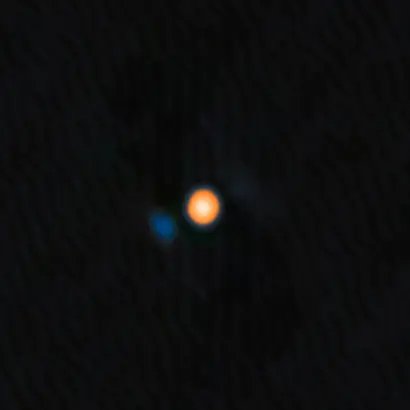
Observing Betelgeuse through Alopeke finally revealed something suspected to be a hidden companion. In the photo above, there is a blue smudge right next to the yellow-shining Betelgeuse—exactly where everyone had hoped to find the companion. Estimated from the observation image, this companion has a mass about 1.6 times that of the Sun and is located just 4 AU away from Betelgeuse. That is closer than the distance between the Sun and Jupiter. The companion appears to orbit Betelgeuse every 5.94 years. However, the confidence level for this companion in this observation is only 1.5 sigma. It is far from sufficient to confirm its existence with certainty. Nevertheless, it is intriguing that something was discovered exactly in the orbit where many had predicted a companion to be.
A fun name has been given to this candidate companion star of Betelgeuse. Betelgeuse means "the giant's hand," referring to one arm of Orion, the hunter of the night sky. Thus, the newly discovered companion was named 'Siwarha,' which means 'bracelet' in Arabic—a bracelet worn on the giant's arm. Siwarha appears to be a very young star, not yet having entered the main sequence stage, where it would perform hydrogen fusion at its center like the Sun. It appears to be a blue pre-main-sequence star. This explains why it shines with a bluer, blue-white light and has not yet started full-scale internal hydrogen fusion. The fact that Betelgeuse's 2,100-day long-period brightness mode was particularly prominent in blue wavelengths is also easily explained by this Siwarha companion.
As more massive and sensitive telescopes are built in the future, the identity of the partner Betelgeuse has been hiding will be revealed. This observation was only able to find traces by pushing the limits of the Alopeke instrument. Estimating Siwarha’s elliptical orbit, it will be at its farthest point from Betelgeuse around November 2027. This will be the best time for further observation. Because Betelgeuse and Siwarha will be at their maximum separation, they will be easier to distinguish clearly.
There is a very high probability that Betelgeuse will undergo a supernova explosion within the next 10,000 years. If Betelgeuse explodes, Siwarha could be shattered, or it might be consumed by Betelgeuse as the latter expands massively beforehand. In any case, we don't have much time left to definitively confirm the existence of Siwarha. We must hurry to confirm it before the giant's bracelet disappears, within at least the next 10,000 years. We are beginning to understand why Betelgeuse, rushing toward its end while facing death at such close range, showed such unusually volatile and violent behavior. Betelgeuse is not alone. It was a binary system with a bracelet on one side.
References
https://noirlab.edu/public/programs/gemini-observatory/gemini-north/alopeke/
https://iopscience.iop.org/article/10.3847/1538-4357/ad93c8
https://iopscience.iop.org/article/10.3847/1538-4357/ad87f4
https://iopscience.iop.org/article/10.3847/2041-8213/abf3c9
https://iopscience.iop.org/article/10.3847/2041-8213/adeaaf
Who is the author, Woong-Bae Ji? He loves cats and the universe. After watching 'Galaxy Express 999' as a child, he dreamed of sharing the beauty of the cosmos. He currently researches galaxy evolution through galactic interactions at the Galaxy Evolution Research Center and the Near-Universe Cosmology Laboratory at Yonsei University. He also engages in various science communication activities, including lectures and writing. He is the author of books such as 'The Observatory of Flirting,' 'Thinking About the Universe All Day Long,' and 'Stars, the Science of Light.'