

[비즈한국] “WHAT IS GOING ON IN SOUTH KOREA? Seems
like a Purge or Revolution. We can’t have that and do business there. I am
seeing the new President today at the White House. Thank you for your attention
to this matter!!!”
With this post, uploaded by U.S. President Donald Trump to his personal social media platform, Truth Social, two hours before the Korea-U.S. summit on the 25th, the meeting began amidst a palpable sense of tension. Contrary to expectations that detailed discussions on the Korea-U.S. tariff agreement—which had been dramatically reached on the 31st of the previous month—would take place, the talks concluded at a level of mere reaffirmation. Nevertheless, President Trump emphasized shipbuilding and energy, raising expectations for expanded cooperation in these sectors between the two nations. He was particularly vocal in his active "love call" to the shipbuilding industry.
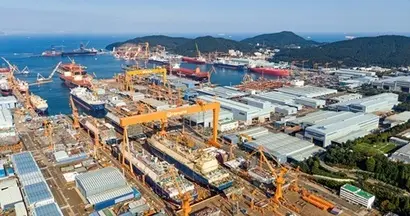
The shipbuilding industry is one of the sectors where President Trump is hoisting the banner of revitalization. While the U.S. is rated as having top-tier capabilities in warship construction, its merchant shipbuilding capacity has regressed to 20th in the world due to neglect of investment since the Cold War. In a situation where the U.S., which recorded a 0.1% share of global ship orders last year, must compete with the number one nation, China (70%), it has effectively determined that cooperation with second-place South Korea (17%) is indispensable.
During the tariff negotiations last month, the government delegation proposed the "MASGA" project, a multi-trillion won initiative that includes not only investment in the U.S. by domestic private shipbuilders but also financial benefits such as guarantees and loans to support them, attracting keen interest from President Trump. MASGA stands for "Make American Shipbuilding Great Again."
At the summit, President Trump also highly praised Korea’s shipbuilding capabilities and requested that the Korean industry expand its investment in the U.S. He stated, “We will buy ships from Korea,” and added, “We will bring some Korean shipyards to the U.S. and have our workers build the ships here.” He continued, “We love Korean ships.”
In the Korea-U.S. tariff negotiations, Korea agreed to create a total of $350 billion (487 trillion KRW) in U.S. investment funds, with the plan to utilize $150 billion (209 billion KRW)—more than 40% of the total—in the shipbuilding sector.
Domestic shipbuilding companies are also quickly expanding their U.S. investment plans. Hanwha Ocean announced plans to invest over $70 million (94.5 billion KRW) in the Philly Shipyard, which it acquired last year. By building automated facilities and smart systems, it is expected to play a pivotal role in modernizing U.S. shipyards, with the goal of increasing ship construction capacity tenfold.
At the Korea-U.S. Business Roundtable held following the summit, HD Hyundai267250 signed an MOU with the Korea Development Bank and U.S.-based Cerberus Capital to create a multi-billion dollar joint investment fund. HD Hyundai plans to participate as an anchor investor and technical advisor. This fund aims to rebuild and strengthen the maritime capabilities of the U.S. and its allies, including in the U.S. shipbuilding industry, maritime logistics infrastructure, and advanced marine technology.
Samsung Heavy Industries010140 also signed an MOU with the Vigor Marine Group to establish a strategic partnership in areas such as maintenance, repair, and overhaul (MRO) for U.S. naval support vessels, shipyard modernization, and joint ship construction. Depending on business performance, Samsung Heavy Industries plans to expand the scope of cooperation to include merchant and specialized vessels and pursue joint ship construction with partner shipyards in the U.S.
The energy sector is already cooperating with Japan, but President Trump expressed hope for additional participation from South Korea. President Trump said, “Korea needs energy, and (the U.S.) has abundant resources in Alaska, so I want to collaborate with Korea,” adding, “I intend to make a deal to create a joint venture (JV).”
The U.S. is pushing for the "Alaska LNG Project," which involves building a 1,300 km gas pipeline connecting the Prudhoe Bay gas field in northern Alaska to liquefaction facilities in the south. It is a massive project with a total scale of $44 billion (61 trillion KRW) and an estimated LNG reserve of 40 trillion cubic feet (1.13 quadrillion liters). The goal is to transport LNG to the southern Alaskan facilities, liquefy it, and export it to Asian countries like South Korea and Japan. On the 22nd of last month, at a meeting with Republican lawmakers at the White House, President Trump disclosed that Japan was participating in the Alaska LNG project to establish a JV with the U.S.
In the recent tariff negotiations, Korea agreed to purchase $100 billion worth of U.S. LNG and other energy commodities over the next three years and six months. Since this involves shifting some of the volume previously purchased from the Middle East to the U.S., it is assessed that the burden will not be significantly greater than it was before.
At the Korea-U.S. Business Roundtable, follow-up measures to the agreements made during the tariff negotiations were also discussed. Korea Gas Corporation signed a contract to newly import 3.3 million tons of LNG annually for 10 years, starting in 2028, from global energy firm Trafigura, as discussed during the negotiations.
This is seen as a point where domestic natural gas price stabilization is expected by diversifying supply lines beyond the geopolitically risky Middle East region.
Kim Jung-kwan, Minister of Trade, Industry and Energy, stated, “The government will provide all necessary institutional support so that Korea-U.S. manufacturing cooperation can meet a renaissance,” and added, “We will work to create endless business opportunities for companies in both countries through this.”