

[비즈한국] Chinese film manufacturer 'Lucky Film' has relaunched color film for film cameras after a 13-year hiatus. The film camera industry had been lukewarm about releasing new products or increasing production despite the global "newtro" (new + retro) craze in the mid-to-late 2010s. However, signs of change have recently emerged, such as the relaunch of film and the development of new film cameras. Attention is focused on whether the "film camera" boom will revitalize the industry.

Lucky Film has brought back the "Lucky C200," a 35mm color negative film that was discontinued in 2012. The film made its debut at the Shanghai Image & Vision Expo on July 17, and prototype sales began on the same day on the Chinese online shopping site "JD.com." Lucky Film announced plans to begin full-scale mass production starting in October and intends to release medium-format film as well.
This relaunch was influenced by the "film camera" craze in China. The "newtro" aesthetic has garnered significant attention, particularly among the younger generation, leading to increased popularity for film cameras. In particular, a "tear-off film" challenge went viral on the social media accounts of Chinese celebrities earlier this year. Tear-off film is a type of instant photo that, unlike regular instant film, requires a process of tearing the film away.
With the relaunch of Lucky Film's color film, film camera enthusiasts are hoping for a reduction in the financial burden of film costs. Currently, prototypes of the Lucky C200 are selling for 60 yuan (approximately 11,600 won) in China. Similar products like Kodak ColorPlus and Fujifilm C200 retail in the high 10,000-won range. A user named Mr. A, who purchased the Lucky C200 through direct overseas shipping, said, "As it is a prototype, I was disappointed by some coating defects and color shifts," but added, "If the quality stabilizes and the company meets their promised price point of around 7,000 won, I believe it will be sufficiently competitive."
Until now, the film market had been suffering from supply shortages, as companies like Kodak and Fujifilm did not easily increase production despite the rising demand caused by the film camera trend. The price of film, which used to be 3,000–4,000 won per roll, skyrocketed to nearly 20,000 won following the COVID-19 pandemic.
Demand remained high regardless, leading to a "film crisis" that resulted in shops limiting purchases per person. The skyrocketing prices made film photography an "expensive hobby," causing great frustration for enthusiasts. Middle school student Choi Hyo-jun said, "Buying film offline costs over 20,000 won, which is a burdensome price for a student," adding, "I would definitely buy it if Lucky Film's price is around 10,000 won."
New film camera models also started appearing last year for the first time in nearly 20 years, attracting attention. Pentax launched its new model, the "Pentax 17." It was the first new film camera from a major manufacturer in 19 years, becoming such a hot topic that it was even exhibited and sold separately in photo labs. Most of the film camera industry had refrained from releasing new products, fearing that the recent craze would be just a passing fad while most models were already discontinued. Only Leica had been releasing new film cameras, but even they hadn't launched a brand-new model. Because of this, the film camera market was dominated by secondhand trading or reusable or disposable cameras, commonly known as "point-and-shoots."
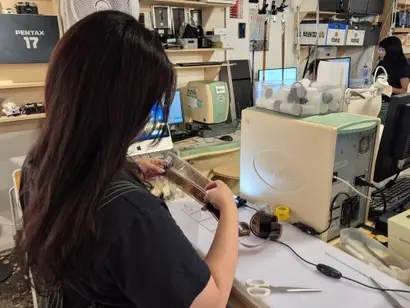
Riding the film camera wave, photo labs are also seeing renewed vitality. Just over a decade ago, there were only four or five labs left in Seoul, and the industry was on the brink of extinction. However, thanks to the popularity of film cameras, the number has grown to about 20. Recently, these labs are transforming from simple processing shops into cultural spaces.
"Il-sam-o-sam-yuk," which opened in Chungmuro, Seoul, in 2019, opened its second location, "Pixel Per Inch," in 2023. Pixel Per Inch is also a boutique shop that sells photography-related books and merchandise, and offers services for taking Polaroid photos. Lim Ji-hye, CEO of Pixel Per Inch, said, "I started because I loved photography, and it seems I have survived because the timing was naturally right," adding, "I wanted to open a space that goes beyond being just a photo lab and shows everything that can be done with photography."
Gorae Photo Studio, located in Chungmuro, is gaining popularity for its "self-scanning" service, where customers scan the film they have developed themselves. It emphasizes its role as a "community" space, notably by hosting photography-related gatherings and events. Yoon Pu-bit, manager of Gorae Photo Studio, said, "In the past, it was enthusiast-centered, but as more people enjoy it casually as a hobby, the base of film camera users has expanded."