

[비즈한국] Interest in virtual assets is rising as Heath Tarbert, President of Circle, the issuer of USDC, the world's second-largest stablecoin, visits South Korea. In particular, with the recent inclusion of virtual asset spot ETFs and stablecoin regulations in the government's five-year national management plan by the Presidential Transition Committee, the trend of virtual assets—which have remained outside the institutional framework—gradually being incorporated into financial infrastructure is expected to accelerate.
One of the most notable keywords in the virtual asset market is the "introduction of a Korean-style Bitcoin spot ETF." Since the launch of spot ETFs in the United States in January of last year, perceptions of virtual asset investment have fundamentally changed. Previously, virtual assets were evaluated as highly speculative and primarily traded by individual investors. However, large institutional capital has begun to enter the market directly through the institutional product of an ETF. The market capitalization of the 11 ETFs launched on the same day reached $152 billion as of the end of last month, and BlackRock's 'IBIT' surpassed the $10 billion mark just 50 days after its launch. This is a record-breaking speed even compared to the gold ETF (GLD), which took 27 months to reach the same scale, and the Nasdaq 100 tracking ETF (QQQ), which took over 9 months. As such, the introduction of virtual asset spot ETFs is changing the nature of the virtual asset market.
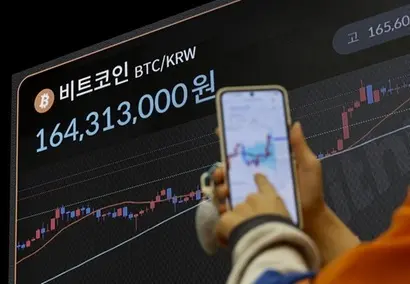
The impact of introducing spot ETFs in South Korea is also expected to be significant. Kim Jin-young, a researcher at Kiwoom Securities039490, forecasted, "If a K-Bitcoin spot ETF is launched, we can expect not only the expansion of the domestic ETF market but also the establishment of virtual asset infrastructure meeting global standards, the broadening of the investment base, the easing of the 'K-premium,' and the acceleration of capital market innovation."
However, in reality, legal and institutional barriers remain high. Recognizing Bitcoin as an underlying asset and trust property requires amendments to the Capital Markets Act, and financial companies must also be permitted to participate in virtual assets. Currently, individual investors can trade directly through private exchanges such as Upbit or Bithumb. However, institutional investors cannot directly invest or hold virtual assets because they are not classified as 'financial investment products.' Ultimately, it is difficult for a Korean-style Bitcoin spot ETF to become a reality without legal and institutional refinement.
Researcher Kim Jin-young predicted, "It seems highly likely that stock-type ETFs and futures ETFs related to blockchain or stablecoins will be introduced in stages ahead of spot ETFs," adding, "Spot ETFs will be launched after technical infrastructure is established."
Along with this, stablecoins are another major topic. Unlike Bitcoin or Ethereum, which have high price volatility, stablecoins are virtual assets designed to maintain a 1 coin = 1 dollar level by linking their value to fiat currency like the dollar or real assets like gold. For example, if a user sends $100 to an issuer, the issuer deposits the $100 and then issues $100 worth of stablecoins to the user. Based on this stability, they can be used in real life for remittances and payments, and they serve as a benchmark for transactions in the virtual asset market, similar to a substitute currency for the dollar.
In the U.S., the Clarity for Payment Stablecoins Act (or similar legislation) has already been passed, and discussions on issuing Won-based stablecoins are underway in South Korea. If dollar-based stablecoins become established as a domestic payment and remittance method, they could influence the central bank's monetary policy, leading to moves to institutionally manage Won-based stablecoins.
If stablecoins settle into the financial market, their influence is expected to go beyond simple payments. There is anticipation that they can increase accessibility for small-scale investors by combining with 'tokenized finance,' which fractionalizes and trades illiquid assets like real estate and artwork. Furthermore, there are prospects that new utilization models could open up in the DeFi (decentralized finance) market. For example, tokenized assets could be pledged as collateral in DeFi to obtain stablecoin loans. This trend is already emerging overseas, and experiments combining institutional systems with blockchain finance are continuing.
However, the situation in South Korea is slightly different. The domestic DeFi market is not yet sufficiently formed, and existing payment and remittance infrastructure is already convenient, leaving consumers with little reason to choose stablecoins. Consequently, some predict that a soft landing for a Won-based stablecoin will not be easy unless backed by economic incentives to generate stable demand and mechanisms to secure trust.
Virtual assets are rapidly moving from simple objects of speculation to part of institutional financial infrastructure. If the three trends of virtual asset spot ETFs, stablecoins, and asset tokenization align, the investment environment for individual investors and financial infrastructure could change significantly. However, for this change to lead to true innovation, the three elements of legal and institutional refinement, market maturity, and consumer demand must come together. As an individual investor, rather than being buried in short-term price fluctuations, it is necessary to watch with a long-term perspective to see what kind of structural changes virtual assets are creating within the financial system.