

[비즈한국] Although Korea Electric Power Corporation (KEPCO)015760 reported strong performance this year, critics argue that its financial structure has not improved. KEPCO’s total debt exceeds 200 trillion won, a level where even a modest surplus cannot easily lead to a turnaround. Analysts suggest that raising electricity rates is necessary to improve performance, but such hikes are a sensitive issue that could impact the approval rating of President Lee Jae-myung.
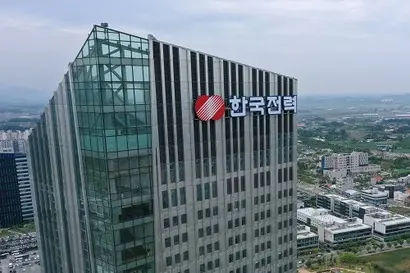
In the first half of this year, KEPCO recorded 46.1741 trillion won in revenue and 5.8895 trillion won in operating profit. This is an improvement compared to the same period last year, which saw 43.7665 trillion won in revenue and 2.5496 trillion won in operating profit. However, the internal atmosphere remains subdued. The current figures are still insufficient to resolve the massive cumulative losses of the past few years.
KEPCO stated, "Driven by stabilized fuel prices, rate adjustments, and self-rescue efforts, we have recorded operating profits for eight consecutive quarters since the third quarter of 2023," while adding, "Further performance improvements are still necessary to resolve the 28.8 trillion won in cumulative operating losses accrued since 2021."
Indeed, while KEPCO posted a surplus in the first half of this year, its total debt increased from 205.445 trillion won at the end of last year to 206.2323 trillion won by the end of June. With debt exceeding 200 trillion won, the interest burden is significant, reaching 2.2113 trillion won in the first half of the year alone. However, the debt-to-equity ratio improved by 24.41 percentage points (p), falling from 496.69% at the end of last year to 472.28% at the end of June.
Future performance projections are also not entirely positive. This is due to the growing trend of companies entering into Power Purchase Agreements (PPAs) to procure renewable energy directly from suppliers, bypassing KEPCO. A recent report by Climate Solutions projected that if this "de-KEPCO" trend continues, KEPCO's margins in the industrial sector will drop from 9.6 trillion won in 2024 to 8 trillion won by 2030. Climate Solutions stated, "Industrial electricity demand is stagnating due to slowing economic growth and sluggish manufacturing performance," adding, "Companies are increasingly opting for direct PPAs to avoid industrial electricity rate burdens and to meet RE100 requirements."
The stock market also views KEPCO’s prospects negatively due to these PPAs. Na Min-shik, an analyst at SK Securities, explained, "The expansion of direct power procurement by large industrial consumers has recently emerged as a key issue. As a result of freezing residential rates while raising industrial rates, there is a clear move to bypass KEPCO and procure electricity directly." Ryu Je-hyun, an analyst at Mirae Asset Securities, analyzed, "Due to cost burdens, LG Chem051910 and SK Advanced have signed direct power purchase contracts. If the exodus of major clients continues, KEPCO’s revenue decline and profitability deterioration will be inevitable."
Some have suggested that residential electricity rates should be raised to facilitate KEPCO's recovery. Analyst Ryu Je-hyun noted, "Without rate hikes, the momentum for KEPCO's performance improvement will likely slow down significantly starting from the fourth quarter of this year." During its first-half earnings announcement, KEPCO itself stated, "We plan to faithfully implement our financial normalization plan and continue to consult with the government on various measures, including rate rationalization and reducing power purchase costs."
Electricity rate adjustments are determined after KEPCO submits a request, followed by consultations between the Ministry of Trade, Industry and Energy and the Ministry of Economy and Finance, and a review by the Electricity Regulatory Commission. In other words, if the government opposes it, a rate hike is realistically difficult. KEPCO President Kim Dong-cheol was appointed during the Yoon Suk-yeol administration, and it is widely assessed that a smooth working relationship with the Lee Jae-myung administration is unlikely.
The ruling Democratic Party has also recently criticized President Kim Dong-cheol. This is due to the controversy over unfair practices regarding the Czech nuclear power plant export contract signed during the Yoon Suk-yeol administration. On August 19, Democratic Party members of the National Assembly’s Trade, Industry, Energy, SMEs and Startups Committee exerted pressure, stating, "The Yoon Suk-yeol administration abandoned our nuclear technology sovereignty and acted in a reckless, treasonous manner. Former Minister of Trade, Industry and Energy Ahn Duk-geun must be held accountable, and KEPCO President Kim Dong-cheol and Korea Hydro & Nuclear Power President Hwang Joo-ho must resign immediately."
However, since President Lee Jae-myung recently mentioned the need for electricity rate hikes, the possibility cannot be ruled out entirely. In a meeting with senior presidential aides on the 14th, President Lee stated, "Electricity rates are bound to rise as we work toward achieving our greenhouse gas reduction targets."
Electricity rate hikes could impact President Lee Jae-myung's approval ratings. Recently, the President's approval ratings fell following the pardons of former Rebuilding Korea Party leader Cho Kuk and former Democratic Party lawmaker Yoon Mee-hyang. For this reason, some analyze that the government will raise rates only after some time has passed.
The stock market expects this to happen around next year. Jung Hye-jung, an analyst at KB Securities, noted, "The importance of improving KEPCO's financial structure and securing cash flow is being emphasized. We believe the possibility of an electricity rate hike as early as 2026 has increased."