

[비즈한국] After about two months of activities by the State Planning Advisory Committee, the national policy tasks of the Lee Jae-myung administration have been finalized. A notable point in the defense sector is the so-called "quasi-fourth military branch system for the Marine Corps." However, for the Republic of Korea Marine Corps to develop and truly become a "fourth branch of the military," it requires not just a simple increase in scale, but thorough preparation for future warfare.
The necessity of so-called "Marine Corps independence" has been discussed for decades. Since its founding in 1949, the Marine Corps has achieved numerous combat successes, including suppressing armed infiltrators and serving with distinction in the Korean and Vietnam Wars. However, it also has a history of command structure changes due to political circumstances, such as the dissolution of the Marine Corps Headquarters in 1973 and its subsequent reinstatement in 1987. The fact that the United States, an ally of South Korea, maintains a four-branch military system including the Marine Corps, and that the ROK Marine Corps ranks within the top five globally in terms of size, is also frequently cited as justification for its independence.
Therefore, the reorganization plan for the Marine Corps presented by this State Planning Advisory Committee is welcome news for Marine Corps veterans, active-duty personnel, and the public who support the Marine Corps and have long hoped for its independence. The committee has decided to reorganize the Marine Corps into a quasi-fourth branch system to ensure its independence and operational autonomy, while enhancing the unit structure and the capabilities and status of its headquarters.
However, one cannot simply approve of the Marine Corps quasi-fourth branch system without reservations. The previous administration also promised to make the Marine Corps an independent fourth branch and produce a four-star general as part of its presidential campaign. Yet, in reality, it neglected the reinforcement of combat capabilities and became embroiled in a "miserable precedent" involving the unfair death of a young Marine and allegations of political pressure, which eventually led to the launch of the Special Counsel investigation into the death of Corporal Chae.
Such wrongful instances were clear acts of aiding the enemy, ruining the military for the sake of political interests and individual greed. Therefore, for the current government's defense pledge of a quasi-fourth branch system to be truly realized, there must be deep contemplation on the "justification for a fourth branch," rigorous consideration of how to enhance the combat power essential to the military's core mission—protecting citizens' lives and national interests—and substantive force modernization to improve the Marine Corps' combat effectiveness.
However, as of 2025, the battlefield environment facing the Marine Corps is, in truth, quite unfavorable. The development of cutting-edge weaponry and the external environment are effectively threatening the very reason for the Marine Corps' existence.
Right now, amphibious operations—the most important mission and the core of the Marine Corps—have become more difficult than ever in human history. In particular, amphibious assault operations that breach a defensive line guarded by an enemy have become extremely rare in recent attempts. This is because the development of detection equipment like radar, missile technology, and aviation has made such operations immensely difficult. Most amphibious operations of modern Marine forces are often assigned to administrative landing missions, which involve offloading supplies and personnel in non-combat situations.
For this reason, the U.S. Marine Corps, the world's largest and most elite, has been undergoing a radical reform known as "Force Design" over the past decade, which essentially breaks down its existing structure. This plan includes the significant reform of abandoning all of its tanks.
If so, should our Marine Corps also implement the same reforms as the U.S. Marine Corps to achieve a quasi-fourth branch system and strengthen its independent operational capabilities? Unfortunately, that is also difficult. The "amphibious assault operation" performed by the Marine Corps is one of the core elements of our wartime operational plan. Because the U.S. Marine Corps is becoming lighter and increasingly abandoning amphibious assault operations for the sake of reform, our Marine Corps is in a situation where it must actually take on the roles abandoned by the U.S. in traditional amphibious warfare.
In fact, the current force buildup for the future Marine Corps is tasked with everything: operations in dispersed regions similar to the U.S. Marine Corps, large-scale amphibious assault operations, and defensive missions for the Northwest Islands, Gimpo, and Ganghwa areas.
Under these conditions, it is nearly impossible for the Marine Corps to exert the combat power necessary to fulfill its role in a true quasi-fourth branch system.
Therefore, for the success of the Marine Corps' reorganization into a quasi-fourth branch, we need innovation to ensure the Marine Corps can exert powerful combat strength in modern warfare, as well as strong support and the acquisition of new capabilities.
First, we must review the current operational plan—specifically, the realistic feasibility of the Marine Corps' mission of rear-area amphibious assault operations in a wartime situation with North Korea—and adopt parts of the U.S. Marine Corps' new operational concepts.
For example, our Marine Corps currently uses high-speed landing craft (LSF-2) to transport heavy equipment like tanks to the shore. Instead of landing tanks or heavy equipment like the U.S. Marine Corps does, we could assign these craft the mission of carrying equipment to construct attack drone bases on unmanned islands in enemy territory, or converting them into resupply bases for friendly unmanned surface or underwater vehicles to replenish missiles or fuel.
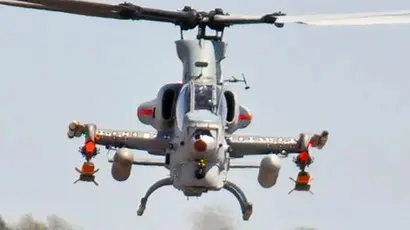
Alternatively, it is worth considering expanding the capabilities of the Marineon amphibious attack helicopter (MAH-1), which is nearing the end of its development, to undertake entirely different missions. For instance, while the current attack helicopter is equipped with autocannons, rockets, and missiles with a range of around 2–8 km, we could integrate long-range cruise missiles exceeding 200 km, such as the U.S. "Barracuda," to perform long-range precision strike missions instead of relying on Air Force fighters. We could also attempt to mount AESA radar for small fighters on these helicopters and equip them with autocannons to intercept enemy suicide drones infiltrating by sea.
Of course, such changes or expansions in missions might not help, or could even conflict with, our Marine Corps' current ultimate goal of "division-level amphibious assault operations." However, it is a fact that the coastal defense systems of North Korea, China, and Japan are so advanced that the traditional operation of landing tanks on an enemy beach is becoming increasingly less feasible. For the Marine Corps' quasi-fourth branch system to truly take root, we need to reconsider the goals and implementation methods of the Marine Corps' expeditionary capabilities with the sense of duty to reinvent the Marine Corps' mission from the ground up.