

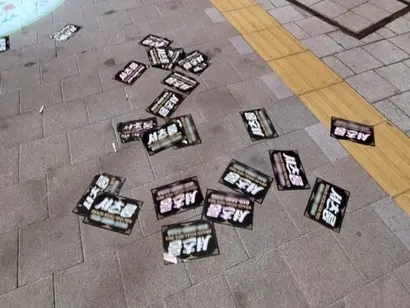
[비즈한국] Since introducing the 'Automatic Warning Call System (AWCS)' in 2024, the Mapo-gu Office in Seoul, which had previously suffered from illegal flyers on the streets in front of Hongik University, has not received a single related complaint. This is because the system effectively neutralizes the effectiveness of advertisements by constantly calling the numbers of businesses that distribute illegal outdoor advertisements. The system is so effective that it is already being used by 99 local governments nationwide. With the recent amendment to the Outdoor Advertisement Act providing a legal basis for automatic warning calls, the related market is expected to grow significantly.
On August 14, the Outdoor Advertisement Act was amended to include a new clause allowing local governments to build and operate AWCS. Last November, the Anti-Corruption and Civil Rights Commission recommended that the Ministry of the Interior and Safety establish a clear legal basis and detailed criteria, stating that "automatic warning calls could lead to legal disputes or be operated arbitrarily."
With the legal framework now in place, local governments are planning to actively pursue crackdowns on illegal outdoor advertisements using automatic warning calls. An official from the Seoul Metropolitan Government's Special Judicial Police Bureau predicted, "Unlike prostitution or illegal lending, there was a risk of complaints if automatic warning calls were used against legal businesses, but with this legal amendment, many local governments will actively utilize it (for cracking down on illegal advertisements)."
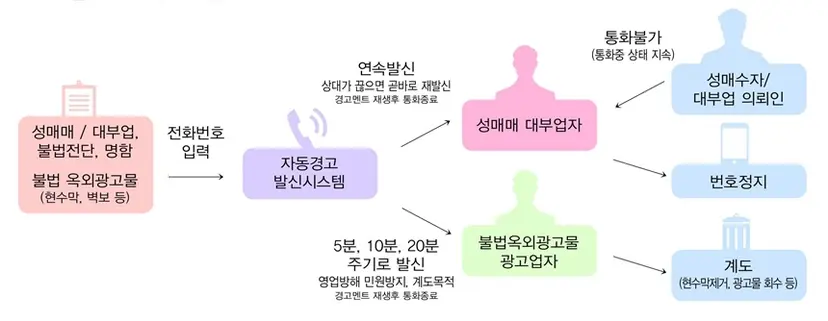
The AWCS works by automatically and repeatedly calling the phone numbers listed on illegal or suggestive advertisements at set intervals, rendering them unusable. It is particularly effective against flyers that are distributed secretly and in large quantities, rather than fixed formats like banners or posters. Under current law, distributing flyers directly or through unauthorized facilities is considered illegal.
The system operates by collecting phone numbers from illegal outdoor advertisements through field inspections or public complaints. Once a number is entered, the system calculates the cumulative number of violations and the severity of the illegal activity to set call times and frequencies, and then initiates continuous dialing. To bypass call blocking, it automatically generates hundreds of virtual numbers. As the calls continue, the specific phone number becomes effectively blocked, making it difficult to receive legitimate calls.
Local governments use this method to encourage the voluntary removal of illegal advertisements. It is especially effective against cases of prostitution or illegal lending, which often rely on burner phones. However, to prevent potential misuse, the system is provided only to public institutions based on the Telecommunications Business Act.
Currently, the AWCS is exclusively supplied by Company A, and the technology is registered as a patent. The patent covers technology that automatically recognizes advertisements to register phone numbers and the system method of sending voice messages to registered contacts. An official from Company A stated, "While our company cannot monopolize the concept of automatic warning calls, it would be practically difficult for others to implement the system while avoiding our patents." Company A requested that its name be withheld due to concerns over retaliation from illegal advertising businesses and potential systematic countermeasures.
AWCS was first introduced in 2017 by the Seoul Metropolitan Government's Special Judicial Police Bureau in collaboration with Company A. It was developed to prevent safety accidents involving vehicles and motorcycles that occurred during the process of cracking down on illegal flyers. Following the introduction of the system, Seoul blocked a total of 21,000 illegal lending phone numbers by 2022, of which 6,679 had their service suspended. As its effectiveness became known, 99 local governments across the country have now signed contracts with the company and are using it.
In the early stages of adoption, many contracts were annual private contracts. According to KONEPS (Korea On-line E-Procurement System) contract data, the cost was approximately 16 million won per year. Recently, the model has shifted to a monthly subscription fee. Costs are calculated by combining a rental fee of 660,000 won, a number usage fee of 330,000 won, and communication costs based on usage volume. The Seoul Special Judicial Police Bureau stated that it pays just over 1 million won per month.
However, some have stopped using the system due to the financial burden. The Yongsan-gu Office in Seoul operated it for three years from 2022 to 2024, but discontinued its use due to the lack of legal basis at the time and budget issues. A Yongsan-gu official explained, "The service costs were excessive compared to the number of illegal outdoor advertisements discovered, and it was difficult to afford the monthly fee of 1.6 to 1.8 million won for only a few crackdowns."