

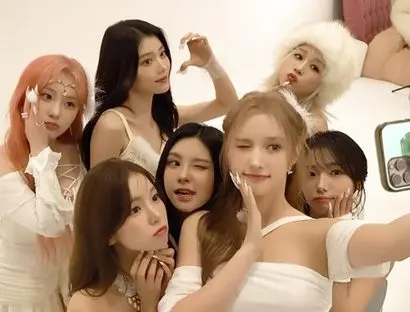
[비즈한국] News has emerged that the girl group Kep1er will hold a solo concert in Fuzhou, China, on September 13. Furthermore, China’s National Radio and Television Administration (NRTA), the regulatory body for broadcast and internet content, announced it would be introducing high-quality programs and broadcasts. The possibility of the "Hallyu ban" (the ban on Korean culture) being lifted seems greater than ever. As the Asia-Pacific Economic Cooperation (APEC) 2025 meeting in Gyeongju in October approaches, more discussions on this topic are likely to surface. To gauge the potential for the ban being lifted, one must look at the trajectory shown by Chinese authorities rather than individual cases.
The Hallyu wave of Korean dramas in China began in 1993 with the broadcast of the drama "Jealousy," starring Choi Jin-sil and Choi Soo-jong, on the state-run CCTV. Being aired on state-run CCTV—the Chinese equivalent of KBS in Korea, NHK in Japan, or the BBC in the UK—signified state-sanctioned approval. Every Chinese citizen could watch the drama without restrictions. Following the success of "Jealousy," CCTV aired "What is Love?" in 1997, which recorded the highest viewership ratings at the time. Even during its rebroadcast in 1998, it reached a 4.2% rating, nearly matching the then-record high of 4.5%. This was followed by the massive hit "Star in My Heart" in 1999, which propelled Ahn Jae-wook to Hallyu star status, surpassing the then-top actor and protagonist Cha In-pyo. This is why Ahn Jae-wook was recently invited to a state banquet in Vietnam.
Before the drama "Winter Sonata," "Autumn in My Heart" was aired across 21 channels in China in 2002 and became a sensation. However, there were signs of change. "Autumn in My Heart" was not aired on state-run CCTV, but on regional public television stations. Despite its immense popularity, it was not rebroadcast on CCTV. In 2005, "Dae Jang Geum" (Jewel in the Palace) was broadcast in China, but it was on Hunan Satellite TV, neither CCTV nor a regional public terrestrial station; it was limited to a regionally broadcast satellite channel. Nevertheless, it recorded an average viewership rating of 3.5% and an average audience share of 15.3%, the highest levels in the history of foreign dramas in China.
The number of Korean dramas aired in China dropped from 67 in 2002 to 32 in 2005. Despite the rising popularity of Korean dramas, the number of broadcasts had been cut by more than half. After a quiet period, "The Heirs" and "My Love from the Star" aired in 2013 and became huge hits. They were not aired on satellite TV, but on the video streaming platform iQIYI. "Descendants of the Sun," which became a major hit in 2016, was also aired on iQIYI. What Chinese authorities had overlooked was that Hallyu content delivered via the internet, rather than traditional broadcasting, held immeasurable influence over the younger generation.
By early 2017, Korean dramas were no longer available even online. Many attributed this to retaliation for the deployment of THAAD (Terminal High Altitude Area Defense). Documents circulated suggesting that the NRTA had issued regulations extending to the online sector. However, looking at the prior trajectory, this did not happen overnight. It was simply the point where the regulations became more full-scale, widespread, and fundamental.
In China, the cultural industry policy promoted by the Xi Jinping-Li Keqiang administration had been in effect since 2012. A keynote was established to cultivate a cultural industry centered on China's cultural identity and socialist characteristics. The cultural industry was intended for domestic consumption, not export. For the sake of regime cohesion and stability, there was a greater focus on fostering content based on traditional Chinese culture. Korean content stood at the opposite end of this spectrum. Exceptions were occasionally attempted in regions south of Shanghai, where the commercial tradition is strong, as a business matter. These regions were effectively the core of the Hallyu wave.

What is important are the regulatory criteria for foreign cultural content established after 2017. At the time, the Chinese pop culture media outlet Chuanmeiquan reported that the main components of the Hallyu ban included: a ban on new investments in Korean entertainment agencies, a ban on concerts featuring Korean idols with audiences over 10,000, a ban on joint production projects for Korean dramas and variety shows, and a ban on airing dramas featuring Korean celebrities in China. Tencent's acquisition of shares in SM Entertainment041510 did not violate the principle of banning new investments in Korean entertainment agencies.
There is still no news of Korean dramas being broadcast in China. Idol concerts like Kep1er's are expected to have audiences well under 10,000, and it is possible the count could be under 1,000. The Fujian Meeting Hall, where Kep1er will perform, has a capacity of about 1,500. The fact that small-scale fan meetings have been held intermittently can be understood in this same context. Fan meetings featuring a few songs or new song listening events are being held mainly in southern regions of the continent, such as Shanghai, Hangzhou, and Chongqing.
K-pop sings about individual freedom, dreams, and happiness, and the fact that Chinese youth flock to such performances could be uncomfortable for Chinese authorities. This is true not only for Korea but also for Western artists. There is no way to respond if the NRTA or local governments decide to cancel or deny permission for performances at any time. The announcement that high-quality content would be permitted can be understood in the same light. If you consider who gets to judge what constitutes a "high-quality" work, it becomes clear. This implies that while there may be a judgment on the work itself, there is also the potential for censorship at any time.
China has been gradually regulating Korean content. It is not solely because of the 2017 Hallyu ban. Even if THAAD were removed, things would likely not change significantly. Because the keynote of China's cultural industry policy is in operation, the situation remains impulsive and fluid. There is a vast difference between the positions of Chinese content companies or fans and those of the authorities. While the private sector may want to import Korean content at any time, it is subject to change based on the will of the Chinese authorities. We need the wisdom to respond while keeping this volatility in mind.
The author, Kim Heon-sik, has spent his time navigating and exploring the forest of popular cultural phenomena since his 20s, driven by the hope that there is a way to make the world a better place through culture. He continues on this path in the 21st century, an era of artificial intelligence and quantum computing, with that same belief.