

[비즈한국] It has been confirmed that domestic plant company Doosan Enerbility034020 has partially lost the appeal trial filed by Korea Hydro & Nuclear Power (KHNP) regarding shoddy construction work on Hanbit Nuclear Power Plant Unit 5. This result comes five years after allegations were first raised in 2020 that the contractor, Doosan Heavy Industries & Construction (now Doosan Enerbility), had performed substandard work on the reactor head penetration nozzles of the Hanbit plant.
While the court acknowledged the liability for damages caused by the shoddy construction, it set the compensation amount at approximately 8.3 billion won out of the original 42 billion won claim filed by KHNP. This figure is about 1.4 billion won higher than the first-instance verdict, as the appellate court interpreted the scope of Doosan Enerbility's liability more broadly.

Lawsuit over 42 billion won nuclear plant maintenance project, KHNP wins 'partial victory'
In the legal battle between nuclear plant operator Korea Hydro & Nuclear Power (KHNP) and contractor Doosan Enerbility over faulty construction at Hanbit Unit 5 in Yeonggwang, South Jeolla Province, the court ruled in favor of KHNP in the second instance, following the first-instance verdict.
According to BizHankook's investigation, the 2nd Civil Division of the Daegu High Court (Presiding Judge Kim Tae-hyun) ruled partially in favor of the plaintiff on the 27th of last month in the damages lawsuit filed by KHNP against Doosan Enerbility. The court stated, "Due to breach of contract or illegal acts resulting from the suspension of Hanbit Unit 5, [Doosan Enerbility] is obligated to compensate for damages equivalent to the power sales profits KHNP failed to earn, fixed costs spent with the expectation of recovery through cost of sales, and power purchase costs incurred to maintain the plant during the shutdown period."
Following this ruling, the compensation Doosan Enerbility must pay to KHNP amounts to 8.294 billion won. The first-instance court in February last year had ordered 6.854 billion won in damages, but the appellate court reassessed the appropriateness of the maintenance costs and increased the total compensation.
This case began with a faulty construction incident that occurred during the repair work on the Hanbit Unit 5 reactor head penetration nozzles in 2020. In 2018, Doosan Enerbility had won a 42 billion won maintenance contract from KHNP. The reactor head is the vessel containing the reactor, and the penetration nozzles are key components that serve as pathways for control rods to manage nuclear fission; if problems occur here, it can lead to situations where nuclear fission cannot be controlled.
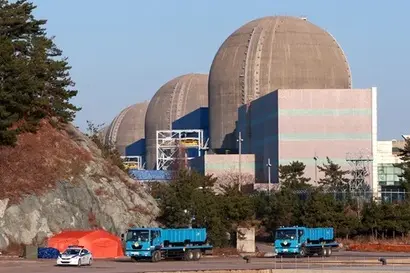
The head penetration nozzle repair work requires welding with a nickel-based special alloy ('Alloy 690') that is durable and resistant to corrosion cracking. However, it was later discovered that Doosan Enerbility's subcontractor used non-compliant stainless steel for some of the nozzles. It is known that Alloy 690 costs 1.05 to 1.2 million won per 15kg, which is 5 to 6 times more expensive than stainless steel, which costs in the 200,000 won range. The fact that the work was performed by unqualified welders from the subcontractor also became an issue.
KHNP confirmed this during a regular inspection in the summer of the same year and reported it to the Nuclear Safety and Security Commission (NSSC). The NSSC launched an official investigation and imposed an 1.8 billion won fine on KHNP in 2023. At the time, during the parliamentary audit of the NSSC, critics pointed out, "It is difficult to understand how workers could fail to distinguish between nickel alloy and stainless steel, which even ordinary people can tell apart. The contractor, Doosan Heavy Industries, likely knew about this but turned a blind eye and attempted to cover up the facts during the NSSC investigation."
Doosan’s liability increased compared to first instance
The period during which KHNP stated that the nuclear plant was shut down due to Doosan's faulty construction is from January to October 2021, when Hanbit Unit 5 received approval for restart. In court, Doosan Enerbility argued that there was "no causal relationship" between its construction work and the shutdown, claiming the defects were not significant enough to justify shutting down the reactor. However, the court opined, "Nuclear regulatory agencies need to supervise construction to ensure it is strictly performed according to designs and follows appropriate procedures," adding, "Because nuclear accidents are virtually impossible to fully recover from and require enormous costs and time to manage, there is a high necessity to fundamentally prevent such accidents."
Although both the first and second-instance courts recognized Doosan Enerbility's failure to follow safety regulations and faulty construction, the ruling is considered a limited victory for KHNP, given that the initial claim amounted to 42.059 billion won.
In the first-instance trial last year, the Gyeongju Branch of the Daegu District Court clearly defined Doosan Enerbility's liability for damages. However, the compensation was limited to 6.8 billion won. This was due to the legal interpretation that: 1) all liability under the contract between KHNP and Doosan Enerbility cannot exceed the total project cost (42 billion won), and 2) the actual maintenance costs incurred by Doosan Enerbility must be excluded from the compensation calculation.
The appellate court also estimated that the actual damages suffered by KHNP amounted to 51.8 billion won, but it also limited the compensation amount. It recognized only 8.2 billion won, which is the total project cost—the ceiling in the contract—minus the maintenance costs (approximately 35.3 billion won). The 51.8 billion won includes lost sales due to the suspension of power generation, fixed costs (labor and maintenance), power purchase costs, and fines.
The decisive factor for the increase in compensation in the second instance was the "scope of recognized maintenance costs." The Daegu High Court excluded approximately 1.4 billion won from the deduction, which it deemed excessively calculated compared to the actual scale of input by the subcontractor, leading to a higher final compensation than in the first trial.
This case is now headed to the Supreme Court. It has been confirmed that both KHNP and Doosan Enerbility have recently appealed the second-instance ruling. The intention is to seek a final judgment from the Supreme Court regarding the validity of the scope of damages and liability, which are the main points of contention.
As this case involves nuclear safety and large-scale liability, it is drawing significant industry attention. The conclusion of this case is expected to influence how nuclear construction, management, and the calculation of liability for defects are handled. A KHNP official stated, "We appealed to obtain an additional judgment from the Supreme Court regarding the interpretation and application of legal principles." A Doosan Enerbility official said, "Since this is a matter currently under litigation, it is difficult to provide a separate official position."