

[비즈한국] Since entering corporate rehabilitation last March, Homeplus has announced large-scale store closures and unpaid leave for headquarters staff, leaving employees in a state of major agitation. Store workers and unions are protesting, demanding an immediate halt to the closures, while fears of increasing pressure to take unpaid leave are spreading among head office employees.
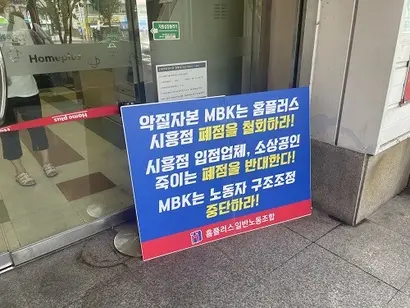
Employees Appeal to Customers for ‘Anti-Closure Petition’
"Please sign our petition against the closure." On the 19th, employees gathered at the entrance of the Homeplus Siheung branch approached passing customers with signature sheets. Customers, showing disappointed expressions, joined the petition, asking, "Is the Siheung branch really closing? You can't do that."
One Homeplus employee, who said they gave up their lunch break to collect signatures, stated, "We have been collecting customer signatures since the 15th, after the reports of the closure were released. Even though they say the closure is already finalized, we started this movement in hopes of stopping it somehow." They added, "Since there are no other large supermarkets nearby, many customers are saddened by Homeplus closing. They are actively participating in the petition."
Recently, Homeplus decided to sequentially close 15 stores where rent negotiations were unsuccessful. The stores slated for closure include Siheung, Gayang, Ilsan, Gyesan, Ansan Gojan, Suwon Woncheon, Hwaseong Dongtan, Cheonan Sinbang, Munhwa, Jeonju Wansan, Dongchon, Janglim, Busan Gamman, Ulsan Buk-gu, and Ulsan Nam-gu.
After entering corporate rehabilitation proceedings, Homeplus negotiated rent reductions with 68 leased stores nationwide. In May, it announced that it had reached agreements on rent adjustments with 41 stores, and after continued negotiations with the remaining locations, it ultimately decided to close the 15 stores where adjustments failed. A Homeplus official stated, "Rent negotiations for most stores are currently in the final stages," and added, "There will be no new stores opening this year."
The decision to close has significantly escalated employment anxiety among store staff. One employee said, "The company hasn't said anything yet about personnel relocation in the event of a closure. Since there are an average of 100 regular employees per store, it’s not easy to reassign everyone to nearby branches. Employees are extremely anxious."
The union has also criticized this closure decision. Ahn Su-yong, head of the Homeplus branch of the Mart Workers' Union, emphasized, "This is a base where thousands of direct employees and numerous shop owners have made their livelihoods. If it shuts down overnight, the local economy will be hit directly, and the livelihoods of workers and shop owners will be plunged into the abyss. MBK must immediately stop closing Homeplus stores and focus on actual self-rescue efforts to save the company."
Regarding the employment of staff at the closing stores, a Homeplus official explained, "We aim to relocate employees to nearby areas they prefer, and if necessary, we will provide support to minimize inconvenience through employment stability programs."

A Strategy to Induce Voluntary Resignations?
As Homeplus announced plans for unpaid leave for head office staff, employment anxiety has spread there as well. Homeplus announced that it would implement three months of unpaid leave starting September 1st. While this is currently known through internal notices, tension is already growing among the staff. Although the company stated that it would be limited to volunteers, employees perceive it as potential de facto restructuring.
A, who works at Homeplus headquarters, said, "After the unpaid leave notice was posted, the atmosphere in the office sank rapidly. I feel the greatest agitation since the corporate rehabilitation process began. Although it is officially a voluntary application method, I am very anxious about the possibility of follow-up indirect pressure."
Another employee remarked, "Since entering rehabilitation, most people who could leave have already resigned. For the employees remaining now, it is directly tied to their livelihood, so it is not easy to decide on unpaid leave. There is significant concern that if the number of applicants doesn't meet the company's expectations, there will be indirect pressure. From team leaders to junior staff, everyone is on edge, and the atmosphere in the office is sensitive."
An industry insider pointed out, "I suspect it's a kind of tactic. Instead of direct restructuring, they are trying to induce voluntary staff reductions through store downsizing and unpaid leave. However, the more they cut staff and stores, the more Homeplus’s business competitiveness will inevitably weaken."
A Homeplus official explained, "Nothing specific has been decided regarding the unpaid leave. The purpose is 'survival management' due to the company's difficult situation, and store closures, unpaid leave, and the return of some executive salaries are being implemented accordingly."

Some analysts within Homeplus suggest that unpaid leave and store closures are strategic moves to accelerate acquisition negotiations. One employee mentioned, "The company planned to announce a preferred bidder around mid-August, but they still haven't found one. When the company informed us of these measures internally, they also explained that it was aimed at appealing strongly to the government and the market."
Experts criticize this approach as being biased toward a "private equity perspective." They argue that the focus is solely on showing financial improvement to potential buyers rather than brand sustainability, such as customer convenience or employee job security. Lee Jong-woo, a professor of business administration at Ajou University, pointed out, "There is no strategy to show employees or customers; it’s a move that only considers the buyer's perspective. MBK has failed to secure the long-term operational viability of Homeplus. That is why retail companies are not interested in the acquisition."
In June, Homeplus received approval from the Seoul Rehabilitation Court to pursue pre-packaged M&A and selected Samil PwC as the lead manager for the sale. While it must submit a rehabilitation plan including debt repayment, operational normalization, and an acquisition plan by September 10th, no company has officially expressed an intent to acquire it so far.
Professor Lee Jong-woo analyzed, "MBK is pushing for a full sale, but if it happens, it will inevitably be traded at a significantly low price. If the situation continues like this, there is also a possibility that core stores in the Seoul metropolitan area could be sold off in pieces."