

[비즈한국] There is a company that once generated over 1 trillion won in annual revenue but now struggles to even hit 300 million won in quarterly revenue. We are talking about Access Bio950130, a flagship company that benefited significantly from the pandemic thanks to its COVID-19 rapid diagnostic kits. With its high reliance on sales from these kits, a turnaround in performance is difficult, and the possibility of it even losing its KOSDAQ listing is being raised.
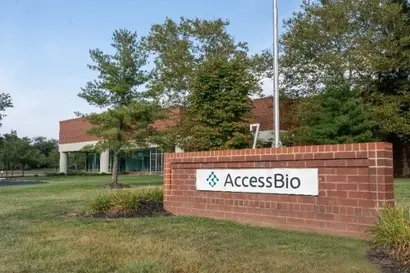
According to the Korea Exchange, trading of Access Bio shares has been suspended since the 18th. The reason given was the failure to meet the quarterly revenue threshold of 300 million won.
The suspension of Access Bio's stock trading could continue until September 5th at the latest. The KOSDAQ Market Division of the Korea Exchange set the 14th as the date the cause arose and decided to determine whether the company will be subject to a substantive review of listing eligibility by September 5th, which is 15 business days later.
If deemed subject to a substantive review, the Korea Exchange can decide to delist the company if it determines that its financial or non-financial requirements no longer satisfy the conditions for maintaining a listing on the KOSPI or KOSDAQ. Prior to Access Bio, companies like Cellivary268600 and PharmAbcine208340 were subjected to such reviews for failing to meet quarterly revenue standards; Cellivary was delisted in March and PharmAbcine in May.
An Access Bio representative stated, "Our goal is to explain our future operational strategy and performance recovery targets to the exchange so that we do not end up subject to a substantive listing eligibility review," adding, "We will do our best to ensure no harm comes to our shareholders."
Access Bio only generated 133,192 dollars (187 million won) in separate revenue for the second quarter of this year. The sharp decline in COVID-19 rapid diagnostic kit sales following the transition to an endemic state had a significant impact. COVID-19 rapid diagnostic kits account for over 70% of Access Bio's total revenue, a figure that exceeded 90% during the peak of the pandemic.
However, there are no suitable alternative revenue sources to buffer the sharp decline in diagnostic kit sales. Before the pandemic, Access Bio's main source of revenue was rapid diagnostic kits for malaria. While they once sold over 33 million dollars (45.9 billion won) worth, the company has failed to break the 13 million dollar (18.1 billion won) annual revenue barrier since the pandemic began.
Access Bio appears to be downsizing staff to cut costs. The number of employees was 104 at the end of last year, which decreased by 24% to 79 by the end of the second quarter of this year.
In contrast to Access Bio, other domestic diagnostic companies affected by the endemic transition are taking the opposite approach and increasing their staff. During the same period, SD Biosensor137310 saw its headcount grow from 613 to 649, Boditech Med206640 from 532 to 578, Sugentech from 152 to 154, Gencurix from 68 to 69, Genematrix from 67 to 69, and Humasis from 65 to 69. Even PCL, which faced a substantive review of listing eligibility before Access Bio last year due to missing quarterly or semi-annual revenue targets, increased its staff by one, from 30 to 31.
The Access Bio official stated, "As the business situation became difficult, we carried out the maximum possible restructuring, making the roles of the remaining employees even more important," adding, "We plan to expand sales and marketing by cooperating with agents who have local distribution networks in the U.S."
Access Bio predicts that demand for home diagnostic kits in the U.S. will rise again to respond to a "twindemic," where COVID-19 and the flu circulate simultaneously. The company argues that since medical costs in the U.S. are high, there is a significant need to determine whether one is infected with either disease at home at a low cost. The Access Bio official said, "We expect approval from the U.S. Food and Drug Administration (FDA) for a combo product that can diagnose both COVID-19 and the flu by September at the latest."
As of the end of the second quarter, Access Bio held 240.2 billion won in cash and cash equivalents and has 428.3 billion won in retained earnings, raising the possibility of new investments or M&A activity. The company also fully owns the investment firm Belight Investment.
As a leading beneficiary of the COVID-19 pandemic, Access Bio recorded 800.23 million dollars (1.1123 trillion won) in consolidated revenue and 363.17 million dollars (504.8 billion won) in operating profit in 2022. However, due to a sharp drop in demand for diagnostic kits following the transition to the endemic phase, it recorded 82.45 million dollars (114.7 billion won) in consolidated revenue and an operating loss of 3.1 million dollars (4.3 billion won) last year. Performance continues to deteriorate, with first-half revenue this year at 15.91 million dollars and an operating loss of 19.25 million dollars.