

[비즈한국] My "life movie" has recently changed. It is now "Elio," which was released in Korea on June 18th. Are we truly alone in the universe? It is the most Pixar-esque, beautiful story that answers this great question humanity has cherished for so long. I almost teared up when the voice of astronomer Carl Sagan played. I consider this work a tribute to Carl Sagan and the Voyager probes that flew into space carrying his dreams.
Every event in "Elio" stems from the Voyager probes that left Earth in 1977. Having exited the solar system, Voyager is discovered by aliens, who then decipher the Golden Record on board to find Earth. But how were these aliens able to find Earth’s location in this vast expanse of space?
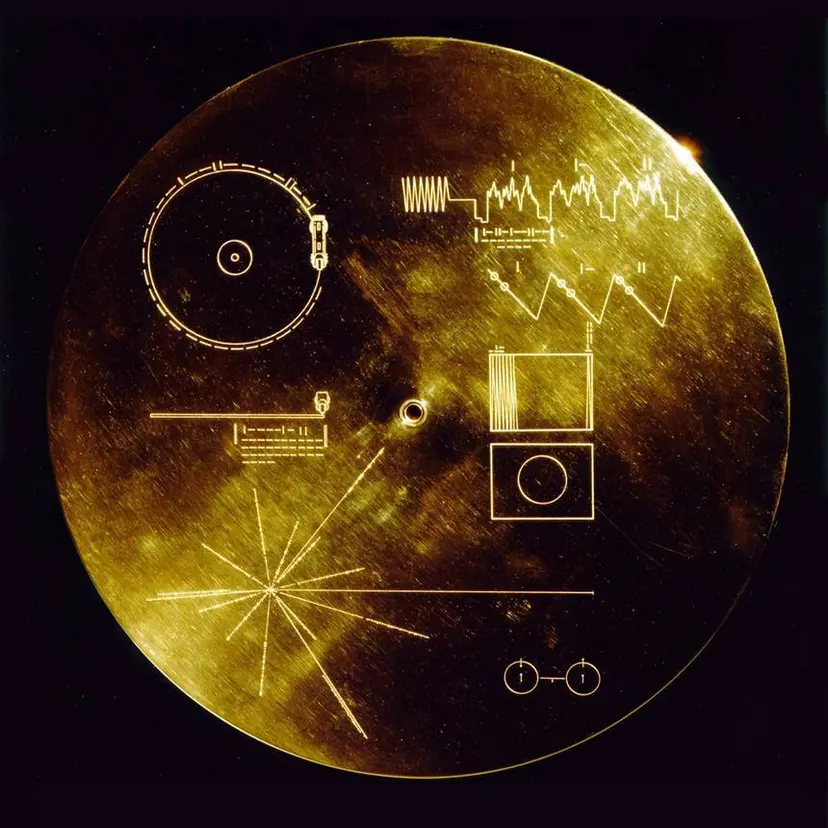
The Golden Record contains a special map inscribed by astronomers. This map features 14 straight lines radiating in all directions, plus one longer line. The center where these lines radiate from indicates the location of Earth. This map was devised by Carl Sagan’s colleague, astronomer Frank Drake. He selected 14 unique stars called pulsars to serve as a compass pointing the way to Earth. The Pioneer probes, which flew into space before Voyager, also carried a copper plate inscribed with the same map. And in "Elio," the aliens actually found Earth by following that map!
However, using pulsars to find one's way is not a technology exclusive to aliens. In fact, humanity is now dreaming of a new era of navigation that goes beyond GPS satellites, using the universe's own natural GPS: pulsars. This is pulsar navigation. Moreover, pulsars can serve as astonishing tools to trace how the very fabric of space-time in the universe vibrates, as well as the traces of the Big Bang. The day is not far off when we will utilize the fundamental vibrations of the universal space-time—which has been oscillating for 13.8 billion years since the Big Bang—to drive our cars and fly our airplanes.
Why did Drake choose pulsars as the guide stars for aliens? On Earth, the North Star acts as a guide. But the moment you leave Earth, the North Star becomes just another common star. The special meaning assigned to the North Star is only valid on Earth. We need a universal, impartial guide star that applies equally to everyone in the universe. Pulsars can fulfill that role perfectly.
A pulsar is a neutron star that rotates with an extremely short period, lasting only seconds. A neutron star is the result of a massive star collapsing into a small size. Consequently, its rotation speed becomes extremely fast and its magnetic field becomes incredibly strong. Along its strong magnetic axis, the neutron star spews out intense energy. However, unlike Earth, the magnetic axis does not perfectly align with the rotation axis; it is slightly tilted. Therefore, when viewed from a distance, the intense energy emitted by the neutron star appears to brighten and disappear repeatedly, much like a lighthouse beam entering and leaving one’s field of vision. Because the rotation period is quite short, the signal appears to be a pulse emitted at intervals of a few seconds. That is why they are called "pulsars," meaning stars that emit pulses.
The period of a pulsar remains very constant, at the millisecond level. Just as fingerprints are unique to every person, each pulsar has its own unique period. If you know the period, you can identify the pulsar. Furthermore, the energy emitted by a pulsar is very strong, making it a "lighthouse" that can be relatively easily detected even at great distances. In particular, pulsars are not artificial structures; they are natural lighthouses formed in the universe.
Drake believed that if there were civilizations like ours sailing the universe and searching for other beings, they would also discover pulsars and understand their characteristics well. He selected 14 pulsars in our galaxy that vibrate at regular intervals and drew lines reflecting the relative distance from Earth to each pulsar. Each pulsar’s rotation period was expressed in binary. The sizzling patterns at the end of each straight line represent the rotation period expressed in 1s and 0s. To allow for distance scale comparison, he added the longest line representing the distance from Earth to the Sagittarius A* black hole at the center of our galaxy. It would be a useful scale for nameless hitchhikers navigating the Milky Way. If there are intelligent beings like those in "Elio," they could identify each pulsar engraved on the Voyager Golden Record and pinpoint the location of Earth, where the lines converge based on their spatial positions.
Pulsars are the most accurate clocks in the universe. Now, pulsars go beyond finding Earth and have become tools to detect the vibrations of the entire cosmic space-time. Immediately after the Big Bang 13.8 billion years ago, the universe was extremely hot. As the universe expanded rapidly, the temperature gradually dropped. When the temperature fell below 10^12 K, basic particles called quarks, which had been roaming separately, began to clump together into protons and neutrons. At this moment, the universe underwent a massive transformation. It was a change as radical as water vapor condensing into water in an instant. This period is actually called the phase transition of the universe. It is possible that a giant vibration, where space-time itself resonated, spread throughout the universe at this time. Its traces would remain as the subtle ripples of gravitational waves spread throughout space-time. This is the "background gravitational wave" that lies like a background across the universe.
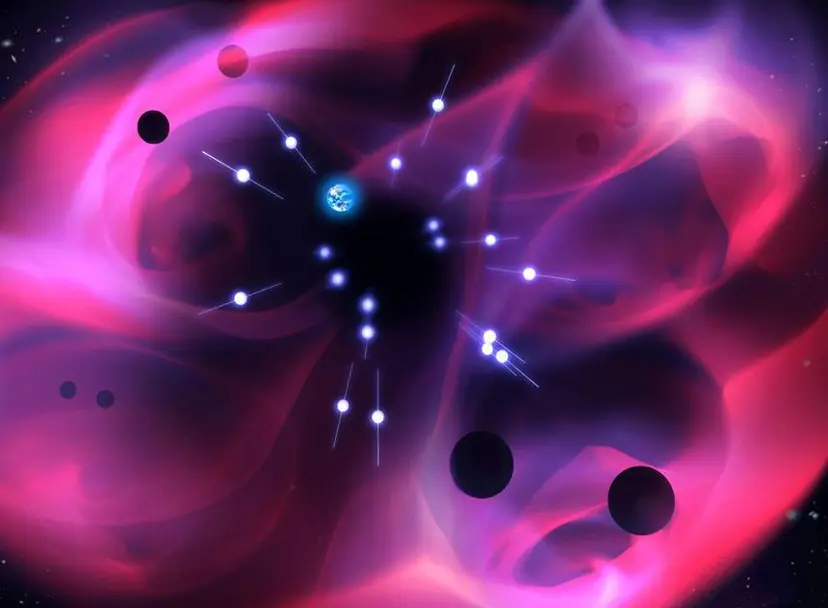
This is different in nature from the gravitational waves detected by the LIGO detector in 2015. The gravitational waves captured at that time were vibrations created when two massive black holes collided. Whenever a pair of black holes existing somewhere in the universe collide, such intense gravitational waves are emitted intermittently. This can be seen as a "gravitational wave tsunami" that appears and disappears suddenly from various places without warning.
On the other hand, "background gravitational waves" are different. These are waves that have been subtly spread across the universe since the dawn of time, literally background gravitational waves. You could see them as the ripples of gravitational waves. Background gravitational waves are similar to the Cosmic Microwave Background, which is the light that first spread across the universe 380,000 years after the Big Bang. You can think of background gravitational waves as the gravitational wave version of the Cosmic Microwave Background.
These vibrations cause the rhythmic signals from each pulsar observed from Earth to arrive faster or slower than expected. By watching the subtle changes in the pulsar vibration periods across the universe, we can detect the gravitational wave vibrations that have swept through them. Pulsars have effectively become a cosmic buoy system that allows us to feel the waves of the transparent cosmic space-time. This observational method of detecting space-time vibrations through pulsars is called a Pulsar Timing Array.
Through this massive observation, astronomers already discovered in 2023 that the cosmic space-time is indeed vibrating as a whole. It was a surprising result obtained by observing dozens of pulsars over nearly a decade. However, more than a year later, astronomers have added recent observations to discover even newer facts. With the addition of a new Pulsar Timing Array using the MeerKAT radio telescope in South Africa, they have detected space-time vibrations with an even larger field of view. Over the past five years, they precisely measured all signals arriving from a total of 83 pulsars. Thus, humanity has completed the first "gravitational wave map" in history.
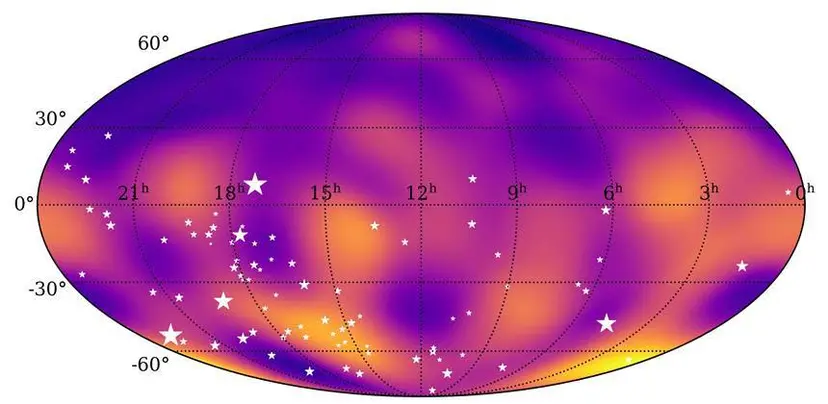
However, an interesting point stands out when looking at the gravitational wave map. There are areas where the gravitational wave vibrations appear stronger. This brings to mind the controversy over the anisotropy of the universe, which is a hot topic in modern astronomy. If these are background gravitational waves left over from the Big Bang, they should have spread evenly throughout the universe, so there would be no reason for such directionality.
Is it possible that there is a higher concentration of supermassive black holes in that particular direction of the universe causing these vibrations? It is possible. However, caution is needed. This area shown on the map appears particularly in the southern sky, which may be due to observation bias caused by the Pulsar Timing Array recently observing from MeerKAT in the Southern Hemisphere.
Pulsars, which act as tools to show even the vibrations of the entire universe, also serve as the most accurate and useful guide stars for travelers lost in space. For probes leaving Earth to navigate the universe, having an absolute guide star is crucial. Until now, probes that have traveled within the solar system, such as those to Mars or Jupiter, have used the brightest stars around Earth, like Sirius or Canopus, as guide stars. However, stars also move through space, which is a problem. Ultimately, an ordinary star cannot be the ultimate, absolute guide star. For explorers like Voyager, Pioneer, and the New Horizons probe that followed to sail beyond Pluto and out of the solar system, these ordinary stars are even less useful.
Instead, a pulsar that vibrates at regular intervals and is so far away that it is effectively perceived as fixed in place could be a more absolute standard. In particular, for humanity, which dreams of a space age where we leave Earth and navigate the cosmos in the near future, space navigation using pulsars is a very important and realistic task.
In fact, in 2017, NASA attempted an experiment to fix the precise position coordinates of a space station using only pulsars. It was an attempt to determine the station's location relying solely on pulsars, without exchanging any information with Earth control. To this end, the space station was equipped with the Station Explorer for X-Ray Timing and Navigation (SEXTANT), a washing-machine-sized device that detects X-ray signals. Through this, they succeeded in pinpointing the space station's exact location in space with an error of less than 5 km using only four X-ray pulsars. Considering that the space station is moving at a staggering speed of 28,000 km/h, the fact that its position could be found with such precision relying only on pulsars is a very surprising result.
We find our location on Earth based on signals from GPS satellites orbiting in geostationary orbit above our heads. But ultimately, GPS satellites are just artificial satellites circling Earth quickly. If we cannot determine the absolute position of the GPS satellites themselves in the first place, using them as a reference to find our way is useless. Therefore, astronomers are considering ways to utilize quasars, which are active galaxies spewing intense energy at the edge of the universe, or pulsars that emit pulse signals at a very constant rhythm across the universe, as a GPS for GPS.
As human civilization has become more advanced, we have come to live in a very sensitive era where our lives are dictated by seconds and millimeters. The future will be an even more sensitive era. It will be a hyper-sensitive society where the cost to individuals and society will differ based on even a single millisecond or a single micrometer. Astronomy, which used to gloss over things with big numbers and was always accompanied by large margins of error, is now a thing of the past. Astronomy is also becoming a field of ultra-precision science that pays attention to even the short time it takes to blink. That change will make the measurements of our daily lives even sharper and more precise. Before long, we will live lives taking autonomous buses guided by pulsars and trusting ourselves to spaceships heading toward Mars led by the guidance of quasars.
References
https://academic.oup.com/mnras/article/536/2/1489/7912548?login=false
https://academic.oup.com/mnras/article/536/2/1467/7912547?login=false
https://academic.oup.com/mnras/article/536/2/1501/7912549?login=false
https://iopscience.iop.org/article/10.3847/2041-8213/ace18b
https://iopscience.iop.org/article/10.3847/2041-8213/acda9a
https://iopscience.iop.org/article/10.3847/2041-8213/acdac6
https://iopscience.iop.org/article/10.3847/2041-8213/acdc91
Who is author Ji Woong-bae? He loves cats and the universe. After watching "Galaxy Express 999" as a child, he dreamed of spreading the beauty of the universe. He currently researches the evolution of galaxies through interactions at the Yonsei University Galaxy Evolution Research Center and the Near-Field Cosmology Laboratory, and conducts various science communication activities such as lectures and writing. He has written books such as "The Observatory of 'Ssum' (flirting)," "Thinking About the Universe All Day," and "Stars, the Science of Light."