

[비즈한국] The wage and collective bargaining agreements for this year at the five major domestic automakers (Hyundai Motor005380, Kia000270, KGM, Renault Korea, and GM Korea) are following different paths depending on the company. Hyundai Motor is considering industrial action after declaring a breakdown in talks, while Kia has entered the early stages of tug-of-war in main negotiations. In contrast, Renault Korea and KGM reached agreements without strikes, while GM Korea is preparing for re-negotiations amid partial strikes.
For Hyundai Motor and Kia, the core issues emerging include a 141,300 KRW monthly base salary increase, extending the retirement age to 64 and adjusting the wage peak system, piloting a 4 to 4.5-day workweek, and expanding the scope of ordinary wages while providing consolation payments. Renault Korea and KGM reached settlements by focusing on adjusting compensation structures like base salary and Profit Incentive (PI) schemes. Meanwhile, GM Korea is currently locked in disputes over core agendas such as the 141,300 KRW base salary increase, the size of performance bonuses, and guarantees for domestic investment and employment.
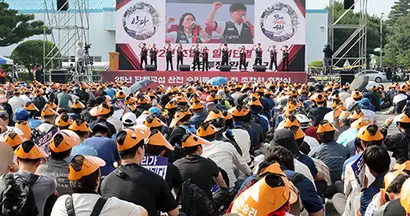
Hyundai Motor began main negotiations on June 18 at its Ulsan plant and held 17 rounds of talks, but the labor union officially declared a "breakdown of negotiations" on August 13 and began discussing steps for industrial action. The union is demanding a 141,300 KRW monthly base salary increase, performance bonuses at a 30% level of the previous year's net profit, an increase in bonuses to 900%, a retirement age of 64, a 4.5-day workweek, expansion of ordinary wages, and a consolation payment for union members (approximately 20 million KRW). Issues regarding retirement age, working hours, and the expansion of ordinary wages are social flashpoints that simultaneously trigger debates over generational employment, productivity, and corporate costs. The company explained that its profitability has been burdened by tariffs and slowing demand, citing a slowdown in second-quarter performance. Depending on whether the union secures the right to strike, the possibility of breaking the 7-year streak of no-dispute agreements cannot be ruled out.
Kia entered full-scale negotiations on August 12 with its first main meeting. The union's demands (141,300 KRW monthly base salary increase, performance bonuses of 30% of operating profit, retirement age of 64, 4 to 4.5-day workweek, and approximately 20 million KRW in ordinary wage-related consolation payments) are in line with those of Hyundai Motor. The company stated that while second-quarter revenue grew, operating profit shrank due to the impact of tariffs, and it intends to pursue second-half recovery in parallel with North American localization adjustments. Although "top-line" growth can be defended due to strong U.S. sales, if margin pressure persists under the tariff regime, the scope for management concessions on performance bonuses and working hours is expected to be limited. There is a high probability that the direction of Hyundai Motor's negotiations will act as a linked variable for Kia's talks.
KGM (KG Mobility) presents a contrast. Following the initial meeting in June, a tentative agreement was reached on July 30, and it was passed by 64.5% of union members on the 31st, marking the 16th consecutive year of settlement without a strike since 2010. The agreement includes a 75,000 KRW base salary increase, a total of 3.5 million KRW in payments including PI, and cooperation on promoting new future vehicles and businesses. The company's strategy is to secure production stability through early settlement despite external variables and speed up internal strengthening in the second half of the year.
Renault Korea was the first among the five companies to reach a settlement this year. Negotiations, which began with an initial meeting in April, reached a tentative agreement during the 9th main negotiation round on July 22, and were finalized on the 25th with a majority vote of approval from the employee general assembly. The core of the deal is a 103,500 KRW base salary increase, a 2.5 million KRW lump-sum settlement bonus, and a 150% variable PI. Within one month of the settlement, a "Labor-Management Joint Personnel System Improvement Committee" will be launched to improve wage structures and working environments. Unlike the difficulties faced by larger companies, the company aims to focus on new car projects like the 'Grand Koleos' by securing a competitive advantage through a strike-free, early settlement.
GM Korea continues to struggle. After the first negotiation in late May, no common ground was found during the June-July talks, leading to partial strikes starting July 10. Although re-negotiations are scheduled for August 18 after the summer vacation, the right to take industrial action has already been secured. The union is demanding a 141,300 KRW base salary increase, higher incentive and performance bonuses, and expanded domestic investment, while the company’s proposal of a 60,300 KRW base salary increase and a total of 16 million KRW in temporary and performance bonuses was rejected. The fact that the "withdrawal rumor" has reignited due to plans to sell direct service centers and idle assets in Bupyeong is also a burden. Due to a business structure highly dependent on North America, the impact of external variables such as tariffs and exchange rates is significant, and the visibility of domestic production and investment promises is considered the key factor that will determine the direction of the negotiations.
What has changed the negotiation landscape this year more than anything is the U.S.-Korea tariff issue. Based on government announcements, tariffs on automobiles and parts were lowered from 25% to 15% following an agreement at the end of July, but compared to the previous zero-tariff environment based on the FTA, the cost burden has become pronounced. Some companies separately explained the impact of tariffs in their second-quarter earnings reports, emphasizing a conservative management stance. This change defined the "realistic limits" for management on major issues such as total performance bonus amounts, working hour reductions, and domestic volume preservation, and also introduced variables into the union's strategy.
For Hyundai Motor and Kia, the structural agenda of retirement age, working hours, and ordinary wages is colliding head-on with the external variables of tariffs and slowing demand. As Hyundai Motor has declared a breakdown, the possibility of industrial action becoming a reality exists, and Kia's negotiation path may vary depending on the outcome at Hyundai Motor. Renault Korea and KGM have prioritized production stability through strike-free, early settlements, but it is difficult to avoid the indirect effects of tariffs and the global demand slowdown. For GM Korea, the August re-negotiation is the watershed moment amidst the dual burdens of reignited "withdrawal rumors" and strikes.
Looking at the industry as a whole, a "package deal" involving the redesign of total performance bonuses, flexible working hours, and the balancing of domestic volume and North American localization is emerging as a realistic solution. Amid the triple variables of tariffs, exchange rates, and demand, the answers to who will smoothly navigate the crisis and who will face a new inflection point lie in the negotiation rooms and earnings reports of the second half of the year.