

[비즈한국] President Lee Jae-myung attended the 80th Liberation Day ceremony on August 15 and stated, "The government will properly record the history of the independence struggle and remember it alongside the people," adding, "Let us move forward together toward a Republic of Korea that leads the world, a nation filled with peace and prosperity, and a country where the light of national sovereignty never goes out."
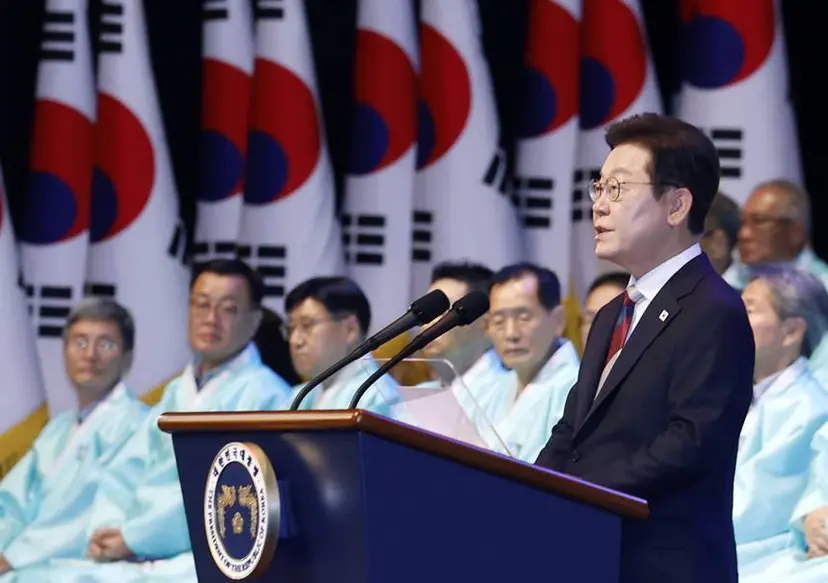
At the Liberation Day ceremony held at the Sejong Center for the Performing Arts in Gwanghwamun, Seoul, President Lee said, "80 years ago today, we reclaimed our lost light. That light was not obtained for free. It was won through the sacrifice and dedication of countless people," adding, "Let us all protect this light together so that the light regained through liberation is never taken away again, and the light defended against dictatorship and civil strife never fades." To this end, he promised to ensure that patriotic martyrs and the surviving families of independence activists, both at home and abroad, receive the honor they deserve.
He also expressed a will to improve political culture. President Lee urged, "Unfortunately, our politics are falling short of the expectations and standards of our people. We must now change our political culture," and called for "moving away from the politics of division based on outdated ideologies and factions, and building a politics of solidarity and mutual growth based on dialogue and concession."
Regarding North Korea, he expressed a desire for peace and coexistence based on the Inter-Korean Basic Agreement. President Lee stated, "The South and the North are in a special relationship in the process of pursuing peaceful unification, while respecting and recognizing each other's systems," and "This spirit contained in the Inter-Korean Basic Agreement permeates inter-Korean agreements, from the June 15 Joint Declaration, the October 4 Declaration, and the Panmunjom Declaration, to the September 19 Joint Declaration." He added, "Our government will respect existing agreements and implement them as possible." In particular, he emphasized, "We clearly state that we respect the North's current system, will not pursue any form of unification by absorption, and have no intention of engaging in any hostile acts."
President Lee announced his intention to preemptively and gradually restore the September 19 Military Agreement to prevent accidental clashes and build military trust between the two Koreas. He said, "Based on the principles of mutual benefit and common prosperity, we will work to restore the foundation for exchange and cooperation and create conditions for mutual growth that can substantially improve the lives of residents in both the South and the North. I hope the North will respond to our path of restoring trust and reviving severed dialogue."
Regarding Japan, he emphasized cooperation that transcends past history to move toward the future. President Lee noted, "As the Republic of Korea and Japan have shared a long and complicated history, establishing a relationship with Japan is always an important task," but added, "Just as Korea and Japan have grown together during the industrialization process, when our two countries cooperate for the future based on trust, we will be able to overcome the challenges of the hyper-gap AI era." He emphasized, "Based on the principle of practical diplomacy centered on national interest, we will seek a path of future-oriented win-win cooperation with Japan by meeting frequently through shuttle diplomacy and engaging in honest dialogue."
He also urged the Japanese government to make efforts. "I expect the Japanese government to face the painful history of the past and make efforts not to undermine the trust between our two countries," he said, adding, "I believe that when that happens, greater mutual interests and a better future will unfold for both sides."
Finally, President Lee concluded, "We are all currently in the midst of a massive whirlwind of change. If we fall one step behind, we are merely weary pursuers, but if we stay half a step ahead, we become leaders who enjoy infinite opportunities," and added, "Let us move forward together toward a Republic of Korea that leads the world, a nation filled with peace and prosperity, and a country where the light of national sovereignty never goes out."
The previous day, on the 14th, President Lee Jae-myung posted on social media to commemorate the late grandmother Kim Hak-sun, who testified about being a victim of the Japanese military's "comfort women" system 33 years ago, and to wish for the well-being of all comfort women victims. In his post, President Lee wrote, "It is the 80th anniversary of liberation, but the comfort women victims still do not enjoy freedom and peace," and promised, "I will surely create a country where human rights are common sense, peace is part of daily life, and justice breathes and lives."
Meanwhile, on the 15th, Liberation Day, Japan's Minister of Agriculture, Forestry and Fisheries Shinjiro Koizumi, who is considered a candidate for the next prime minister, visited the Yasukuni Shrine. He is the first incumbent cabinet member to do so since the launch of the Ishiba Shigeru cabinet. Local Japanese media reported that Minister Koizumi visited the Yasukuni Shrine in Chiyoda-ku, Tokyo, and paid for the offering with his own money. Koizumi had attended major ceremonies in person even before becoming a minister, and also visited the Yasukuni Shrine on the anniversary of the end of the war in 2020 and 2021.