

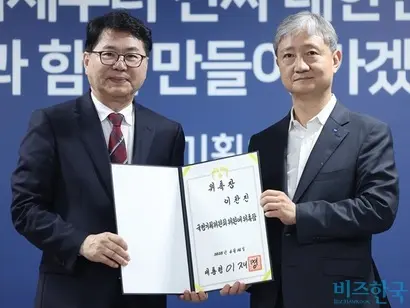
[비즈한국] Lawyer Lee Chan-jin has been appointed as the new Governor of the Financial Supervisory Service (FSS), filling a vacancy that had lasted for over two months. On the 13th, the Financial Services Commission (FSC) recommended his appointment through an extraordinary plenary session, and the President finalized the appointment on the 14th. This comes about two months after former Governor Lee Bok-hyun stepped down on June 5. As a former Judicial Research and Training Institute classmate of President Lee Jae-myung and the first FSS governor to come from the progressive lawyers' group Minbyun (Lawyers for a Democratic Society), Lee Chan-jin’s appointment has drawn significant public attention.
Character
FSS Governor Lee Chan-jin was born in Seoul in 1964 and graduated from Hongik University High School and Seoul National University College of Law. After passing the 28th Bar Examination in 1986, he completed the 18th class of the Judicial Research and Training Institute. He is known to be a classmate of President Lee Jae-myung from their time at the institute and to have been active together in the Labor Law Research Society. Governor Lee has been involved in civic groups for a long time, serving as vice-chair of Minbyun and executive committee chair of People's Solidarity for Participatory Democracy (PSPD).
Career
After serving as a military judge advocate, Governor Lee opened his private legal practice in 1992 and has been working at Jeil Joint Law Firm ever since. He later served as vice-chair of Minbyun and executive committee chair of PSPD.
He also possesses experience in advising public institutions. He served as a member of the National Pension Service Fund Management Committee (and its working group), as a director for the Seoul Foundation of Women and Family, the Korea Institute for Gender Equality Promotion and Education, and the Sangji Academy school foundation, and as a civilian member of the Ministry of National Defense’s Committee on Past Affairs. Furthermore, he has a track record of legal consulting and litigation related to capital markets and accounting.
His ties to the President run deep. As a classmate from the Judicial Research and Training Institute, he and President Lee Jae-myung were active together in the Labor Law Research Society. When President Lee served as mayor of Seongnam, Lee participated in the legal team during the litigation against Gyeonggi Province regarding the "three major free welfare projects," and he was also on the defense team for the "Ssangbangwool North Korea remittance" case. This past January, President Lee appointed him as his lawyer for the second trial of his "Public Official Election Act violation case." In June, he was appointed to lead the Social Division 1 of the President's State Planning Committee.
Capability
In its recommendation, the FSC stated, "He is evaluated as having excellent job performance capabilities, having conducted legal consulting and litigation related to capital market accounting for numerous companies, including venture startups and listed firms," adding, "Based on his diverse experience and expertise, he is considered the right person to carry out the FSS's urgent tasks, such as restoring trust in financial institutions and strengthening financial consumer protection."
The FSC also highly valued his experience with Minbyun, PSPD, and the National Pension Service Fund Management Committee. This has led to expectations that he will implement reformative policies based on his background in civic and social activism.
In fact, in May 2020, when Lee was the committee chair at PSPD, the organization proposed 70 reform tasks to the National Assembly. These included: reforming the Restriction of Special Taxation Act and the Income Tax Act to strengthen taxation on financial and rental income; revising the Interest Limitation Act and the Credit Collection Act to resolve household debt issues and strengthen financial consumer protection; raising real estate holding tax rates to 1% to address asset inequality; enacting the "Act on Fair Online Transactions" to regulate monopolies and unfair practices by online platforms; and amending the Comprehensive Real Estate Holding Tax Act and the Local Tax Act to reflect real market prices for real estate.
In particular, as he is viewed as a figure who well understands President Lee Jae-myung's direction for state affairs, there is speculation that he will spearhead the reorganization of the financial supervisory system alongside Lee Eog-won, the former First Vice Minister of Economy and Finance who was nominated as the FSC Chairman.
There is also talk that he has shown interest in current financial regulatory issues, such as the amendment of the Commercial Act and the rights of minority shareholders. Given his career, he is expected to heighten sensitivity toward consumer protection.
Critical
His history with Minbyun and PSPD is both a strength and a weakness for Governor Lee. Critics argue that he lacks financial experience and expertise, given his non-financial background. It is known that he has never worked in a field directly related to financial supervision. Furthermore, due to his close ties to President Lee Jae-myung, concerns have been raised regarding his independence and political neutrality as the head of the FSS.
Park Sung-hoon, the chief spokesperson for the People Power Party, stated in a commentary on the 14th, "Lawyer Lee Chan-jin, nominated as the FSS Governor, is a classmate of President Lee Jae-myung from the Judicial Research and Training Institute and served as his lawyer for the Ssangbangwool North Korea remittance allegations and the Public Official Election Act violation case," and criticized the move by saying, "This is an appointment where loyalty to protect the President takes precedence over financial market stability and crisis response."
Challenges
Immediately after taking office, the task facing Governor Lee is the reorganization of the FSS and the FSC. Since the government has expressed its intent to dismantle the FSC and merge its supervisory functions with the FSS, Governor Lee is tasked with a massive organizational overhaul. He must also handle major pending issues such as household debt management and the revision of the Commercial Act.
Since President Lee Jae-myung visited the Korea Exchange on June 11 and declared, "If anyone is involved in stock price manipulation, I will ensure they never set foot in the stock market again," calling for a 'one-strike-out' system, a concrete implementation plan must also be prepared.
In his inaugural address on the 14th, Governor Lee presented five directions for financial supervision: expanding the supply of risk capital from the financial sector to small and medium-sized enterprises (SMEs) and ventures, establishing a fair market order, resolving the real estate project financing (PF) problem, stabilizing household debt, and expanding financial consumer protection functions.
Specifically, he explained that he would support the smooth supply of funds to SMEs and strive to provide legal and institutional support for the utilization of AI. He also stated that he would firmly maintain a "stable management policy for total household debt" to normalize housing and construction finance and curb the rise in real estate prices.
For financial consumers, he announced that he would expand the monitoring functions of the financial sector and actively utilize supervision and inspection capabilities. He also warned of strict responses with a "zero-tolerance policy" regarding stock price manipulation and the abuse of dominant market positions.