

[비즈한국] The Gyeongju ‘Gold Carnival’ festival, which drew 150,000 visitors last year, has been caught in a controversy over plagiarism. After the Gyeongju Central Commercial District Renaissance Project Group (the Project Group) announced a call for service bids for this year’s Gold Carnival, the company that planned the festival last year protested, claiming the city of Gyeongju used their creative work without authorization. The city of Gyeongju countered that there is no issue because, according to the contract, all copyrights belong to the ordering agency. Experts point out that the practice of ordering agencies claiming sole ownership, which violates the principle of joint copyright ownership in government service contracts, must change.
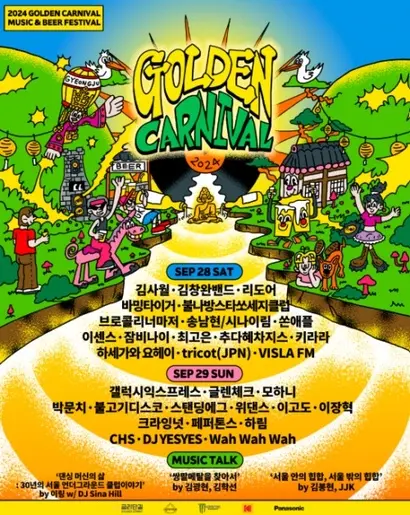
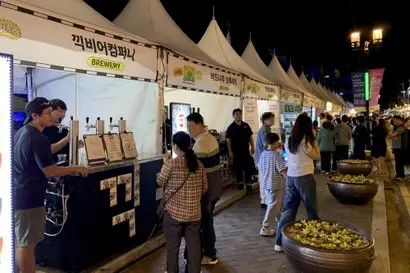
The cultural planning firm Common held its own town-style music festival called the ‘Hwangnam-dong Carnival’ in 2022 and 2023. Town-style festivals are characterized by hosting performances and events in small local spaces such as shops, cafes, and clubs. Last year, Common bid on the ‘3rd Geumridan Art Festa Event Agency Service’ ordered by the Project Group and expanded the event to include Bonghwangdae and Geumridan-gil, holding the event under the name ‘Gold Carnival & Gold Beer Festival.’ In essence, they received financial support from the local government for a local festival they had initiated themselves.
At the time, Common received 180 million KRW in project funding but stated that they had invested an additional 280 million KRW of their own company budget for smooth operations. They particularly emphasized that the Gold Beer Festival was a purely internal event that did not utilize any of the local government's service budget.
The conflict began when the Project Group announced the ‘4th Geumridan Festa Event Agency Service’ this year. The task description included items similar to last year’s Gold Carnival, such as “spatial direction and operation utilizing vacant and commercial stores within the commercial revitalization zone.” Common did not participate in this year’s bid due to debts and difficulties incurred from the previous event.
Afterward, Common was shocked to see this year’s festival website, created by the new agency. It used performance photos and slogans from the days of the ‘Hwangnam-dong Carnival.’ Common protested, stating this was a clear copyright infringement. Hwang Gyu-seok, CEO of Common, said, “The Gold Carnival is the result of years of accumulated know-how and creative work,” adding, “Taking it without consent is a serious copyright infringement.” In response, the representative of the new agency explained, “We brought in images from the previous Gold Carnival website during the website testing process, but closed the site after being pointed out by the Project Group.”
Determining that their copyright had been plagiarized, Common demanded that Gyeongju City and the Project Group: stop using the name ‘Gold Carnival & Gold Beer Festival,’ issue an apology, hold the personnel in charge accountable, and revoke the qualifications of the copyright-infringing company. CEO Hwang emphasized, “This year’s event is being held during the APEC host week, and I believe there is an intention to claim the achievements of the Gold Carnival as Gyeongju City’s own,” adding, “At the very least, they should change the name so fans aren’t confused.”
However, Gyeongju City maintains that there is no problem. A Gyeongju City official stated, “The contract includes a clause stating that ‘all copyrights for the produced results belong to the ordering agency,’” adding, “The event name, planning proposal, and side events are all included in the scope of the contract.” The official further added, “We paid 12 million KRW in logo design fees and rightfully acquired the copyright.” They did not accept Common’s claim that it was a ‘self-hosted event,’ asserting that the Gold Beer Festival was also included in the original planning proposal.
Regarding the demand to revoke the new agency’s qualifications, the city maintained there were no legal issues, stating, “It does not fall under the grounds for contract cancellation under the Local Contract Act.”
Experts point out that this matter conflicts with copyright regulations for government service contracts. According to Article 56 of the Ministry of Economy and Finance’s ‘General Conditions for Service Contracts,’ the intellectual property rights for service results are, in principle, jointly owned by the ordering agency and the contractor. In 2020, the Presidential Council on Intellectual Property reaffirmed this principle and released ‘Government Service Contract Guidelines,’ stating that the practice of sole ownership by the ordering agency must be improved.
Analysis suggests that because the contract signed by Common and the Project Group included the General Conditions for Service Contracts that specify the joint ownership principle, it conflicts with the ‘sole ownership by the ordering agency’ clause in the task description. Lim Ae-ri, an attorney at Daese Law Firm, said, “While festival concepts and ideas are difficult to include in the scope of copyright protection, it is necessary to examine whether there was an unfair contract or a possibility of violation of the Unfair Competition Prevention Act.”
Some visitors who have enjoyed the Gold Carnival also expressed their disappointment. Kwon, a visitor who attended last year’s Gold Carnival, said, “It is unfortunate to see local culture lose its momentum again, blocked by the wall of the local government,” adding, “Even if the copyright belongs to the ordering agency, a way to coexist with the planner would have preserved the trust of local youth.”