

[비즈한국] ‘A story about the owner of a small business who is petty, imprudent, and somewhat lacking.’ This is how Jung Tae-seung, the author of ‘Self-Capitalism,’ describes his own book. However, even office workers know well that becoming and surviving as a small business owner in South Korea is no easy feat.
The author graduated with a degree in Korean Literature, joined a trading company, and spent over a decade gaining practical experience in overseas sales and import-export operations both domestically and internationally. He had no capital or connections, but he possessed strong intangible assets: ‘people,’ ‘attitude,’ and ‘self-trust.’ This gave him the confidence to start his own business, and he now runs a company with an annual revenue of 20 billion won.
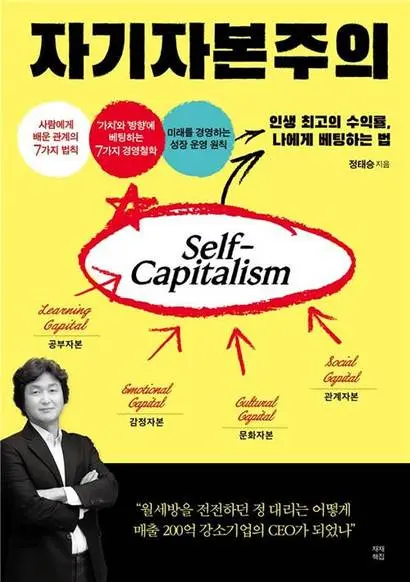
Through the process of reaching his current position as a CEO after numerous failures and small achievements, the author presents the topic of ‘Self-Capitalism’ to us.
The capital he speaks of is not financial. It refers to invisible, intangible assets such as relational capital, study capital, emotional capital, and cultural capital. How should we accumulate, manage, and utilize these forms of capital that support and grow our lives? This book is a record of those practices.
From his college days, when he was more devoted to protests and night school activities than to his classes, the author consistently studied English conversation. Though his academic grades were poor, his English skills helped him land a job at a trading company, eventually leading him to start his own business today.
No matter how much he drank or how late he stayed up, he was always the first to arrive at the campus language institute at 6 AM. Even when the political climate was chaotic and he was protesting, or when he felt pessimistic and disgusted with the world, he never failed to polish his English skills at the institute. Whenever he saw a foreigner, he would boldly strike up a conversation, even if it was broken Konglish. As such, once you set a direction, the means and methods follow naturally. Tools can change at any time, but the direction becomes the ‘fate’ of your life, the power that pulls you forward. -p. 296
Reading is the same. Because he traveled abroad frequently, he spent his time on airplanes reading, and thanks to maintaining that habit for a long time, he grew day by day, eventually becoming a manager and even writing a book.
Songs and books are my cultural capital. The books I have built up in my head are the foundation of my emotions and the mental asset that allows me to move toward the future without wavering today. Thanks to these assets, I was able to have my own judgment and direction even in an uncertain world. That is exactly ‘how not to have your time mortgaged’ and ‘how to manage your future in your own way.’ -p. 311
At first glance, it may seem like the ordinary life story of an ordinary person, but the author has forged that ordinariness with consistency to reach where he is today. He shows an attitude toward life management that involves treating even time, energy, failures, experiences, relationships, and emotions as assets to be accumulated.
The author’s journey is not just a story about making money. It is a record of a person who constantly asks ‘what should I invest in?’ within a capitalist society, and ultimately proves that the most certain investment is ‘yourself.’