

[비즈한국] Amid intensifying global competition in the field of artificial intelligence (AI), the government has been pushing to build a 2 trillion won AI computing center, but has failed to attract participation from private companies. After two failed bidding rounds, the national AI computing center construction project is set to resume soon with significantly relaxed public offering requirements. The fact that not a single private company submitted a bid in the first and second rounds is a painful point for the government. High initial investment burdens, restricted management autonomy, and opaque profit structures are cited as the main hurdles. This article examines the background behind the repeated cancellation of the bids and the challenges for improvement.

Restarting After Two Failed Bids
The project to build and operate a national AI computing center, which had been drifting due to a lack of participating companies, is starting up again. According to industry and government sources, the Ministry of Science and ICT (MSIT) plans to adjust the requirements for the national AI computing center project and announce them as early as the end of this month. Ahead of the full-scale project launch, the ministry is reviewing detailed criteria based on the action plan announced in January of this year.
This project aims to secure national-level AI infrastructure by building an AI data center integrated with advanced GPUs (Graphics Processing Units). Its goals include technological self-reliance, increased access to computational resources, revitalization of the domestic semiconductor market, and the establishment of a public-private cooperation system. The plan is to invest up to 2.5 trillion won by 2027 to establish an AI data center in a non-capital region with a performance of over 1 exaflops (EF), providing high-performance computing resources that can be easily utilized by small and medium-sized enterprises (SMEs), startups, and academia.
GPUs are essential resources for AI training and computation. This is why the AI data center construction project is being promoted as a major national policy project to leap into the 'top 3 AI powerhouses.' Unlike existing data centers that focus on general-purpose usage, AI data centers provide an infrastructure optimized for computation, equipped with high-performance power, cooling, and network capabilities, in addition to a high-density, highly efficient computing environment.
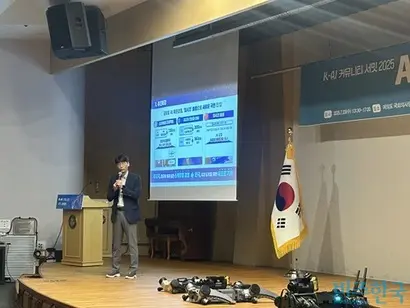
Operation will be handled by a public-private special purpose corporation (SPC). Kim Kyung-man, Director General of Artificial Intelligence-based Policy at the Ministry of Science and ICT, said at the National Assembly's 'K-AI Community Summit 2025' last month, "Korea is severely lacking in GPUs. The plan we have been contemplating the longest is to create a national AI computing center in the form of an SPC and secure GPUs through private investment." He added, "It will take until around November 2027 for the physical data center to be built. We have already worked to secure about 10,000 units through the first supplementary budget."
According to the plan, the final private operator should have been selected by the end of August after an evaluation process in June and July, with the SPC established by October. However, with the two bidding rounds in May and June falling through, it is highly likely that the center's opening will be delayed until around 2028.
Revising 'Equity and Buyback' Clauses; Structural Challenges Noted
While the government's stake was initially planned at 51%, it appears this will be revised in the third bidding round, as the SPC's equity structure is cited as a primary reason for the low private participation. It is reported that the Ministry of Science and ICT is adjusting its governance structure to lower the government's stake in the new corporation from 51% to below 49%. In a briefing on the 4th, Director General Kim said, "We are aware of the criticism that the failure of the bids was partly due to the hindrance of private autonomy, and we are continuing to discuss easing measures with relevant ministries."
According to the existing project manual, public and private participants were to contribute up to 200 billion won each over six years, and additional funds necessary for the project were to be borrowed through policy financing and commercial bank loans. Although it is stated that "matters concerning management will be operated primarily by the private sector," the fact that the governance structure is tilted toward the government was pointed out as a disadvantage for companies.
There are also complaints about the buyback clause, which requires operators to return public shares when the government demands it, and the fact that the SPC could be designated as a public institution due to the injection of national funds. An industry official said, "You have to invest hundreds of billions of won, and if the project fails mid-way, it is difficult to recover the investment. It's a structure where you could end up bearing additional burdens. While the actual operation could end up in the hands of the government, which holds the majority stake, it is hard for companies to step forward under such conditions."

The buyback clause carries the burden of financial risk for companies as they would have to shoulder potential losses. A corporate financial strategy official pointed out, "If a buyback obligation arises when you have already invested heavily, it could lead to an urgent liquidity squeeze. Public-private projects often have uncertain profitability, and if the public interest is prioritized, it is expected that the return on investment will be low or profits will be less than expected. In such cases, if a buyback is triggered, the company might have to buy back shares at a price much higher than the market value." This, the official explained, is a factor that inherently increases the uncertainty of financial planning.
It is reported that the government is also considering ways to ease this buyback clause. The possibility of removing the existing condition that domestic AI semiconductors, focusing on Neural Processing Units (NPUs), must make up up to 50% of the semiconductors used in the computing center by 2030 is also being discussed.
While attention is focused on whether the re-promoted bidding project will be able to attract private participation, some argue that there are limits to merely relaxing conditions or adjusting the equity structure. The criticism is that the background of the national AI computing center project's struggle is not just because the conditions are unfavorable, but because there are structural problems that make it difficult to pursue immediately. Domestic companies have limited experience in operating data centers and high-performance computing, and it is hard to ignore the gap between the business model/operating structure set by the government and the reality of private companies and research fields.
Baek Eun-kyung, a professor at Ewha Womans University's Graduate School of Artificial Intelligence, noted, "Korea lacks the foundational technologies and personnel related to systems and infrastructure, such as data centers or computing centers. In the field of AI, while applied research that leads directly to profits and results is active, there aren't many researchers in system technology because it requires long-term investment and is difficult. This weakness in foundational technology is directly linked to the operation of the national AI computing center." She added, "Ultimately, long-term support, such as continuous investment in foundational technologies and the cultivation of researchers, is also necessary."