

[비즈한국] Do you remember 'Oumuamua, which once excited many SF fans before vanishing? 'Oumuamua, an interstellar object that flew in from outside the solar system, drew significant attention for its elongated shape and its surprising movement, appearing to accelerate as it left our solar system. The issue gained further traction when Harvard astronomer Avi Loeb seriously proposed that it might be a spacecraft of extraterrestrial origin. Unfortunately, 'Oumuamua was already on its way out after grazing the Sun when it was first discovered, and it has since disappeared into the darkness. Thus, we may never know if it was truly an alien scout ship, or if Loeb was just getting overexcited about a plain, icy rock.
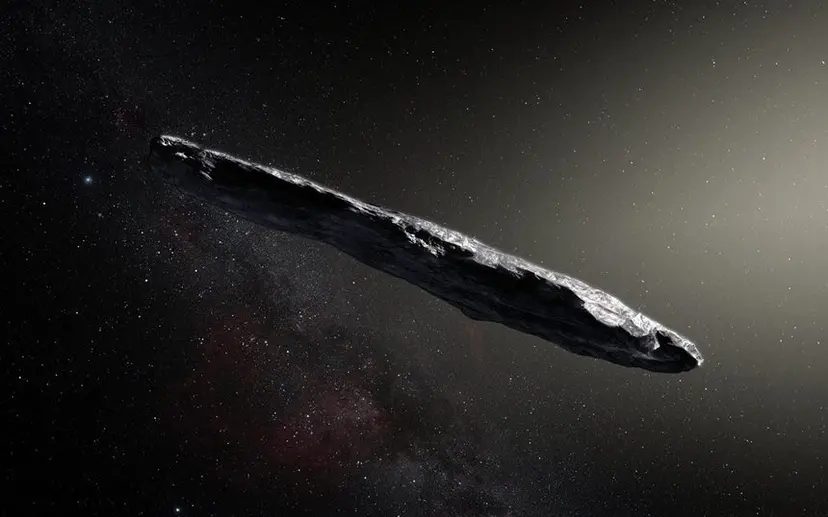
However, another event has recently set the hearts of SF fans racing once again. After a long wait, another interstellar object has arrived. It is the third one, following 'Oumuamua (1I/ʻOumuamua) in 2017 and Borisov (2I/Borisov) in 2019. And once again, Avi Loeb has appeared. He claims that this third visitor is also suspected to be an alien spaceship. He has even suggested that it might be carrying highly hostile beings. If so, was 'Oumuamua the vanguard, and has an alien army now arrived to invade Earth in earnest? We delve into the reality of these claims, exploring how much we can trust Avi Loeb and why the mainstream astronomical community criticizes him.
Since the discovery of 'Oumuamua in 2017, interstellar objects have been occasionally detected. Interstellar objects are celestial bodies that have flown from deep space outside the solar system into its interior. Following Borisov, discovered in 2019, a third interstellar object was captured by the ATLAS survey telescope in Chile on July 1, 2025. Initially designated with the temporary name A11PL3z, early analysis confirmed that it was moving along an extremely hyperbolic trajectory. The object was traveling through space at a staggering speed of 61 km/s, a level that could not be explained by an object simply captured by the solar system's gravity. The eccentricity of the hyperbolic trajectories was about 1.2 for 'Oumuamua and 3.8 for Borisov, whereas this third visitor has an eccentricity exceeding 6. The fact that it originated from outside the solar system has been officially confirmed, and it has now been added to the list of interstellar objects under the official name 3I Atlas.
Various ground-based and space telescopes are currently targeting this object. New observational data is pouring in every moment. However, as the characteristics of 3I Atlas are gradually being revealed, the famous "alien spaceship follower" has started to take the stage again: Avi Loeb, a professor of astronomy at Harvard University. Back in 2017, he already drew significant attention from academia and the media by seriously proposing that 'Oumuamua could be an alien spaceship traveling through interstellar space.
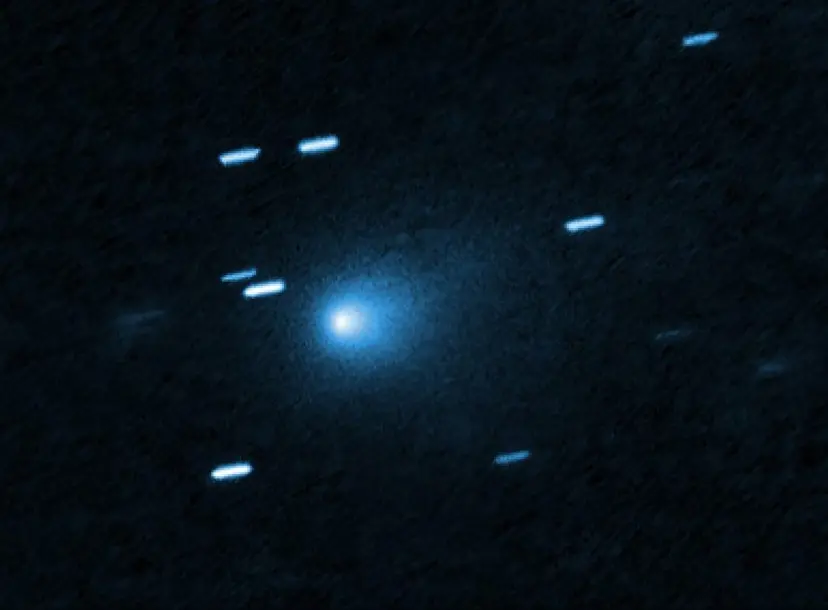
Why, then, did Loeb raise these claims again? The strange aspects of 3I Atlas he points out are as follows:
First, it is excessively large. Second, it lacks the chemical components expected from a typical comet. Third, its orbit is tilted in a strange direction relative to the solar system's plane, and it follows a path that makes close approaches to several planets, such as Venus, Mars, and Jupiter.
However, there are many problems with his arguments. First, the size of 3I Atlas, inferred from the photos observed so far, reaches several tens of kilometers. This is quite large compared to the previous two interstellar objects. 'Oumuamua was about 150 meters long, and Borisov was an interstellar comet about 0.5 km in size. The fact that 3I Atlas is more than 10 times larger may seem strange at first glance. But in reality, asteroids and comets of this size are not rare. It is not at all abnormal for a comet's size.
Moreover, measuring the size of a comet is quite tricky. As it gets closer to the Sun, comet ice sublimates due to solar radiation, causing the gas cloud, or coma, to grow. In fact, Comet Holmes, which passed near the Sun in 2007, saw its coma expand to a staggering 1.4 million km. That is roughly the size of the Sun's diameter.
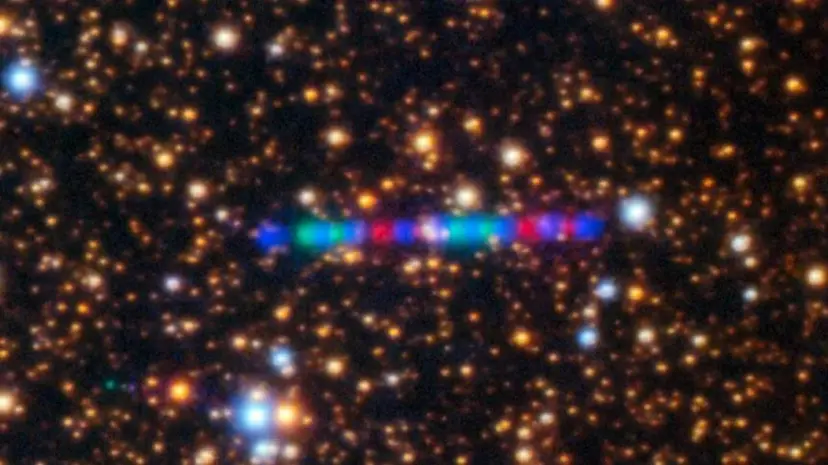
Coincidentally, the Vera C. Rubin Observatory, which recently began operations, also captured 3I Atlas. Looking at the photo, it appears to be right before its comet tail began to grow in earnest. The size of 3I Atlas at the time, estimated from the image, was about 11.5 km. Additional photos captured by the Hubble Telescope clearly show that the comet tail has grown long since then. This is a typical characteristic of a comet, where ice sublimates and the tail becomes longer and more distinct as it approaches the Sun. Therefore, 3I Atlas was officially recognized as a comet 24 hours after its first discovery and was given the name Comet C/2025 N1. Thus, the argument that it is an alien spaceship solely because it is large holds no water.
Furthermore, Loeb actually argued the opposite in the case of 'Oumuamua; he claimed that its size of exactly 100–200 meters was just the right size for a spaceship carrying aliens. In other words, he makes arguments that fit his narrative regardless of whether the object is large or small.
Second, the claim that the expected chemical components are missing has already been dismissed by additional observations. Recent observations from various sources, including the Gemini North telescope, have confirmed that 3I Atlas consists at least of water ice and silicates. This is a typical characteristic of a standard comet composed of ordinary water ice and rock. The absence of prominent cyanide (CN) or hydroxyl (OH) components is not particularly strange either. If the ice hasn't sufficiently sublimated before approaching the Sun, such components might not be abundant. This is also a feature commonly seen in long-period comets.
The third argument has received the most attention: that the orbit of 3I Atlas lies nearly parallel to the ecliptic plane and is drawn in a way that allows for close approaches to some planets in the solar system. Consequently, Loeb claimed that someone intentionally flew it here for the purpose of exploring multiple planets in the solar system.
However, the actual orbit of 3I Atlas is tilted by about 175 degrees to the ecliptic plane. In other words, it is moving in the opposite direction of the solar system's travel. And contrary to his claims, the orbit of 3I Atlas does not get very close to the planets of the solar system. It can approach Mars within about 0.2 AU, but it reaches a distance of about 4 AU from Jupiter. It does not approach Earth at all.
In fact, Avi Loeb has already been criticized by the academic community multiple times. Having gained massive attention by proposing the alien spaceship hypothesis for 'Oumuamua, he treated the mainstream astronomical community, which was skeptical of his "novel hypothesis," like old-fashioned curmudgeons and painted himself as a lonely Galileo.
In 2023, Avi Loeb left behind an embarrassing dark history that caused him to lose much credibility. He claimed to have discovered remnants of an alien interstellar spacecraft in the Earth's ocean, but it turned out to be false. On January 8, 2014, a massive explosion occurred in the sky above Papua New Guinea in the South Pacific. It is presumed that a meteorite entered the Earth's atmosphere at a speed of 45 km/s and fell. This meteor is called CNEOS 2014-01-08. In a 2019 paper, Avi Loeb argued that this meteor was actually a fragment of an interstellar object from outside the solar system, and in 2023, he started fundraising for the "Galileo Project," claiming he would personally search the ocean for fragments of that interstellar spaceship. Loeb, who even appeared on billboards in New York's Times Square, passionately promoted the "Galileo Project" and spent $1.5 million (about 2 billion KRW) to scour the seabed.

Loeb narrowed his search range based on seismic vibration records detected near the time the meteor was estimated to have fallen. He then claimed to have found metal fragments using magnetic detectors on the seabed. The pieces were smooth and spherical like small BB pellets, a shape commonly seen in debris that passes through the Earth's atmosphere.
However, many astronomers questioned Loeb's research method itself, criticizing that one couldn't even verify if the found fragments were truly from an interstellar object in such a way. In fact, large trucks often traveled on the road near the beach where Loeb investigated. The vibrations he used as evidence for the meteor impact were merely at the level commonly created by large trucks passing by. Because of this, some astronomers sarcastically asked, "Did the aliens come to Earth in a truck?" after he claimed to have found UFO fragments but ended up finding truck debris. As this dark history accumulates, Loeb is gradually losing his reputation.

Actually, these claims by Loeb are detrimental because they constantly distract us from more important astronomical questions that we should be focusing on. The appearance of consecutively discovered interstellar objects is important not because of the possibility that they are alien spaceships. The existence of interstellar objects is significant because it demonstrates that our solar system is not isolated and is constantly exchanging matter directly with the interstellar space outside our solar system.
If new celestial bodies flow in from outside the solar system, conversely, objects that were in the solar system can also fly outwards. Although it takes a long time, this shows that the numerous individual stellar systems that make up our galaxy are exchanging the material they contain, ensuring that various substances are evenly distributed throughout the galaxy. Astronomers already estimate that there are at least 10,000 or more interstellar objects constantly coexisting within our solar system. With the Vera C. Rubin Observatory having begun full-scale observations, and the James Webb Space Telescope, we will discover even more interstellar objects in the future.
What makes 3I Atlas particularly unique is not that it is the most plausible alien spaceship. It is because the origin from which it is presumed to have flown is very interesting. The Milky Way disk is divided into a thin disk and a thick disk. The thin disk is home to many relatively younger stars born later, like our Sun. On the other hand, the thick disk is mostly filled with much older stars with lower metal content. The previous two interstellar objects both came from the thin disk. It is presumed that they were objects living near a neighbor star similar to our solar system that left their home and flew to the solar system by chance.
However, this 3I Atlas appears to have originated from the thick disk. This means it could be an object that left its home after living next to a star much older than the Sun. There is a possibility it flew from a star at least 3 billion years, and up to 9 billion years, older than the Sun. The thick disk is a region of old, ancient stars hundreds of light-years away from the thin disk where our solar system resides. 3I Atlas may have stayed for a while near a star that was just being born 9 billion years ago and was immediately ejected. It means it flew in around the time planets were just being kneaded and a planetary system was about to form. As such, 3I Atlas is highly likely to hold all the memories of the era of ancient planet formation intact. Judging from the results observed so far, 3I Atlas appears to be very rich in water ice. It is highly likely that at the time of its formation, it was born outside the "snow line," the boundary far from its home star where water can freeze.
What is particularly interesting is that it does not appear to have visited any other stars during the long time between leaving its home star and accidentally entering our solar system. Thanks to this, 3I Atlas still retains much of its original water ice. Preserving its appearance from the moment it left its home star about 9 billion years ago, it flew into our solar system bearing precious evidence of the star and planet formation process. Between this September and November, 3I Atlas will pass quickly near the Sun, causing a large amount of water ice to sublimate. Then, we will be able to clearly see a comet tail. And this will be the most certain proof that 3I Atlas was not an alien spaceship but just a comet rich in water ice.
We seem to be a species that feels a great deal of loneliness. Always gazing at the same empty sky, we wait for something mysterious to happen. We are so desperate that we hope aliens might be secretly riding inside the interstellar objects that occasionally visit us. While such imagination allows us to view the boring night sky in a more unique way, it simultaneously prevents us from properly listening to the more important questions we should be paying attention to. Even great astronomers, and those who have had a taste of the spotlight, often make such mistakes. We need a mindset that can patiently wait for the boring universe and listen to more important astronomical questions.
Who is the writer Woong-bae Ji? He loves cats and the universe. After watching 'Galaxy Express 999' as a child, he dreamt of sharing the beauty of the universe. Currently, he is researching the evolution of galaxies through interactions at the Center for Galaxy Evolution Research and the Near-Field Cosmology Lab at Yonsei University. He is engaged in various science communication activities, including lectures and writing. He has authored books such as 'The Observatory of Flirting', 'Thinking About the Universe All Day', and 'Stars, the Science of Light'.