

[비즈한국] It has been confirmed that the military drone, which reportedly crashed last year during a mission to distribute anti-North Korea leaflets over Pyongyang, lacked 'satellite communication' capabilities, a feature essential for remotely monitoring the aircraft's status. While this feature was included in the military's initial test and evaluation model, it was removed from the units delivered to and actually operated by the Drone Operations Command (Drone Command). Consequently, the Drone Command was fundamentally incapable of tracking the real-time location of the drone during long-distance operations or determining whether it had crashed.
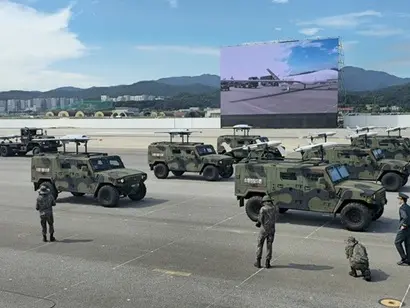
On August 4, the office of Rep. Boo Seung-chan of the Democratic Party of Korea, a member of the National Assembly's National Defense Committee, pointed out that "the drone sent to Pyongyang did not meet the minimum security requirements." The core of the issue is that the drone belonging to the Drone Command, which infiltrated North Korean territory between October and November of last year, had not undergone the essential security module verification process required for weapons systems.
A comprehensive analysis of public documents from the Defense Acquisition Program Administration (DAPA) and the Agency for Defense Development (ADD), along with materials from Rep. Boo Seung-chan’s office, reveals that the fundamental reason security verification was not applied to this drone was because the core 'satellite communication' device had been removed.
The drone did not lack satellite communication capabilities from the start of its development. Before being delivered to the Drone Command, the initial model from the manufacturer, 'Company S', had been operated by the Army for about a year starting in 2020 under the name 'Small Reconnaissance Drone for Long-Distance Missions' as part of the 'Rapid Demonstration Acquisition Project'.
The aircraft operated by the Army at the time possessed two communication functions. One was 'line-of-sight (LOS) RF communication,' which supports manual control during take-off and landing. As the name implies, this function only allows for communication within the operator's line of sight.
The other was the 'satellite communication' function, which was omitted in this instance. It is a critical piece of equipment that utilizes a civilian satellite phone network to allow the drone to transmit status information—such as altitude, speed, and coordinates—to Ground Control Stations (GCS) and even perform remote control, even when flying long distances beyond the operator's line of sight. In the equipment test-introduced to the Army in 2020, this satellite communication function, along with the Korea Cryptographic Module Validation Program (KCMVP) certified by the National Intelligence Service, was properly applied.
However, this satellite communication feature was removed from the drones supplied to the Drone Command, and consequently, the KCMVP security module was also omitted.
As a result, the moment the Drone Command launched the drone toward Pyongyang, it was conducting a "blind operation" where it was impossible to adjust flight paths or check the aircraft's status. With the previous model, the Ground Control Station would have been able to immediately detect issues if the drone went off-course or crashed, but it is highly likely that the Drone Command was unable to determine not only whether the mission was successful, but even when and where the drone had crashed.
Some point out that these problems were foreseeable. The Drone Command had defined the drone as "equipment for education and training" meant for pilot training and the development of operational capabilities, and it is understood that officials at the Agency for Defense Development perceived it for the same use. The developers and operators of the drone had not envisioned it being used for sensitive, remote infiltration missions.
Of course, in a wartime situation, a drone without satellite communication can be utilized as a "decoy" to disrupt enemy lines or exhaust air defense systems. However, in such cases, it is common to operate multiple units simultaneously to avoid detection by the enemy and increase the success rate of the mission. Given that only one or two units were deployed in the actual operation, leading to the drone being discovered by the enemy and the mission failing, the operation is difficult to defend against criticism of being a strategic failure.