

[비즈한국] As the employment landscape deteriorates due to slumps in the manufacturing and construction sectors, the number of workers aged 50 and older who lost their jobs and applied for job seeker benefits (unemployment benefits) in the first quarter of this year reached an all-time high. The number of people pushed out of large corporations who applied for unemployment benefits reached its second-highest level, and with benefit payouts climbing to their highest levels since the COVID-19 pandemic, the fallout from the economic downturn has been found to be spreading throughout the entire labor market. As President Lee Jae-myung identified the recovery of public livelihoods as his top priority during his 30-day post-inauguration press conference on July 3, attention is focused on whether this worsened employment market will see improvement.
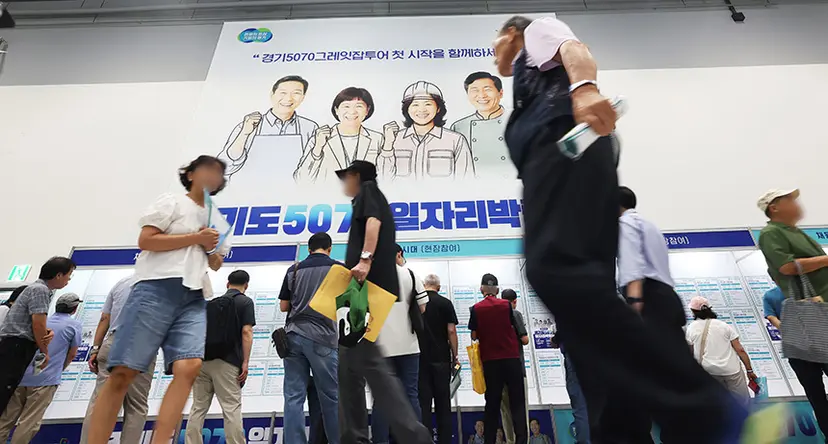
According to the Ministry of Employment and Labor, the number of unemployed workers who applied for job seeker benefits in the first quarter of this year was 439,265, an increase of 13,651 compared to the same period last year (425,614). Among these applicants, 234,887 were unemployed workers aged 50 and older, accounting for 53.5%. This is an increase of 16,847 (7.7%) compared to the same period last year (218,040), a higher growth rate than the total number of applicants.
In particular, the number of job seeker benefit applicants aged 50 and older was the highest since relevant records began in 2015. Analysts suggest this is because workers over 50 are being prioritized for layoffs as company conditions worsen due to the economic slump. In fact, Hyundai Steel004020, which declared emergency management, has implemented voluntary retirement for employees aged 50 and older. Because it is not easy for workers over 50 to find new employment—outside of government-funded public work or day labor—if they lose their jobs, their unemployment can become a serious social issue. Furthermore, as workers over 50 often have children in college or approaching marriage, the loss of employment is highly likely to lead to household poverty.
With companies across various industries implementing back-to-back voluntary retirement programs amid the persistently poor economic conditions this year, the number of people pushed out of large corporations who applied for job seeker benefits has also soared to its second-highest level ever. In the first quarter of this year, 108,433 people who lost their jobs at large corporations with 300 or more employees applied for job seeker benefits, an increase of 6,337 (6.2%) compared to the same period last year (102,096).
This is the highest level since the first quarter of 2021 (115,146), when the number of job seeker benefit applicants from large corporations peaked due to the aftermath of the COVID-19 pandemic, and the second-highest total since statistics began in 2015. Large corporations are initiating voluntary retirements one after another because of both sluggish domestic demand and the export environment, which is suffering from U.S. tariff pressure. This year, large corporate affiliates including LG Display, SK Planet, SK Signet, CGV, E-mart139480, Hyundai Department Store Duty Free, and Lotte Wellfood280360 have implemented voluntary retirement programs. The economy is performing so poorly that even large corporations cannot endure it.
The number of people who found new jobs after losing their previous ones, only to become unemployed again this year due to the economic downturn, has also risen to a record high. The number of second-time applicants among job seeker benefit claimants reached 104,910 in the first quarter of this year, an increase of 2,469 (2.0%) from the same period last year, surpassing the 100,000 mark for the first time in history. As the number of unemployed people continues to rise across both large and small-to-medium enterprises due to the economic decline, the total amount of job seeker benefits paid out hit its highest level since the COVID-19 era. In the first quarter of this year, the payout reached 3.0985 trillion won, the highest since the second quarter of 2021 (3.3302 trillion won), when unemployment surged due to COVID-19.
Recognizing the worsening labor market caused by this economic slump, President Lee stated during his 30-day post-inauguration press conference last month, "Above all, we are doing our utmost to recover the collapsed public livelihood," adding, "As my first directive after taking office, I activated an emergency economic task force to gather wisdom and find solutions to revitalize the livelihood economy," expressing his commitment to focus on economic recovery. Furthermore, since last month, the government has begun efforts to revive domestic demand by issuing 13 trillion won in livelihood recovery consumption coupons.
However, there remains concern that job seeker benefit applications will continue to rise, as the employment situation is projected to deteriorate further in the second half of the year compared to the first half. The Bank of Korea forecasted that the increase in the number of employed people this year would be 120,000, a decrease of 40,000 compared to last year (160,000). In particular, it predicted that the increase in employment for the second half of this year would drop sharply to 90,000, compared to 150,000 in the first half.