

[비즈한국] A representative way to mitigate the uncertainty of box office success in content production is to base works on popular original material. Recently released films, 'Zombie Daughter' and 'Omniscient Reader's Viewpoint' (ORV), were both adapted from hit webtoons and web novels. However, their outcomes were completely different. It goes without saying, but simply basing a film on an original work does not guarantee success. The difference in these results is tied to the rudder of Korean visual content.
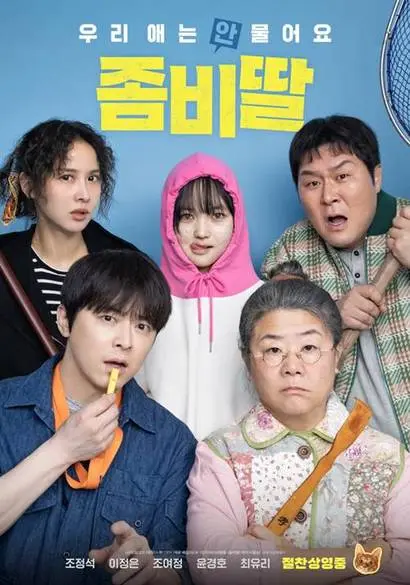
Content based on original works draws in a core fan base at the start of its release. 'Omniscient Reader', whose original web novel has reached 300 million cumulative views since 2018, attracted 400,000 viewers in its first week alone. With director Kim Byung-woo of 'The Terror Live' at the helm and a cast including Ahn Hyo-seop, Lee Min-ho, Nana, and Blackpink's Jisoo, there was high anticipation for its casting power. Furthermore, expectations were bolstered by the global popularity Ahn Hyo-seop gained from 'K-Pop Demon Hunters,' as he provided the voice for Jinwoo, the leader of the boy group 'Saja Boys' featured in the animation. However, the results did not meet these expectations.
On the other hand, 'Zombie Daughter' reached 430,000 viewers on its opening day, surpassing the record for the highest-grossing opening of a comedy film set by 'Extreme Job' (368,500), and even beat the record of this year's top film, 'Mission: Impossible - Final Recording' (423,800). Within a week, it easily surpassed its break-even point of 2.2 million viewers.
What are the factors behind the success of 'Zombie Daughter'? First, it became the biggest beneficiary of the movie consumption coupons distributed by the government. Amidst rising criticism that audiences are avoiding theaters due to high ticket prices, and with many consumers stating that a price under 10,000 won is appropriate, the 6,000 won discount coupon proved effective. Furthermore, applying 'Culture Day' discounts allowed viewers to watch movies for as little as 1,000 won. Additionally, the film's release coincided with the start of the late-July/early-August summer vacation period, which was also the peak of the sweltering heat. In this respect, 'Omniscient Reader' missed the mark regarding its release timing.
However, there is a decisive difference between 'Omniscient Reader' and 'Zombie Daughter'. First, they showed different aspects from the perspective of fandom psychology. 'Omniscient Reader' focused on the director's artistic expression, deviating from the source material's verification. It was quite different from the original and focused on highlighting the director's point of view. If it failed to secure the core fan base of the original, it was highly likely to face unfavorable results from the start.
Conversely, 'Zombie Daughter' made an effort to remain faithful to the webtoon original. In particular, it increased the character synchronization, and the case of Bam-soon (played by Lee Jung-eun) received universal acclaim. Moreover, the production took an approach of trimming what needed to be cut while adding plausibility and supplementing the narrative. Because of this, it avoided the harsh criticism from original fans. It even enjoyed a positive "bounce" effect precisely because 'Omniscient Reader' had previously neglected fidelity to its source material.
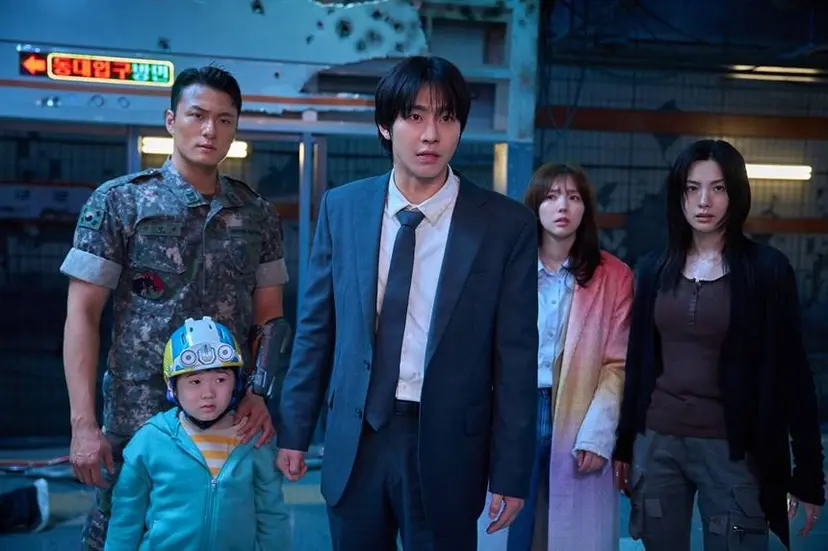
The second aspect is the content. 'Omniscient Reader' is a traditional fantasy action piece, while 'Zombie Daughter' is a family-oriented human comedy. If 'Omniscient Reader' aims for a macroscopic discourse on saving the world, 'Zombie Daughter' is a microscopic zombie story based on B-movie sensibilities. If one values grand social themes, 'Omniscient Reader' might be more fitting. However, because it depicted an unrealistic future in a dystopian manner, it could not be enjoyed in a lighthearted or cheerful way, even if the ending was shocking. While 'Zombie Daughter' also faces a world plagued by zombies, it uses subtle, everyday humor to show a hopeful ending along with sentimental emotions.
Above all, 'Zombie Daughter' overcame the limitations of the zombie genre. The linear narrative of zombie virus infection no longer works, as shown by the Coupang Play series 'Newtopia'. The zombie genre hit a slump because everyone experienced the COVID-19 pandemic and realized that anyone could become a virus spreader. However, 'Zombie Daughter' interpreted this experience in a hopeful way, leading to favorable reviews. The story of a father, a grandmother, and a neighborhood man working to protect and help a daughter infected with the zombie virus find a way to recover resembles the process of overcoming the COVID-19 pandemic. Although it uses zombies as the subject matter, it resonated with audiences because it contains themes that all generations can relate to. In other words, it provided the motivation for the whole family to visit a theater as part of their summer vacation.
Moreover, because the production cost was 11 billion won, it was relatively easy to pass the break-even point. However, 'Omniscient Reader' carried the heavy burden of requiring over 6 million viewers due to its 30 billion won production cost. If one is going to strengthen a perspective different from the original, production costs should be lowered; ignoring this was a mistake. Original creations should adopt a strategy of lowering costs and building a new fan base. Conversely, 'Zombie Daughter' secured its core fan base by being faithful to the original, and was able to capture an even wider audience by adapting the ending for the general public.
Ultimately, 'Zombie Daughter' focused on what the audience wanted to see, whereas 'Omniscient Reader' did not. At the very least, when considering box office success, it is self-evident what should be the priority. The fact that 'Squid Game 3' was relatively ignored by fans is deeply related to this. If that is not the goal, one could keep the break-even point as low as possible and conduct free, creative experiments. Following the foundational distinction between independent film and popular cinema, creators for the fans—rather than "artist masters"—must now become the basic model for K-content remakes.
The author, Kim Heon-sik, has walked through and navigated the forest of pop culture phenomena since his 20s, driven by the expectation that there is a way to make the world a better place through culture. In the 21st century, where artificial intelligence and quantum computers are active, he continues to walk the same path with the same belief.