

[비즈한국] The Korea Art Promotion Project, which began as an initiative solely to support artists, has continued for 10 years. We have supported over 230 artists while keeping our initial purpose intact. It was a unique endeavor that no other media outlet, cultural organization, or government agency in Korea had ever attempted. We take pride in the fact that this decade of persistence has been etched into the 21st-century Korean art scene as a significant value. Consequently, it is recognized that "the 10-year history of the Korea Art Promotion Project has established a vantage point from which to observe the flow of contemporary Korean art." Now, in Season 11, we intend to pave another path for Korean art.
At some point, we began "reading" paintings. To read a painting is to find its content. What occupies most of that content is a story. It consists of things with clear narratives, such as myths, biblical themes, heroic tales, or the achievements of kings.
To express these stories vividly, painters created various devices. Most classical paintings are appreciated by reading the stories that the painters implemented on the canvas.
The method of trying to find stories in contemporary painting is also widely used. Especially in Korea, the tendency to "read" art is dominant. Thus, "reading a painting" is recognized as the best way to understand fine art.
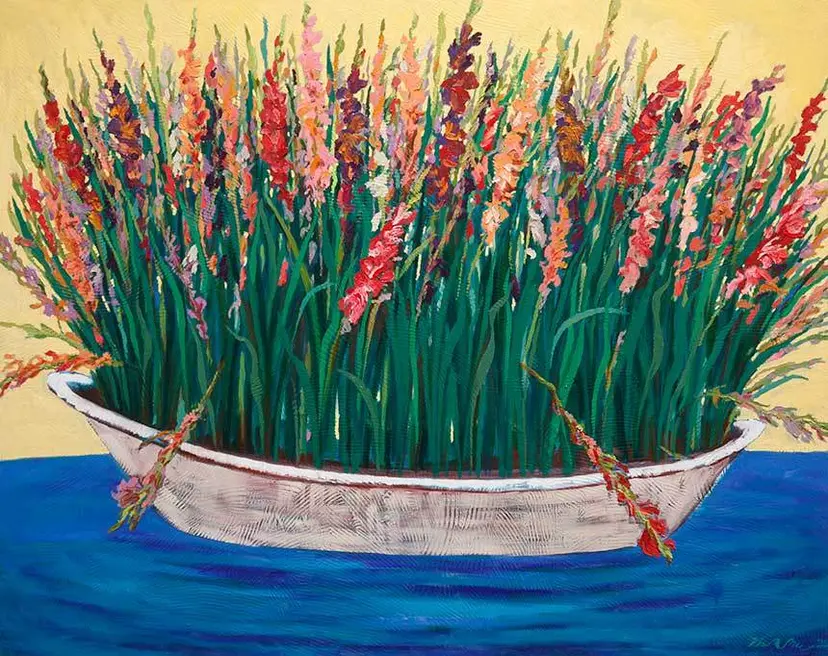

However, reading art is only one aspect of appreciation, not the whole. It is a misguided method to try to understand art other than literature by "reading" it. This is because every art form has its own unique language. For instance, dance has movement as its unique language. Just as music uses sound, film uses imagery, and sculpture uses material, painting uses color, line, and plane.
It was in the 20th century that the unique language of painting began to be recognized independently. The new method of painting attempted by Post-Impressionist Paul Cézanne served as the starting point.
Thereby, painting shifted from being "art to be appreciated" to "art to be contemplated." The main focus of pictorial expression moved from "what was painted" to "how it was painted." "How it was painted" is a matter of expression, which can only be understood through observation. In the process of discovering the materials or methods of a work through observation, the unique language of painting gained its value.
The time when this unique language shone brightest was during the era of abstract painting. Abstract painting is a case where content is discarded in favor of emphasizing pure pictorial language. Therefore, the attitude of trying to find a story in abstract painting is not a correct way of understanding.
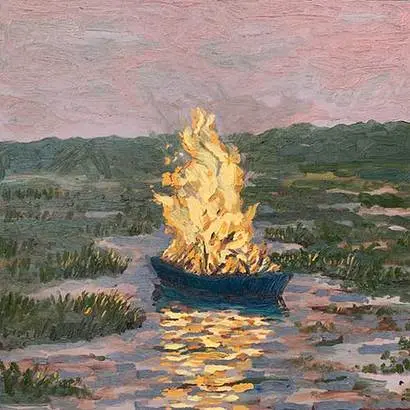
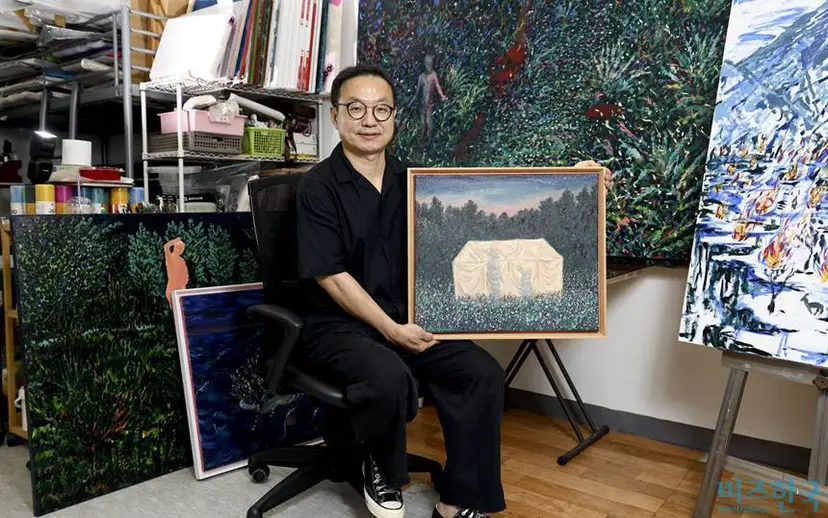
However, contemporary painting captures content other than stories through pictorial language. Kim Ho-jun’s painting is one such case. There is no story in his pictures. While there is no explicit content, they are not as dry as abstract painting. They are canvases imbued with the texture of emotion. They appear to be landscapes shaped by forms and refined with diverse colors, but no narrative structure can be found. This is because they are landscapes created through poetic composition.
The artist uses pictorial language to capture emotions found in the folds of life, based on the reality he has experienced. The landscapes he paints are mostly of a nocturnal atmosphere. He captures the forest at night—where light has vanished and color is absent—on the canvas as if taking a stroll. Looking for a story in such landscapes is futile. Discovering one’s own emotions in the atmosphere of the forest—that is the essence of Kim Ho-jun’s painting.
Kim Ho-jun’s faith in the unique language of painting can be confirmed in the artist’s own confession: "Painting is an immediate expression that emerges as one with my body through the sense of the brush. Through this, I want to create paintings that capture human nature, scents, and textures."