

[비즈한국] One thing that is never missing from a hot summer vacation is alcohol. We commonly call it alcohol, but scientifically, the term alcohol doesn't just include liquor. The ethanol found in the alcohol we drink is just one type among many. There is a famous science joke that if you draw the molecular structure of ethanol, it looks like a cute puppy—which is perhaps why people say you "become a dog" (get drunk and act crazy) when you drink.
Alcohol refers to a molecule where a hydroxyl group (–OH) is attached to a carbon atom. Simply put, any hydrocarbon compound containing oxygen is collectively called an alcohol. Methanol, found in car antifreeze, is also an alcohol. I hope you don't confuse it with the ethanol in spirits, as methanol is quite dangerous.
So, when did humans start drinking alcohol? According to archaeological evidence, humanity has been "hooked" on alcohol since 10,000 BCE. Some archaeologists even suggest that alcohol is the reason agriculture began. This implies that humans didn't learn to make alcohol after starting farming; rather, they started farming in the first place because they wanted to consume alcohol more frequently. However, some say that alcohol existed even before humans. Stories are passed down about "primitive wine," where monkeys discovered the taste of alcohol by eating fruit that had fallen to the ground or into rock crevices and fermented naturally.
Surprisingly, however, the true origin of alcohol lies elsewhere. Long before humans—or even monkeys—existed, alcohol already existed in the universe. Most of the hundreds of molecular clouds embroidering the Milky Way are imbued with alcohol. It even exists in molecular clouds drifting in the very center of our galaxy. Perhaps our galaxy has been "marinated" in alcohol for billions of years.
Space looks empty. It is vast and void. Moreover, celestial bodies emitting massive amounts of X-rays, gamma rays, and ultraviolet rays shine throughout. High-energy light breaks apart large, bulky molecules. For this reason, it was long thought that space was a harsh environment where complex molecules like alcohol could not survive. Contrary to our assumptions, however, complex molecules stubbornly persist in space. So far, 270 types of chemical molecules have been discovered in nebulae drifting through space!
One of the sites where various organic compounds and polymers are actively produced is the birthplace of baby stars. Molecular clouds where stars are born have relatively low temperatures and high densities. Dust gathers here in high concentrations, acting as condensation nuclei that help molecules grow. Inside these clouds, light gas atoms like hydrogen, nitrogen, and oxygen drift about. While they usually move very fast, they sometimes stick to solid dust grains. Then, the atoms slow down, meet other atoms on the dust particle, and begin to bond. Though the dust is invisibly small, it becomes a stage for "cosmic alchemy," where new chemical molecules are born.
Since radio antennas first began pointing toward the cosmos, there has been one crucial component that astronomers have been chasing for nearly 50 years: amino acids. Amino acids are the most important building blocks of life on Earth. They are key clues that tell us how complex organic life could have emerged and whether there might be other life elsewhere in the universe.
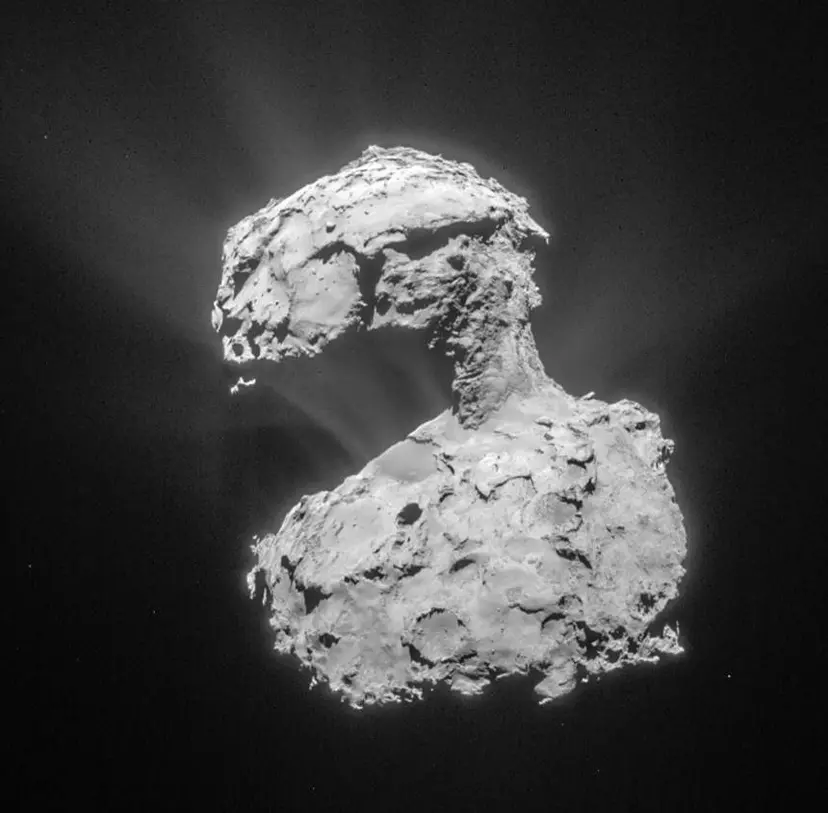
The existence of amino acids has already been confirmed on comets outside of Earth. The Rosetta mission, which explored Comet 67P, discovered the amino acid glycine in the ice on its surface; it is one of the simplest amino acids that make up life on Earth. This opened a new possibility: the ingredients for life on Earth did not necessarily have to be assembled here. The materials that already existed outside Earth might have accidentally flown to our planet, becoming the seeds of life.
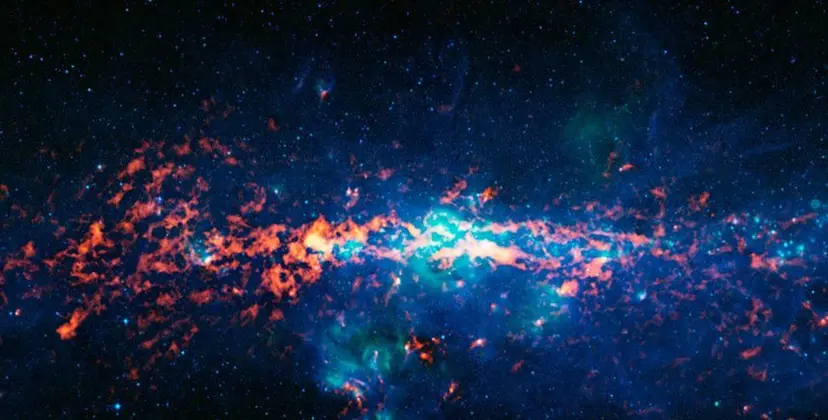
Now, the gaze of astronomers is turning beyond the solar system toward the Milky Way. Are there other places among the countless molecular clouds that harbor amino acids? Is the history of life that occurred on Earth 4.5 billion years ago happening elsewhere as well?
Regrettably, clear evidence has not yet been found in nebulae or molecular clouds outside our solar system. However, through repeated exploration, astronomers have detected an unexpected component: alcohol. A prime example is the gas cloud G34.3, located 10,000 light-years away toward the constellation Aquila. Within this gas cloud, which is 1,000 times the size of our solar system, a total of 400 trillion liters of alcohol are gathered. If humans on Earth wanted to drink all of that, every single person would have to drink 170,000 liters of alcohol every day for a billion years. It sounds like the ultimate spot for heavy drinkers. However, I wouldn't recommend it—most of the alcohol there is methanol, not ethanol.
An amazing site filled with large amounts of alcohol was discovered in an unexpected place: the very center of our galaxy. In the 1970s, astronomers began a journey to find traces of amino acids in a gas cloud called Sagittarius B2, which drifts in the galactic center. Unfortunately, the expected amino acids weren't detected, but a massive amount of alcohol was. Various components exist there, including ethanol and methanol. In 2009, a small amount of ethyl formate was also detected. Interestingly, this chemical is responsible for the scent of fruits like raspberries. If you could stick your tongue out in the center of the Milky Way and take a sip, you might taste rum with a hint of raspberry.
This is an astonishing discovery. Heavy stars live in high density at the center of our galaxy. They live short lives and frequently vanish in supernova explosions. Moreover, new stars are constantly being born explosively. These stars vomit massive amounts of high-energy light, such as gamma rays, into the galactic center. In fact, when observing the Milky Way with a gamma-ray space telescope, one can see gamma-ray bubbles spreading out roundly above and below the center, which is presumed to be caused by the explosive birth of young stars. Furthermore, a black hole with a mass 4 million times that of the sun lives in the galactic center (though it is currently quiet), which also makes the environment high-energy.
As explained earlier, large polymers are vulnerable to high-energy light and easily break down into smaller molecules. However, the fact that such a vast variety of organic compounds and complex molecules is detected in such an extreme environment as the galactic center suggests that they are actually common throughout the universe. Contrary to initial beliefs, the ingredients needed for life may not be rare; they might be common materials easily found anywhere in the cosmos.
Ethyl formate is a particularly tantalizing discovery for astronomers searching for amino acids. If you simply swap one carbon atom for a nitrogen atom, it becomes glycine, one of the amino acids. Although they haven't discovered the amino acid itself yet, the existence of molecules as complex as ethyl formate implies that glycine could very well exist too.
More recently, another compound was found in Sagittarius B2—one that many people have touched with their own hands: isopropanol, commonly used in hand sanitizers and disinfectants.
Thanks to the massive radio telescope ALMA, astronomers can now observe Sagittarius B2 with a wider field of view using a single dish telescope. Among the newly discovered components in the Sagittarius B2 cloud are isopropyl cyanide, a representative molecule where carbon atoms are linked in a ring rather than a straight line, which is occasionally found in meteorites falling to Earth. Other components such as urea and N-methylformamide have also been discovered.
Propanol, detected most recently, is a relatively large alcohol molecule with a molecular weight exceeding 60g/mol. This substance has isomers—molecules with the same constituent atoms but different structures—and astronomers confirmed that two different isomers coexist there. Optical isomers, in particular, are like a reflection in a mirror, similar to the relationship between the left and right hand. They have the same molecular weight and no major chemical differences; only the arrangement of the molecule is different. Therefore, identifying the two requires very sensitive frequency resolution. This remarkable observation was made possible thanks to ALMA's giant eyes and sensitive spectroscopic equipment.
Since isomeric molecules are made of virtually identical atoms, one might assume that both are naturally created by chance in the same environment and conditions. Detecting two propanol isomers together in the Sagittarius B2 gas cloud seems perfectly natural. However, applying this to life on Earth makes the problem confusing. For some unknown reason, life on Earth digests only one of the two isomers. A prime example is glucose, which corresponds to sugar.
Glucose also has two mirror-image optical isomers. Among them, D-glucose exists in nature; it is the sugar that we can eat and digest. On the other hand, the inverted L-glucose does not exist in nature. It can only be created in a lab, and even if we eat it, we cannot use it for nutrition at all. The same applies to DNA, which is woven into a double helix structure using amino acids. If two isomers can coexist naturally in the universe, why did life on Earth become such that it can digest only one side? Is this bias an essential property for something to become life? Even at the molecular level, Earth and life are full of incomprehensible charms.
Knowing that cosmic nebulae are "alcohol clouds" filled with such diverse and abundant alcohol will make you see the universe in a completely different light. The Milky Way flowing across the night sky feels like looking at a giant Goseokjeong (a traditional Korean stone watercourse for flowing wine cups). Perhaps our galaxy is a massive liquor vat, quickly swirling while emitting a strong scent of alcohol? If so, we might just be the "lees"—the leftover dregs created unintentionally while that liquor was fermenting. Being born inside a giant liquor vat, maybe it was our cosmic destiny to fall in love with alcohol.
Who is the author, Ji Woong-bae? He loves cats and the universe. After watching 'Galaxy Express 999' as a child, he dreamed of sharing the beauty of the cosmos. He currently studies galactic evolution through galactic interactions at the Yonsei University Galaxy Evolution Center and the Near-Field Cosmology Lab, and engages in various science communication activities including lectures and writing. He has authored books such as 'A Observatory for Flirting', 'Thinking About the Universe All Day', and 'Stars, the Science of Light'.